In question paper there are five questions to be attempted and answer to each question has two choices - True (T) or False (F). It is given that no two candidates have given the answers to the five questions in an identical sequence. For this to happen the maximum number of candidates is:

- A10
- B18
- C26
- D32Correct
Explanation
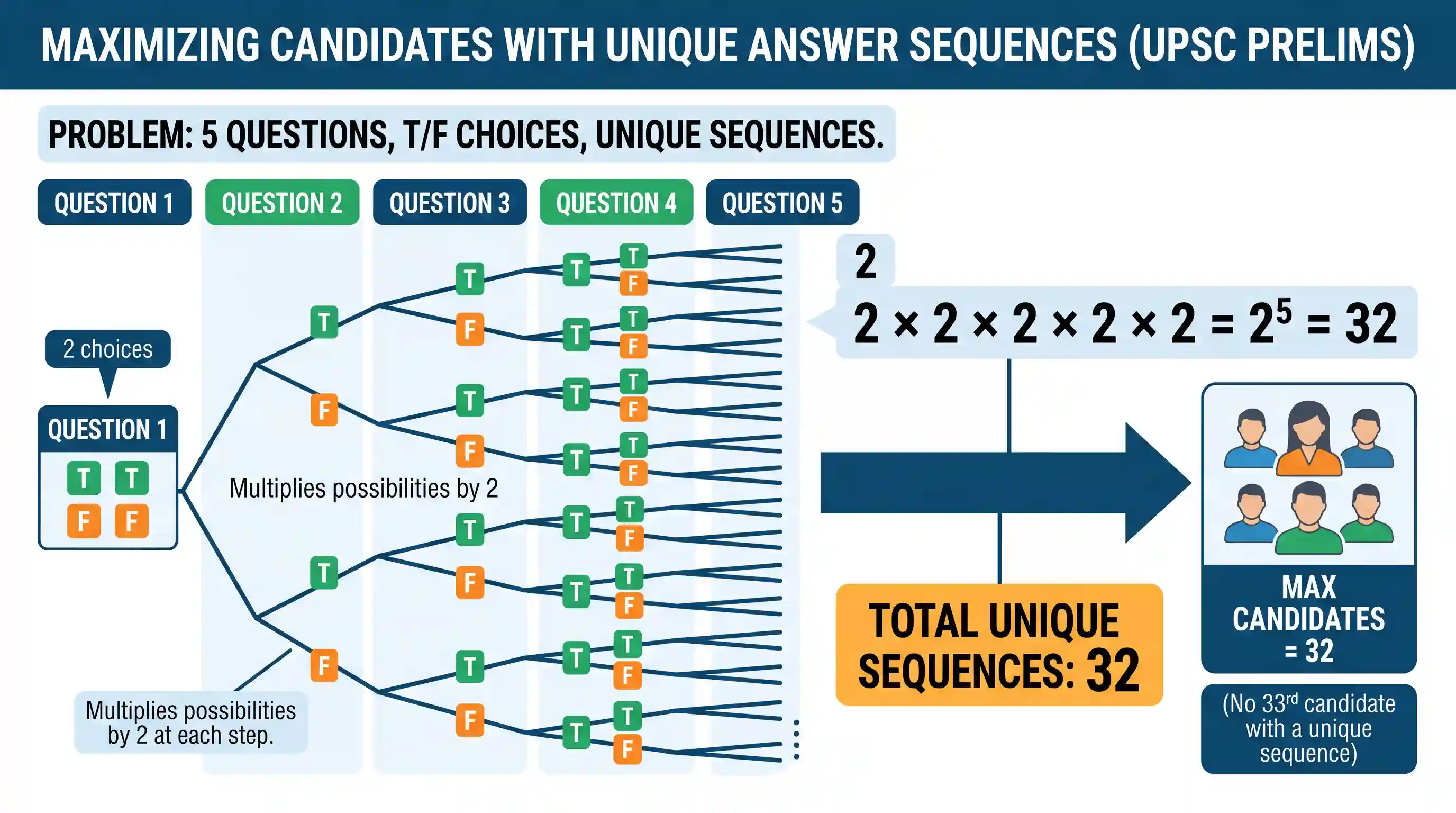
To find the maximum number of candidates such that no two have an identical sequence of answers, we need to calculate the total number of possible ways to answer the five questions.
Each of the five questions has 2 choices (True or False). According to the fundamental principle of counting, if there are n questions and each question has k choices, the total number of distinct sequences is k raised to the power of n.
In this case, there are 2 choices for each of the 5 questions. Therefore, the total number of unique sequences is: 2 multiplied by 2 multiplied by 2 multiplied by 2 multiplied by 2, which equals 2 to the power of 5.
2 to the power of 5 is 32.
Since each candidate must have a unique sequence, the maximum number of candidates possible is 32. If there were 33 candidates, at least two would have to share the same sequence.
The correct answer is D.
Related questions
More UPSC Prelims practice from the same subject and topic.
- Prelims 2016CSATQuantitative Aptitude
Four-digit numbers are to be formed using the digits 1, 2, 3 and 4; and none of these four digits are repeated in any manner. Further, 1, 2 and 3 are not to immediately follow each other 2. 1 is not t…
- Prelims 2016CSATQuantitative Aptitude
A round archery target of diameter 1 m is marked with four scoring regions from the centre outwards as red, blue, yellow and white. The radius of the red band is 0.20 m. The width of all the remaining…
- Prelims 2016CSATQuantitative Aptitude
There are five hobby clubs in a college — photography, yachting, chess, electronics and gardening. The gardening group meets every second day, the electronics group meets every third day, the chess gr…
- Prelims 2016CSATQuantitative Aptitude
There are some nectar-filled flowers on a tree and some bees are hovering on it. If one bee lands on each flower, one bee will be left out. If two bees land on each flower, one flower will be left out…
- Prelims 2016CSATQuantitative Aptitude
There is an order of 19000 quantity of a particular product from a customer. The firm produces 1000 quantity of that product per out of which 5% are unfit for sale. In how many days will the order be …
- Prelims 2016CSATQuantitative Aptitude
A class starts at 11:00 am and lasts till 2:27 pm. Four periods of equal duration are held during this interval. After every period, a rest of 5 minutes is given to the students. The exact duration of…