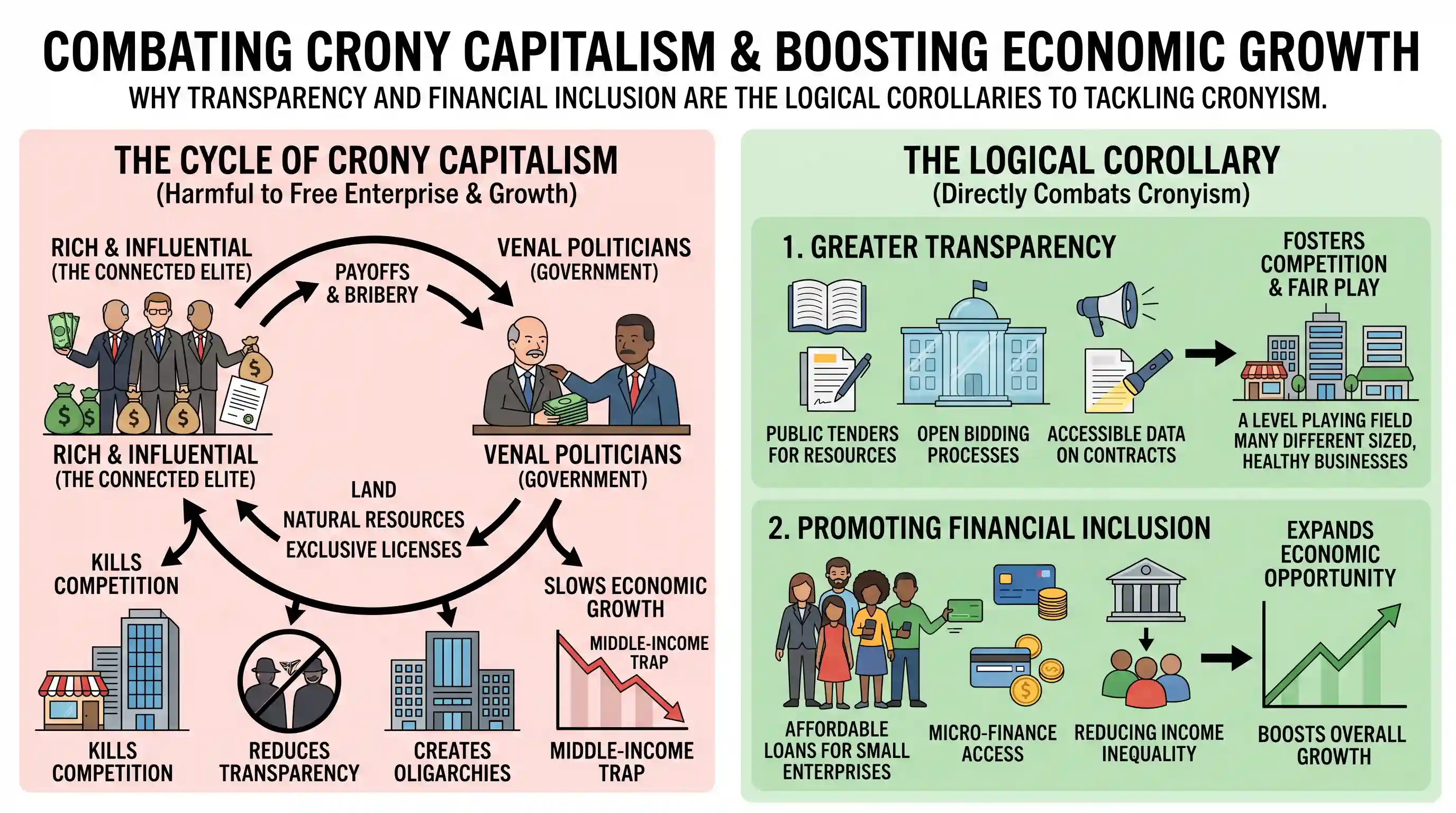
By killing transparency and competition, crony capitalism is harmful to free enterprise, opportunity and economic growth. Crony capitalism, where rich and the influential are alleged to have received land and natural resources and various licences in return for payoffs to venal politicians, is now a major issue to be tackled. One of the greatest dangers to growth of developing economies like India is the middle-income where crony capitalism creates oligarchies that slow down the growth. Which among the following is the most logical corollary to the above passage?

- ALaunching more welfare schemes and allocating more finances for the current schemes r are urgently needed
- BEfforts should be made to push up economic growth by other means and provide licences to the poor
- CGreater transparency in the functioning of the government and promoting the financial inclusion are needed at presentCorrect
- DWe should concentrate more on developing manufacturing sector than service sector
Explanation
The passage describes crony capitalism as harmful because it kills transparency and competition, leading to unfair allocation of resources (land, licenses) and creating oligarchies that slow down growth.
Let's analyze each option:
A) Launching more welfare schemes and allocating more finances for the current schemes are urgently needed. This option focuses on welfare, which is not the primary concern or solution discussed in the passage. The passage highlights issues of corruption, transparency, and fair competition, not a lack of welfare provisions.
B) Efforts should be made to push up economic growth by other means and provide licences to the poor. "Push up economic growth by other means" is vague. While providing licenses to the poor might address inequality, the passage's core issue is the process of how licenses are given (corruptly, without transparency), not just who receives them. This option doesn't directly tackle the root cause of cronyism.
C) Greater transparency in the functioning of the government and promoting the financial inclusion are needed at present. This option directly addresses the core problems. The passage explicitly states that crony capitalism kills "transparency." Therefore, "greater transparency in the functioning of the government" is a direct and logical corollary to combat cronyism. "Promoting financial inclusion" aims to provide economic opportunities to a wider population, counteracting the creation of "oligarchies" and fostering "free enterprise and opportunity" which crony capitalism destroys. This aligns with the passage's concern about restricted opportunity and growth.
D) We should concentrate more on developing manufacturing sector than service sector. This option discusses sector-specific economic strategy, which is entirely outside the scope of the passage's discussion on crony capitalism, transparency, and corruption.
Therefore, C is the most logical corollary as it directly addresses the issues of lack of transparency and restricted opportunity/growth caused by crony capitalism.
Related questions
More UPSC Prelims practice from the same subject and topic.
- Prelims 2016CSATReading Comprehension
Accountability, or the lack of it, in governance generally, and civil services, in particular, is a major factor underlying the deficiencies in governance and public administration. Designing an effec…
- Prelims 2016CSATReading Comprehension
Accountability, or the lack of it, in governance generally, and civil services, in particular, is a major factor underlying the deficiencies in governance and public administration. Designing an effec…
- Prelims 2016CSATReading Comprehension
Accountability, or the lack of it, in governance generally, and civil services, in particular, is a major factor underlying the deficiencies in governance and public administration. Designing an effec…
- Prelims 2016CSATReading Comprehension
Accountability, or the lack of it, in governance generally, and civil services, in particular, is a major factor underlying the deficiencies in governance and public administration. Designing an effec…
- Prelims 2016CSATReading Comprehension
In general, religious traditions stress our duty to god, or to some universal ethical principle. Our duties to one another derive from these. The religious concept of rights is primarily derived from …
- Prelims 2016CSATReading Comprehension
In general, religious traditions stress our duty to god, or to some universal ethical principle. Our duties to one another derive from these. The religious concept of rights is primarily derived from …