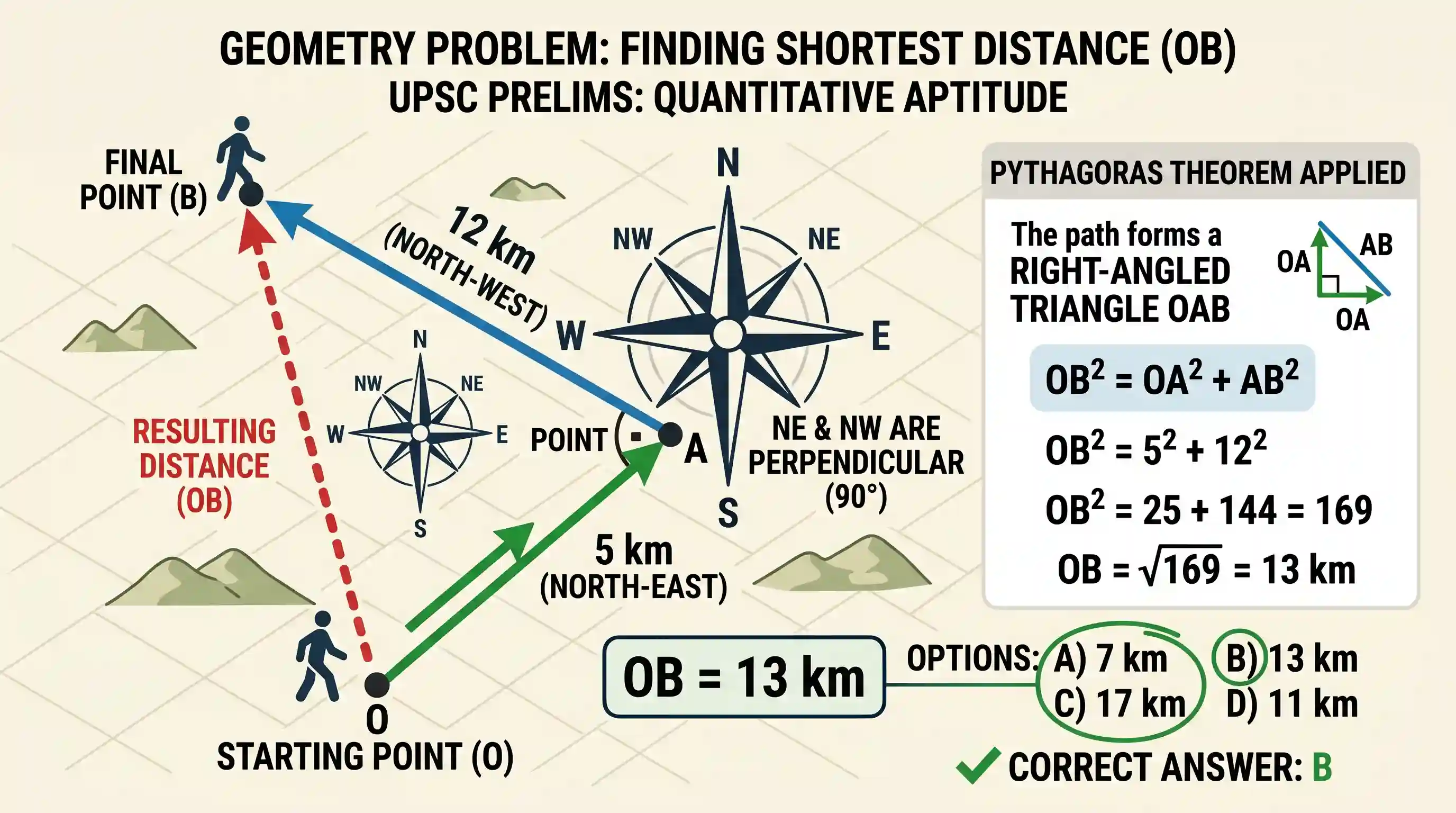
A person climbs a hill in a straight path from point 'O' on the ground in the direction of north-east and reaches a point 'A' after travelling a distance of 5 km. Then, from the point 'A' he moves to point 'B' in the direction of north- west. Let the distance AB be 12 km. Now, how far is the person away from the starting point 'O'?

- A7 km
- B13 kmCorrect
- C17 km
- D11 km
Explanation
The problem describes a journey that forms a right angled triangle.
First, the person moves from point O to point A in a north east direction for 5 km. From point A, the person moves to point B in a north west direction for 12 km.
In navigation, north east and north west directions are perpendicular to each other. This means the angle at point A is 90 degrees. Therefore, triangle OAB is a right angled triangle where OA and AB are the two sides and OB is the hypotenuse.
To find the distance from the starting point O to the final point B, we use the Pythagoras theorem: OB squared equals OA squared plus AB squared. OB squared equals 5 squared plus 12 squared. OB squared equals 25 plus 144. OB squared equals 169. OB equals the square root of 169, which is 13.
The person is 13 km away from the starting point. Thus, option B is correct.
Related questions
More UPSC Prelims practice from the same subject and topic.
- Prelims 2016CSATQuantitative Aptitude
A piece of tin is in the form of a rectangle having length 12 cm and width 8 cm. This is used to construct a closed cube. The side of the cube is:
- Prelims 2016CSATQuantitative Aptitude
An agricultural field is in the form of a rectangle having length X1 meters and breadth X2 meters (X1 and X2 are variable). If X1 + X2 = 40 meters, then the area of the agricultural field will not exc…
- Prelims 2016CSATQuantitative Aptitude
AB is a vertical trunk of a huge tree with A being the point where the base of the trunk touches the ground. Due to a cyclone, the trunk has been broken at C which is at a height of 12 meters, broken …
- Prelims 2016CSATQuantitative Aptitude
A cylindrical overhead tank of radius 2 m and height 7 m is to be filled from an underground tank of size 5.5m × 4m × 6m. How much portion of the underground tank is still filled with water after fill…
- Prelims 2016CSATQuantitative Aptitude
There are five hobby clubs in a college — photography, yachting, chess, electronics and gardening. The gardening group meets every second day, the electronics group meets every third day, the chess gr…
- Prelims 2016CSATQuantitative Aptitude
There are some nectar-filled flowers on a tree and some bees are hovering on it. If one bee lands on each flower, one bee will be left out. If two bees land on each flower, one flower will be left out…