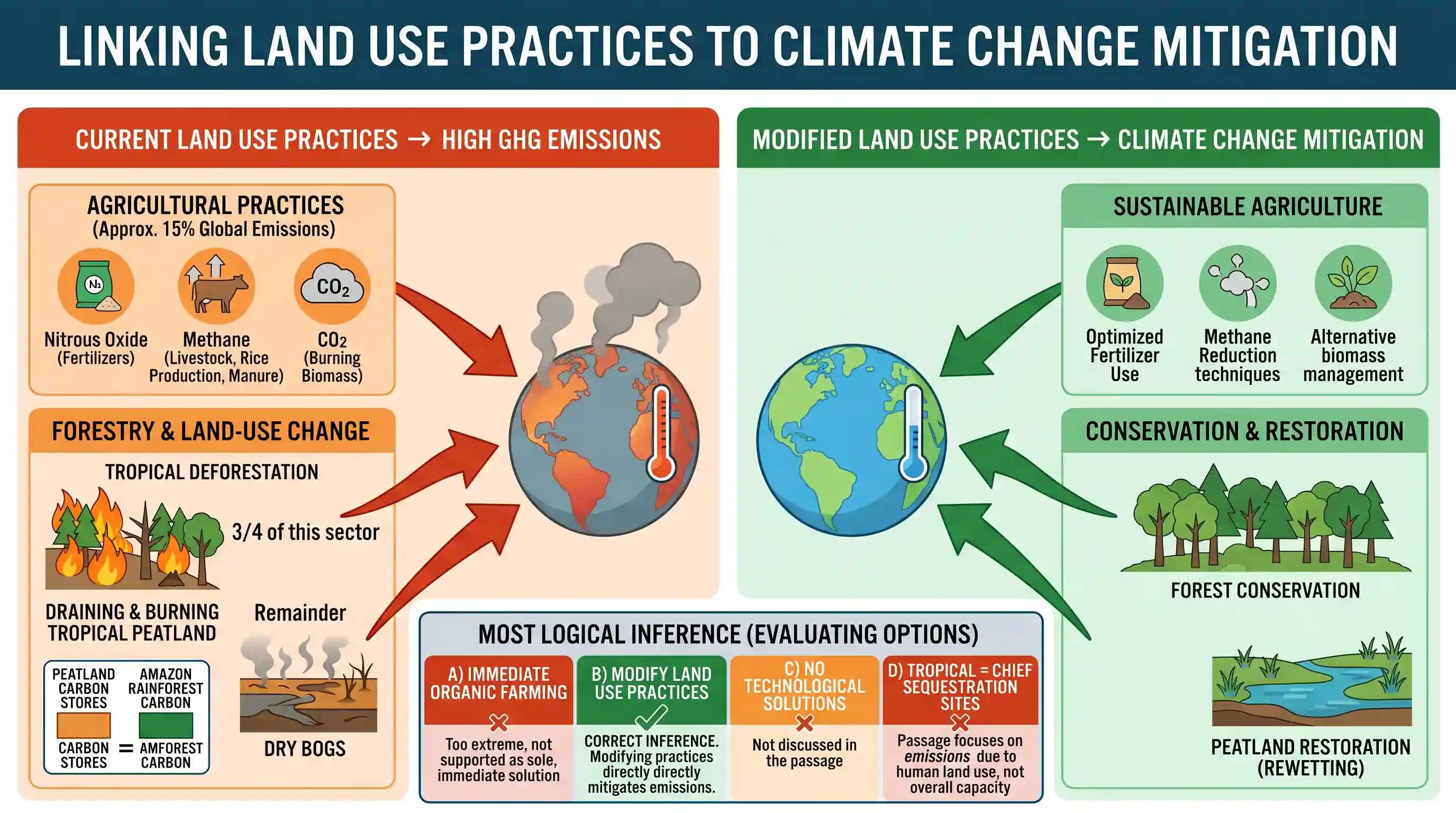
About 15 percent of global greenhouse gas emissions come from agricultural practices. This includes nitrous oxide fertilizers; methane from livestock, rice production, and manure storage; and carbon dioxide (CO2) from burning biomass, but this excludes CO2 emissions from soil management practices, sayannah burning and deforestation. Forestry and use, and land-use change account for another percent of greenhouse gas emissions each ear, three quarters of which come from tropical deforestation. The remainder is largely from draining and burning tropical peatland. About the same amount of carbon is stored in the world's peatlands as is stored in the Amazon rainforest. Which among the following is the most logical and rational inference that can be made from the above passage?

- AOrganic farming should immediately replace mechanised and chemical dependant agricultural practices all over the world
- BIt is imperative for us to modify our land use practices in order to mitigate climate changeCorrect
- CThere are no technological solutions to the problem of greenhouse gas emissions
- DTropical areas are the chief sites of carbon sequestration
Explanation
The passage details how a significant portion of global greenhouse gas emissions comes from agricultural practices, forestry, and land-use change, specifically mentioning tropical deforestation and the draining/burning of tropical peatlands. All these activities fall under the umbrella of 'land use practices'. Therefore, modifying these practices would be crucial for mitigating climate change.
Let's analyze each option:
A) Organic farming should immediately replace mechanised and chemical dependant agricultural practices all over the world. The passage points to emissions from fertilizers and livestock but does not specifically endorse organic farming as the sole, immediate, global solution. This is too strong and specific an inference.
B) It is imperative for us to modify our land use practices in order to mitigate climate change. The passage explicitly links agricultural practices, forestry, deforestation, and peatland management (all forms of land use) to substantial greenhouse gas emissions. This directly supports the idea that modifying these practices is essential for climate change mitigation.
C) There are no technological solutions to the problem of greenhouse gas emissions. The passage discusses sources of emissions related to land use but does not discuss technological solutions or their absence. This cannot be inferred.
D) Tropical areas are the chief sites of carbon sequestration. The passage mentions that tropical deforestation is a major source of emissions and that peatlands (some of which are tropical) store a lot of carbon. However, it primarily focuses on emissions from these areas due to human activities, not on their overall role as chief sites of global carbon sequestration. The emphasis is on the vulnerability and loss of carbon from these areas due to land-use change.
Related questions
More UPSC Prelims practice from the same subject and topic.
- Prelims 2016CSATReading Comprehension
Accountability, or the lack of it, in governance generally, and civil services, in particular, is a major factor underlying the deficiencies in governance and public administration. Designing an effec…
- Prelims 2016CSATReading Comprehension
Accountability, or the lack of it, in governance generally, and civil services, in particular, is a major factor underlying the deficiencies in governance and public administration. Designing an effec…
- Prelims 2016CSATReading Comprehension
Accountability, or the lack of it, in governance generally, and civil services, in particular, is a major factor underlying the deficiencies in governance and public administration. Designing an effec…
- Prelims 2016CSATReading Comprehension
Accountability, or the lack of it, in governance generally, and civil services, in particular, is a major factor underlying the deficiencies in governance and public administration. Designing an effec…
- Prelims 2016CSATReading Comprehension
In general, religious traditions stress our duty to god, or to some universal ethical principle. Our duties to one another derive from these. The religious concept of rights is primarily derived from …
- Prelims 2016CSATReading Comprehension
In general, religious traditions stress our duty to god, or to some universal ethical principle. Our duties to one another derive from these. The religious concept of rights is primarily derived from …