The age of Mr. X last year was the square of a number and it would be the cube of a number next year. What is the least number of years he must wait for his age to become the cube of a number again?

- A42
- B38Correct
- C25
- D16
Explanation
Let Mr. X's current age be A. According to the problem:
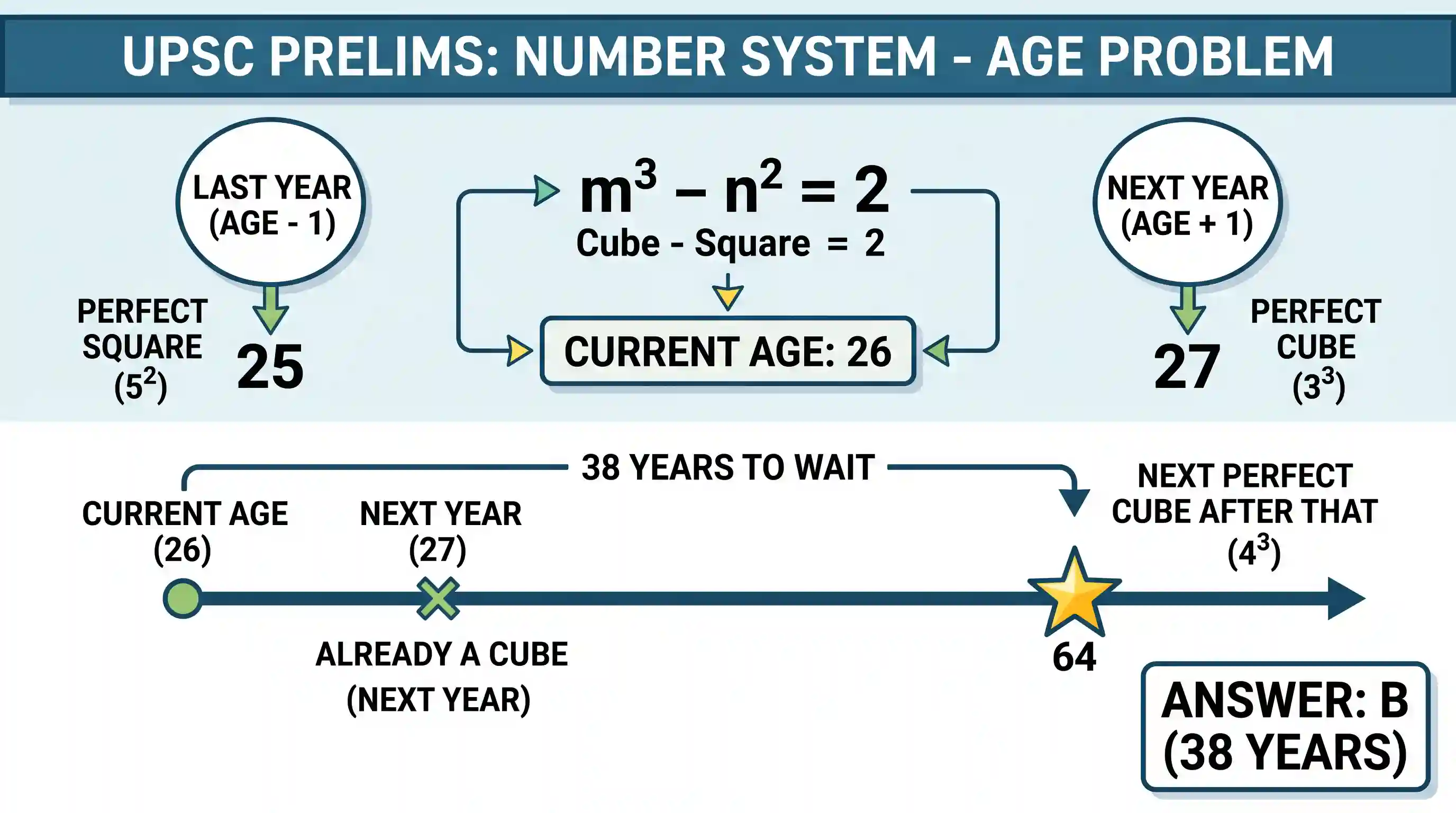
- His age last year was A-1. This was the square of a number. So, A-1 = n^2 for some integer n.
- His age next year will be A+1. This will be the cube of a number. So, A+1 = m^3 for some integer m.
From these two equations, we can subtract the first from the second: (A+1) - (A-1) = m^3 - n^2 2 = m^3 - n^2
We need to find integer values for m and n that satisfy m^3 - n^2 = 2. Let's test small integer values: If m=1, m^3=1. Then n^2 = 1-2 = -1 (not possible for real n). If m=2, m^3=8. Then n^2 = 8-2 = 6 (not a perfect square). If m=3, m^3=27. Then n^2 = 27-2 = 25. This is a perfect square (n=5).
So, m=3 and n=5 is a valid solution. This is the smallest positive integer solution. Using these values to find Mr. X's current age (A): A-1 = n^2 = 5^2 = 25 => A = 26 A+1 = m^3 = 3^3 = 27 => A = 26 Both equations consistently give Mr. X's current age as 26.
Now, the question asks: "What is the least number of years he must wait for his age to become the cube of a number again?" His current age is 26. Next year, his age will be 27, which is 3^3 (a perfect cube). The word "again" implies we are looking for the next perfect cube after 27. Let's list perfect cubes: 1^3 = 1 2^3 = 8 3^3 = 27 4^3 = 64 5^3 = 125
Since his age next year will be 27 (a cube), the next cube after 27 is 64 (which is 4^3). To find out how many years he must wait from his current age (26) to reach 64: Years to wait = 64 - 26 = 38 years.
Analyzing the options: A) 42: Incorrect. B) 38: This matches our calculated value. C) 25: Incorrect. If he waited 25 years, his age would be 26+25 = 51, which is not a cube. D) 16: Incorrect. If he waited 16 years, his age would be 26+16 = 42, which is not a cube.
The final answer is B.
Related questions
More UPSC Prelims practice from the same subject and topic.
- Prelims 2017CSATQuantitative Aptitude
Certain 3-digit numbers following characteristics: 1. All the three digits are different. 2. The number is divisible by 7. 3. The number on reversing the digits is also divisible by 7. How many such 3…
- Prelims 2017CSATQuantitative Aptitude
How many numbers arc there between 99 and 1000 such that the digit 8 occupies the units place?
- Prelims 2017CSATQuantitative Aptitude
A 2-digit number is reversed. The lamer of the two numbers is divided by it smaller one. What is the largest possible remainder?
- Prelims 2017CSATQuantitative Aptitude
There are certain 2-digit numbers. The difference between the number and the one obtained on reversing it is always How many such maximum 2-digit numbers are there?
- Prelims 2017CSATQuantitative Aptitude
What is the total number of digits printed, if a book containing 150 pages is to numbered from 1 to 150?
- Prelims 2017CSATQuantitative Aptitude
If for a sample data Mean < Median < Mode then the distribution is