A 2-digit number is reversed. The lamer of the two numbers is divided by it smaller one. What is the largest possible remainder?

- A9
- B27
- C36
- D45Correct
Explanation
Let the 2-digit number be represented as 10a + b, where 'a' is the tens digit (1-9) and 'b' is the units digit (0-9). The reversed number is 10b + a. For this to also be a 2-digit number, 'b' must be non-zero (1-9). So, 'a' and 'b' are both digits from 1 to 9.
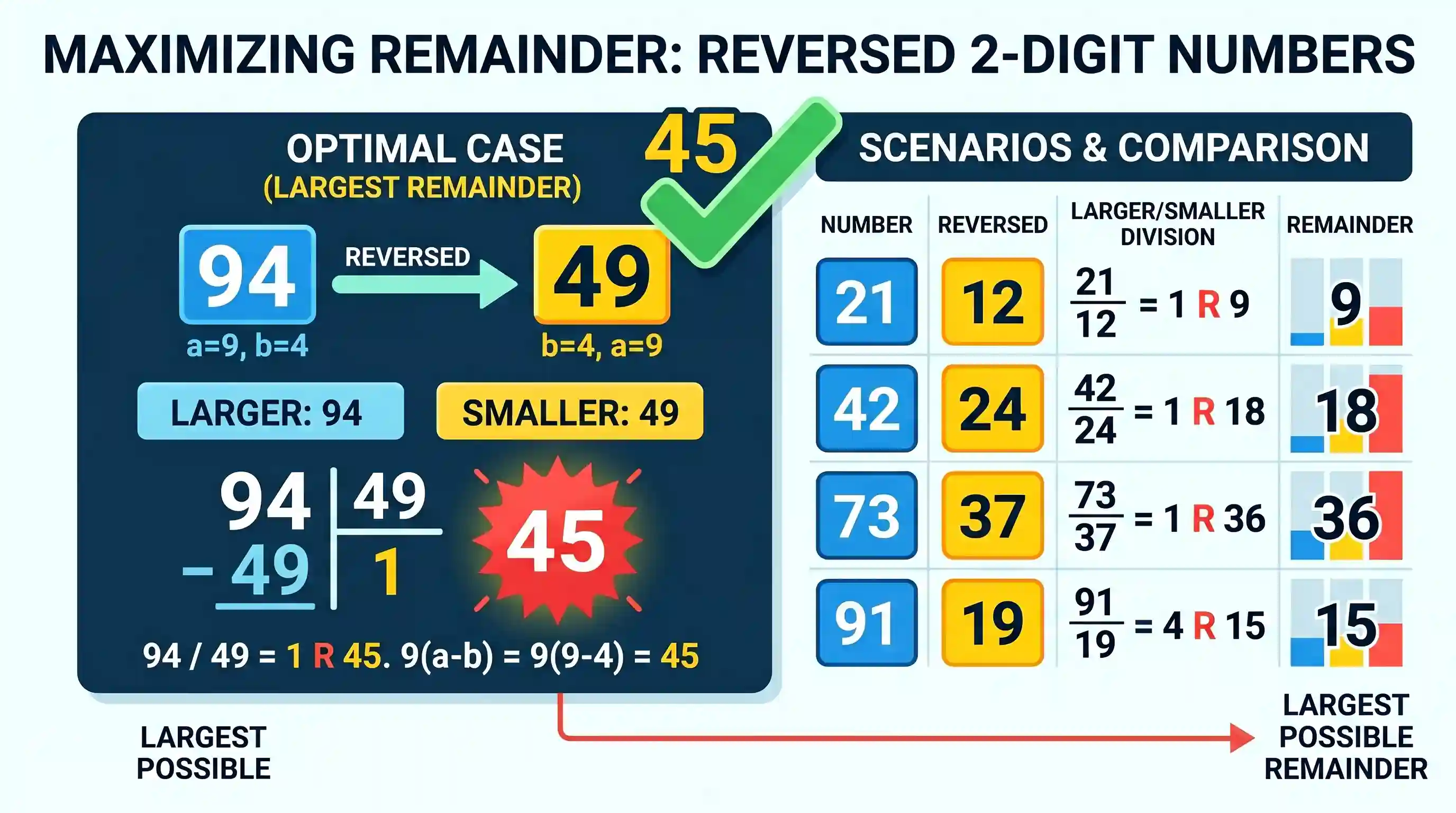
We need to divide the larger of the two numbers by the smaller one and find the largest possible remainder. Let N_larger be the larger number and N_smaller be the smaller number. The division can be expressed as: N_larger = Q * N_smaller + R, where Q is the quotient and R is the remainder. A fundamental property of division is that the remainder R must be less than the divisor N_smaller (R b). Then 10b + a is the smaller number. R = (10a + b) - (10b + a) = 9a - 9b = 9(a - b). For Q=1, we need 10a + b b and a b, a = 2. Number = 21, Reversed = 12. Larger = 21, Smaller = 12. 21 / 12 = 1 remainder 9. (R = 9(2-1) = 9) 2. If b = 2: a b, max a = 4. Number = 42, Reversed = 24. Larger = 42, Smaller = 24. 42 / 24 = 1 remainder 18. (R = 9(4-2) = 18) 3. If b = 3: a b, max a = 7. Number = 73, Reversed = 37. Larger = 73, Smaller = 37. 73 / 37 = 1 remainder 36. (R = 9(7-3) = 36) 4. If b = 4: a b, max a = 9. Number = 94, Reversed = 49. Larger = 94, Smaller = 49. 94 / 49 = 1 remainder 45. (R = 9(9-4) = 45) 5. If b = 5: a b, max a = 9. Number = 95, Reversed = 59. Larger = 95, Smaller = 59. 95 / 59 = 1 remainder 36. (R = 9(9-5) = 36)
As 'b' increases further, 'a-b' decreases, leading to smaller remainders for Q=1. The maximum remainder found when Q=1 is 45.
Now consider cases where the quotient Q > 1. This happens when a >= 2.375b. For example:
- If a = 9, b = 3: (9 >= 2.375 * 3 = 7.125). Number = 93, Reversed = 39. Larger = 93, Smaller = 39. 93 / 39 = 2 remainder 15. (R = 15)
- If a = 9, b = 1: (9 >= 2.375 * 1 = 2.375). Number = 91, Reversed = 19. Larger = 91, Smaller = 19. 91 / 19 = 4 remainder 15. (R = 15)
In cases where Q > 1, the smaller number (divisor) tends to be smaller, which limits the maximum possible remainder (since R 1 (e.g., 15) are less than 45.
The largest remainder found through this systematic check is 45.
The final answer is D
Related questions
More UPSC Prelims practice from the same subject and topic.
- Prelims 2017CSATQuantitative Aptitude
Certain 3-digit numbers following characteristics: 1. All the three digits are different. 2. The number is divisible by 7. 3. The number on reversing the digits is also divisible by 7. How many such 3…
- Prelims 2017CSATQuantitative Aptitude
How many numbers arc there between 99 and 1000 such that the digit 8 occupies the units place?
- Prelims 2017CSATQuantitative Aptitude
The age of Mr. X last year was the square of a number and it would be the cube of a number next year. What is the least number of years he must wait for his age to become the cube of a number again?
- Prelims 2017CSATQuantitative Aptitude
There are certain 2-digit numbers. The difference between the number and the one obtained on reversing it is always How many such maximum 2-digit numbers are there?
- Prelims 2017CSATQuantitative Aptitude
What is the total number of digits printed, if a book containing 150 pages is to numbered from 1 to 150?
- Prelims 2017CSATQuantitative Aptitude
If for a sample data Mean < Median < Mode then the distribution is