If 2 boys and 2 girls are to be arranged in a row so that the girls are not next to each other, how many possible arrangements are there?

- A3
- B6
- C12Correct
- D24
Explanation
The problem asks for the number of arrangements of 2 boys and 2 girls in a row such that the girls are not next to each other.
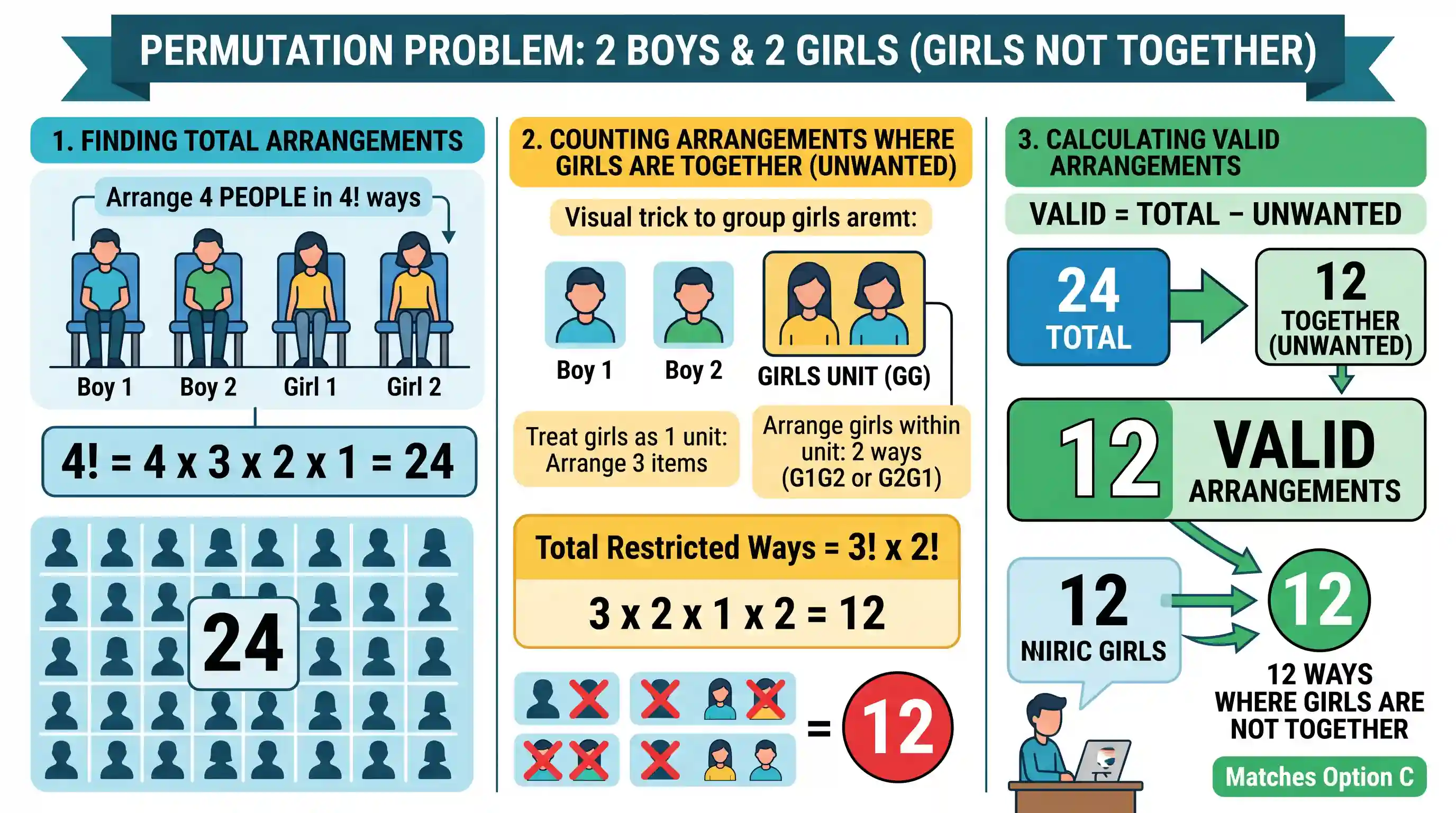
We can solve this using the complementary counting principle: Total arrangements - Arrangements where girls ARE next to each other = Arrangements where girls are NOT next to each other.
-
Calculate the total number of arrangements: There are 4 distinct people (2 boys and 2 girls). The total number of ways to arrange them in a row is 4! (4 factorial). 4! = 4 x 3 x 2 x 1 = 24.
-
Calculate the number of arrangements where the two girls are next to each other: Treat the two girls as a single unit (GG). Now we are arranging 3 units: Boy1, Boy2, and (GG). These 3 units can be arranged in 3! ways = 3 x 2 x 1 = 6 ways. Within the (GG) unit, the two girls can swap positions (Girl1 Girl2 or Girl2 Girl1). So, there are 2! = 2 ways to arrange the girls within their block. Therefore, the number of arrangements where the girls are together is 3! * 2! = 6 * 2 = 12.
-
Subtract to find the desired arrangements: Number of arrangements where girls are NOT next to each other = Total arrangements - Arrangements where girls ARE next to each other = 24 - 12 = 12.
Alternatively, by placing boys first:
- Arrange the 2 boys: B B. There are 2! = 2 ways to arrange them (e.g., B1B2 or B2B1).
- Now, create spaces around and between the boys: _ B _ B _. There are 3 possible spaces (indicated by underscores) where the girls can be placed so they are not next to each other.
- We need to choose 2 of these 3 spaces for the 2 girls. This can be done in C(3, 2) = 3 ways.
- Once the 2 spaces are chosen, the 2 girls can be arranged in those 2 spaces in 2! = 2 ways.
- So, for each arrangement of boys, there are C(3, 2) * 2! = 3 * 2 = 6 ways to place the girls.
- Total arrangements = (Ways to arrange boys) * (Ways to place girls) = 2 * 6 = 12.
Both methods yield 12.
Options analysis: A) 3: Incorrect. B) 6: Incorrect. This would be the answer if the girls were identical and placed around one specific arrangement of boys, or if there were fewer constraints. C) 12: Correct. D) 24: Incorrect. This is the total number of arrangements without any restrictions.
The final answer is C.
Related questions
More UPSC Prelims practice from the same subject and topic.
- Prelims 2017CSATQuantitative Aptitude
A bag contains 20 balls. 8 balls are green, 7 are white and 5 are red. What is the minimum number of balls that must be picked up from the bag blindfolded (without replacing any of it) to be assured o…
- Prelims 2017CSATQuantitative Aptitude
Certain 3-digit numbers following characteristics: 1. All the three digits are different. 2. The number is divisible by 7. 3. The number on reversing the digits is also divisible by 7. How many such 3…
- Prelims 2017CSATQuantitative Aptitude
How many numbers arc there between 99 and 1000 such that the digit 8 occupies the units place?
- Prelims 2017CSATQuantitative Aptitude
If for a sample data Mean < Median < Mode then the distribution is
- Prelims 2017CSATQuantitative Aptitude
The age of Mr. X last year was the square of a number and it would be the cube of a number next year. What is the least number of years he must wait for his age to become the cube of a number again?
- Prelims 2017CSATQuantitative Aptitude
P works thrice as fast as Q, whereas P and Q together can work four times as fast as R. If P, Q and R together work on a job, in what ratio should they share the earnings?