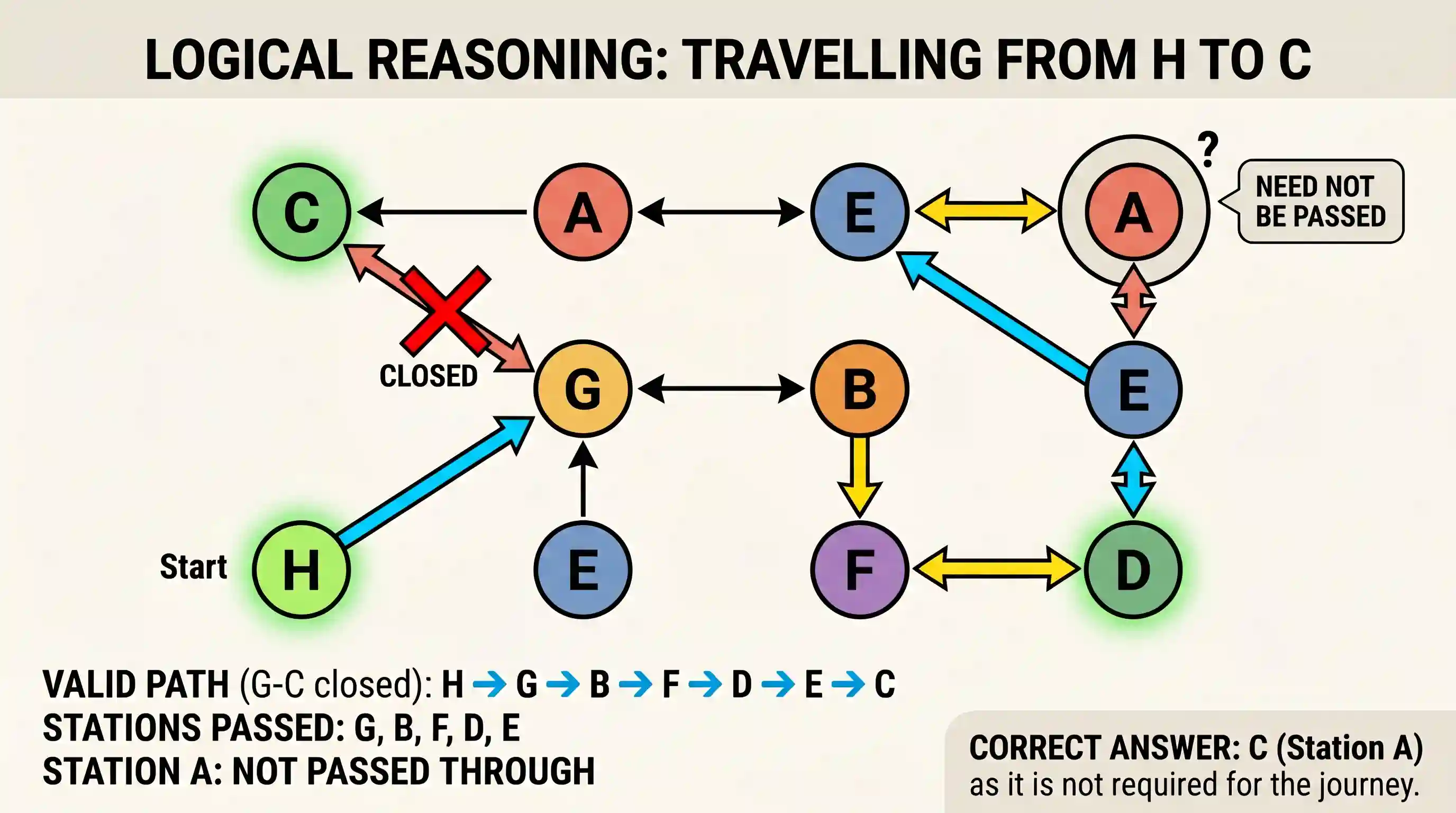
Eight railway stations A, B, C, D, E, F, G and H are connected either by two-way passages or one-way passages. One-way passages are from C to A, E to G, B to F, D to H, G to C, E to C and H to G. Two-way passages are between A and E, G and B, F and D, and E and D. If the route between G and C is closed, which one of the following stations need not be passed through while travelling from H to C?

- AE
- BD
- CACorrect
- DB
Explanation
To solve this, we need to find a valid route from H to C, given that the route G to C is closed. We then identify which of the given stations is not part of this route, meaning it "need not be passed through".
Let's list the connections: One-way: C -> A, E -> G, B -> F, D -> H, E -> C, H -> G. (G -> C is closed) Two-way: A E, G B, F D, E D.
Now, let's trace a path from H to C:
-
From H, the only forward passage is H -> G. (Path so far: H -> G)
-
From G, the passage G -> C is closed. The only other forward passage (from G to a new station) is G -> B (since G B is two-way). (Path so far: H -> G -> B)
-
From B, the passage B -> G would take us back. The only forward passage is B -> F. (Path so far: H -> G -> B -> F)
-
From F, the passage F D means we can go F -> D. (Path so far: H -> G -> B -> F -> D)
-
From D, D -> H and D -> F would take us back. The only forward passage (from D to a new station) is D -> E (since E D is two-way). (Path so far: H -> G -> B -> F -> D -> E)
-
From E, E -> G and E -> D would take us back. We have two options to go forward: E -> A or E -> C. If we take E -> A, the only passage from A is A -> E, which brings us back to E. So, going through A is an unnecessary detour if we can reach C directly from E. The direct passage to our destination C is E -> C. (Final path: H -> G -> B -> F -> D -> E -> C)
In this valid path (H -> G -> B -> F -> D -> E -> C), the stations passed through are G, B, F, D, and E.
Now let's check the options: A) E: E is part of the path (H -> G -> B -> F -> D -> E -> C). So, E must be passed through in this path. B) D: D is part of the path (H -> G -> B -> F -> D -> E -> C). So, D must be passed through in this path. C) A: A is not part of this path. Since we found a valid route from H to C that does not include A, station A need not be passed through. D) B: B is part of the path (H -> G -> B -> F -> D -> E -> C). So, B must be passed through in this path.
Therefore, station A need not be passed through while travelling from H to C.
The final answer is C
Related questions
More UPSC Prelims practice from the same subject and topic.
- Prelims 2017CSATLogical Reasoning
Consider the following: A, B, C, D, E, F, G and H are standing in a row facing North. B is not neighbour of G. F is to the immediate right of G and neighbour of E. G is not at the extreme end. A is si…
- Prelims 2017CSATLogical Reasoning
A, B, C, D, E, F and G are Lecturers from different cities—Hyderabad, Delhi, Shillong, Kanpur, Chennai, Mumbai and Srinagar (not necessarily in the same order) who participated in a conference. Each o…
- Prelims 2017CSATLogical Reasoning
A, B, C, D, E, F and G are Lecturers from different cities—Hyderabad, Delhi, Shillong, Kanpur, Chennai, Mumbai and Srinagar (not necessarily in the same order) who participated in a conference. Each o…
- Prelims 2017CSATLogical Reasoning
A, B, C, D, E, F and G are Lecturers from different cities—Hyderabad, Delhi, Shillong, Kanpur, Chennai, Mumbai and Srinagar (not necessarily in the same order) who participated in a conference. Each o…
- Prelims 2017CSATLogical Reasoning
In a school, there are five teachers A, B, C, D and E. A and B teach Hindi and English. C and B teach English and Geography. D and A teach Mathematics and Hindi. E and B teach History and French. Who …
- Prelims 2017CSATLogical Reasoning
Eight railway stations A, B, C, D, E, F, G and H are connected either by two- way passages or one- way passages. One- way passages are from C to A, E to G, B to F, D to H, G to C, E to C and H to G. T…