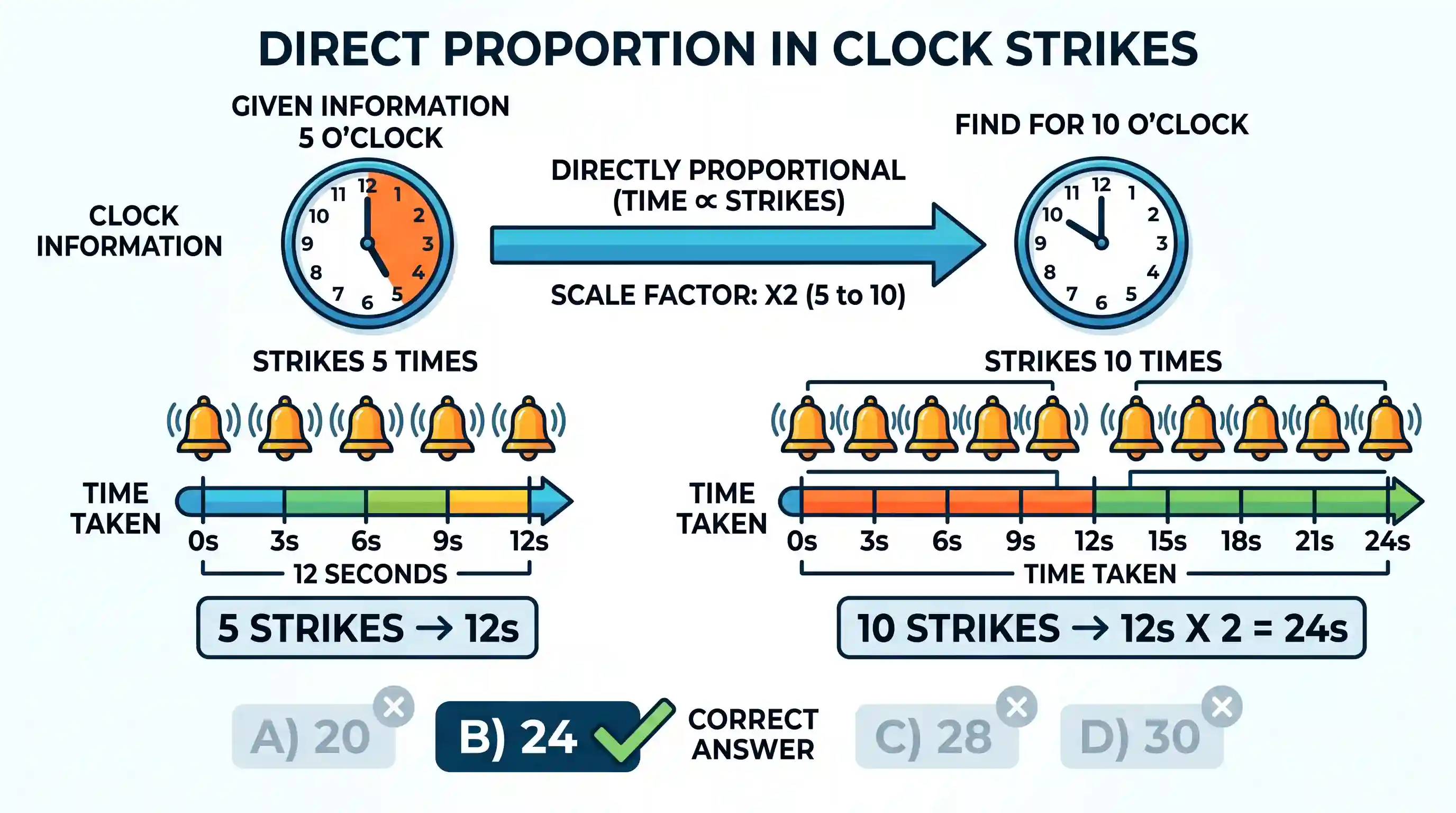
A clock strikes once at 1 o'clock, twice at 2 o'clock and thrice at 3 o'clock, and so on. If it takes 12 seconds to strike at 5 o'clock, what is the time taken by it to strike at 10 o'clock?

- A20
- B24Correct
- C28
- D30
Explanation
The problem implies a direct proportionality between the number of times the clock strikes and the total time taken for those strikes.
-
Analyze the given information:
- At 5 o'clock, the clock strikes 5 times.
- The time taken to strike at 5 o'clock is 12 seconds.
-
Determine the time per strike (proportionality constant):
- If 5 strikes take 12 seconds, then the time taken per strike is 12 seconds / 5 strikes = 2.4 seconds/strike.
-
Calculate the time for 10 o'clock:
- At 10 o'clock, the clock strikes 10 times.
- Using the time per strike calculated above, the total time taken for 10 strikes = 10 strikes * 2.4 seconds/strike = 24 seconds.
Therefore, the time taken by the clock to strike at 10 o'clock is 24 seconds.
Why other interpretations might be incorrect for this specific question: A common alternative approach for such problems involves calculating time based on the intervals between strikes (N-1 intervals for N strikes). If we used this method:
- At 5 o'clock, there are 5-1 = 4 intervals. If 4 intervals take 12 seconds, then 1 interval takes 3 seconds.
- At 10 o'clock, there are 10-1 = 9 intervals. This would take 9 * 3 = 27 seconds. However, since 24 seconds (Option B) is the correct answer, the direct proportionality method (time is directly proportional to the number of strikes) is the intended logic for this question.
The final answer is B) 24.
Related questions
More UPSC Prelims practice from the same subject and topic.
- Prelims 2017CSATLogical Reasoning
A watch loses 2 minutes in every 24 while another watch gains 2 minutes, in 24 hours. At a particular instant, the two watches showed an identical time. Which of the following statements is correct if…
- Prelims 2017CSATLogical Reasoning
If second and fourth Saturdays and ,all the Sundays are taken as only holidays for an office, what would be the minimum number of possible working days of any month of any year?
- Prelims 2017CSATLogical Reasoning
Examine the following statements: 1. All colours are pleasant. 2. Some colours are pleasant. 3. No colour is pleasant. 4. Some colours are not pleasant. Given that statement 4 is true, what can be def…
- Prelims 2017CSATLogical Reasoning
Consider the following relationships among members of a family of six persons A, B, C, D, E and F: 1. The number of males equals that of females. 2. A and E are sons of F. 3. D is the mother of two, o…
- Prelims 2017CSATLogical Reasoning
Consider the following: A, B, C, D, E, F, G and H are standing in a row facing North. B is not neighbour of G. F is to the immediate right of G and neighbour of E. G is not at the extreme end. A is si…
- Prelims 2017CSATLogical Reasoning
In a certain code, '256' means 'red colour chalk', '589' means 'green colour flower' and '254' means 'white colour chalk'. The digit in the code that indicates 'white' is