There are thirteen 2-digit consecutive odd numbers. If 39 is the mean of the first live such numbers, then what is the mean of all the thirteen numbers?

- A47Correct
- B49
- C51
- D45
Explanation
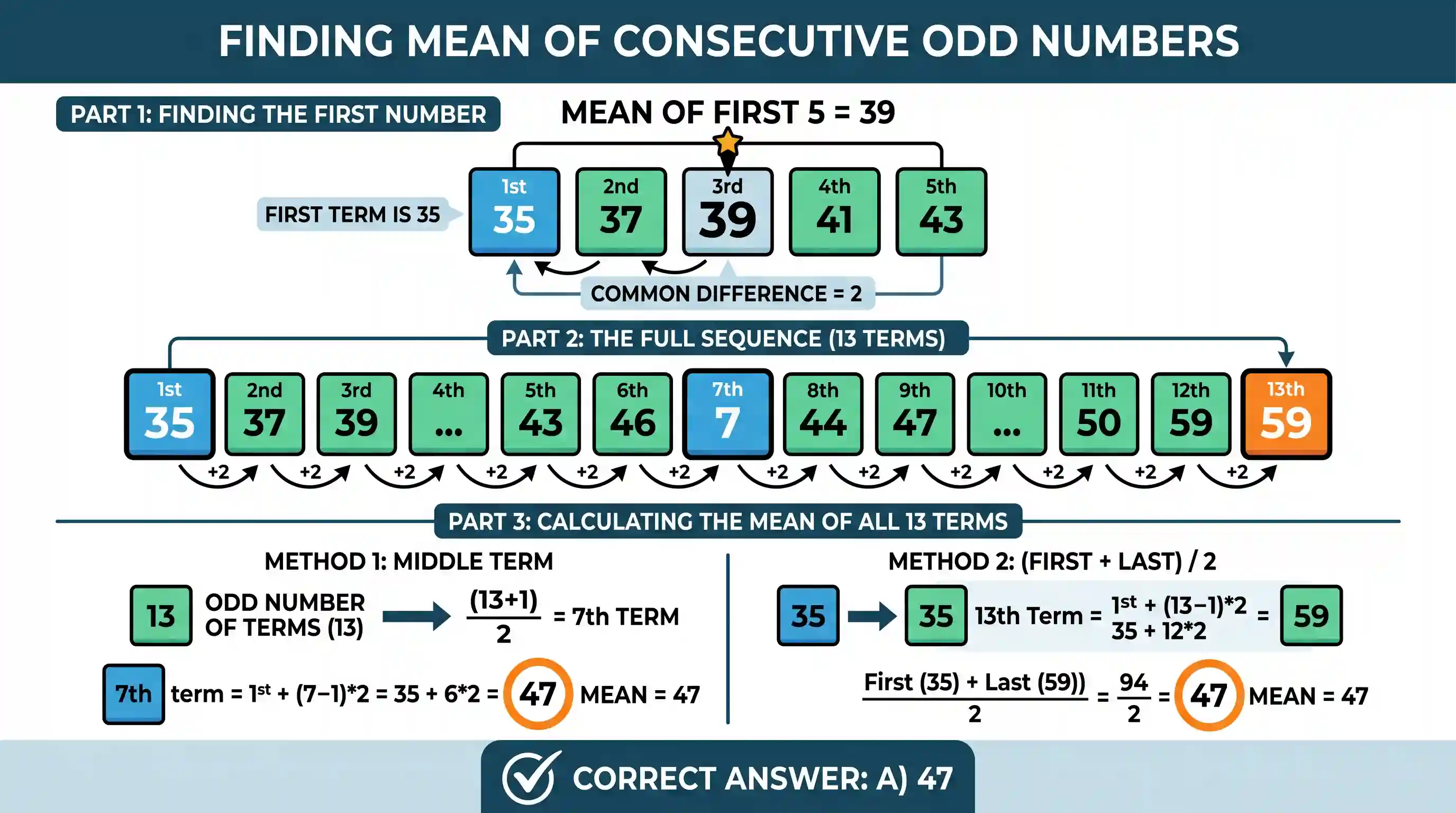
The mean of an odd number of consecutive odd numbers is the middle number. For the first five numbers, the mean is 39. This means the 3rd number among the first five is 39. Since they are consecutive odd numbers, the 3rd number is 39. The numbers are: 1st, 2nd, 3rd, 4th, 5th. The 3rd number is 39. The 2nd number is 39 - 2 = 37. The 1st number is 37 - 2 = 35. (Check: The first five numbers are 35, 37, 39, 41, 43. Their mean is (35+37+39+41+43)/5 = 195/5 = 39. This is correct.) The first number in the sequence of thirteen numbers is 35.
Now we need to find the mean of all thirteen numbers. The sequence starts with 35. The 13th number will be 35 + (13-1)2 = 35 + 122 = 35 + 24 = 59. So the thirteen numbers are 35, 37, ..., 59.
For an arithmetic progression (like consecutive odd numbers), the mean is the average of the first and last term. Mean = (First term + Last term) / 2 Mean = (35 + 59) / 2 = 94 / 2 = 47.
Alternatively, for an odd number of terms in an arithmetic progression, the mean is the middle term. There are 13 terms, so the middle term is the (13+1)/2 = 7th term. The 7th term = First term + (7-1)2 = 35 + 62 = 35 + 12 = 47.
Thus, the mean of all thirteen numbers is 47.
Analyzing the options: A) 47: This matches our calculated mean. B) 49: Incorrect. C) 51: Incorrect. D) 45: Incorrect.
The final answer is A) 47.
Related questions
More UPSC Prelims practice from the same subject and topic.
- Prelims 2017CSATQuantitative Aptitude
If for a sample data Mean < Median < Mode then the distribution is
- Prelims 2017CSATQuantitative Aptitude
The average rainfall in a city for the first four days was recorded to be 0.40 inch. The rainfall on the last two days was in the ratio of 4:3. The average of six days was 0.50 inch. What was the rain…
- Prelims 2017CSATQuantitative Aptitude
The monthly incomes of X and Y are in the ratio of 4:3 and their monthly expenses are in the ratio of 3:2. However, each saves Rs. 6,000 per month. What is their total monthly income?
- Prelims 2017CSATQuantitative Aptitude
Suppose the average weight of 9 persons is 50 kg. The average weight of the first 5 persons is 45 kg, whereas the average weight of the last 5 persons is 55 kg. Then the weight of the 5th person will …
- Prelims 2017CSATQuantitative Aptitude
In a city, 12% of households earn less than Rs. 30,000 per year, 6% households earn more than Rs. 2,00,000 per year, 22% households earn more than Rs. 1,00,000 per year and 990 households earn between…
- Prelims 2017CSATQuantitative Aptitude
There is a milk sample with 50% water in it. If 1/3rd of this milk is added to equal amount of pure milk, then water in the new mixture will fall down to