Six boys A, B, C, D, E and F play a game of cards. Each has a pack of 10 cards. F borrows 2 cards from A and gives away 5 to C who in turn gives 3 to B while B gives 6 to D who passes 1 to E. Then the number of cards possessed by D and E is equal to the number of cards possessed by

- AA, B and C
- BB, C and FCorrect
- CA, B and F
- DA, C and F
Explanation
Initially, each of the six boys (A, B, C, D, E, F) has 10 cards.
Let's track the card changes:
-
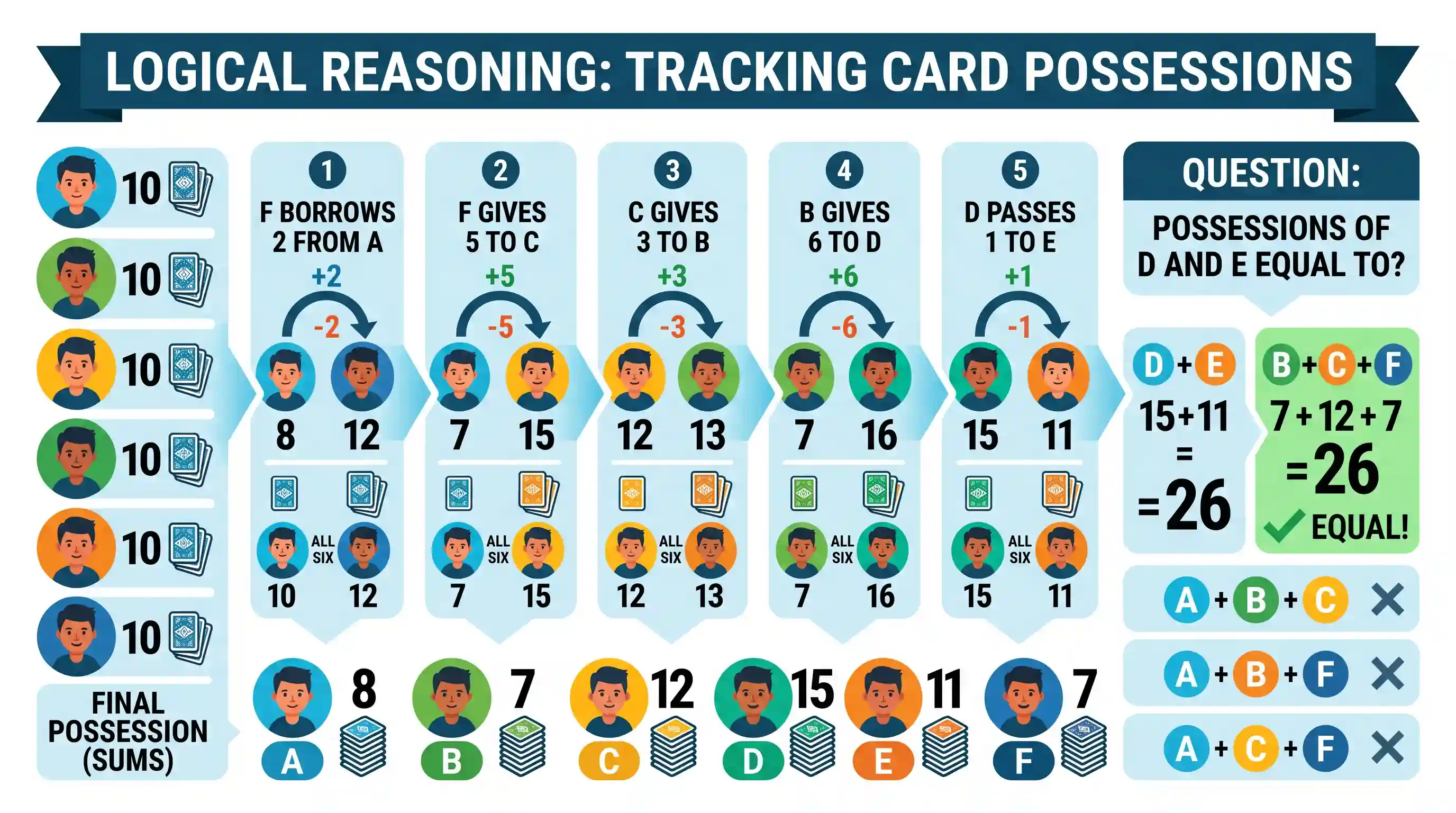
F borrows 2 from A: A = 10 - 2 = 8 F = 10 + 2 = 12
-
F gives 5 to C: F = 12 - 5 = 7 C = 10 + 5 = 15
-
C gives 3 to B: C = 15 - 3 = 12 B = 10 + 3 = 13
-
B gives 6 to D: B = 13 - 6 = 7 D = 10 + 6 = 16
-
D passes 1 to E: D = 16 - 1 = 15 E = 10 + 1 = 11
Final card counts: A = 8 B = 7 C = 12 D = 15 E = 11 F = 7
Number of cards possessed by D and E = D + E = 15 + 11 = 26.
Now, let's check the options: A) A, B and C = 8 + 7 + 12 = 27 (Not equal to 26) B) B, C and F = 7 + 12 + 7 = 26 (Equal to 26) C) A, B and F = 8 + 7 + 7 = 22 (Not equal to 26) D) A, C and F = 8 + 12 + 7 = 27 (Not equal to 26)
Therefore, the number of cards possessed by D and E is equal to the number of cards possessed by B, C and F.
The final answer is B.
Related questions
More UPSC Prelims practice from the same subject and topic.
- Prelims 2017CSATLogical Reasoning
Consider the following: A, B, C, D, E, F, G and H are standing in a row facing North. B is not neighbour of G. F is to the immediate right of G and neighbour of E. G is not at the extreme end. A is si…
- Prelims 2017CSATLogical Reasoning
A, B, C, D, E, F and G are Lecturers from different cities—Hyderabad, Delhi, Shillong, Kanpur, Chennai, Mumbai and Srinagar (not necessarily in the same order) who participated in a conference. Each o…
- Prelims 2017CSATLogical Reasoning
A, B, C, D, E, F and G are Lecturers from different cities—Hyderabad, Delhi, Shillong, Kanpur, Chennai, Mumbai and Srinagar (not necessarily in the same order) who participated in a conference. Each o…
- Prelims 2017CSATLogical Reasoning
A, B, C, D, E, F and G are Lecturers from different cities—Hyderabad, Delhi, Shillong, Kanpur, Chennai, Mumbai and Srinagar (not necessarily in the same order) who participated in a conference. Each o…
- Prelims 2017CSATLogical Reasoning
In a school, there are five teachers A, B, C, D and E. A and B teach Hindi and English. C and B teach English and Geography. D and A teach Mathematics and Hindi. E and B teach History and French. Who …
- Prelims 2017CSATLogical Reasoning
Eight railway stations A, B, C, D, E, F, G and H are connected either by two- way passages or one- way passages. One- way passages are from C to A, E to G, B to F, D to H, G to C, E to C and H to G. T…