No supporters of 'party X', who knew Z and supported his campaign strategy, agreed for the alliance with 'party Y'; but some of them had friends in 'party Y'. With reference to the above information, consider the following statement 1. Some supporters of 'party X' knew Z 2. Some supporters of 'party X', who opposed Z's campaign strategy, knew Z. 3. No supporters of 'party X' supported Z's campaign strategy. Which of the statements given above, is/are not correct?

- A1 only
- B2 and 3 only
- C3 onlyCorrect
- D1, 2 and 3
Explanation
The given information states: "No supporters of 'party X', who knew Z and supported his campaign strategy, agreed for the alliance with 'party Y'; but some of them had friends in 'party Y'."
Let's break this down:
- There is a group of people: "supporters of 'party X', who knew Z and supported his campaign strategy".
- None of these people agreed for the alliance with 'party Y'.
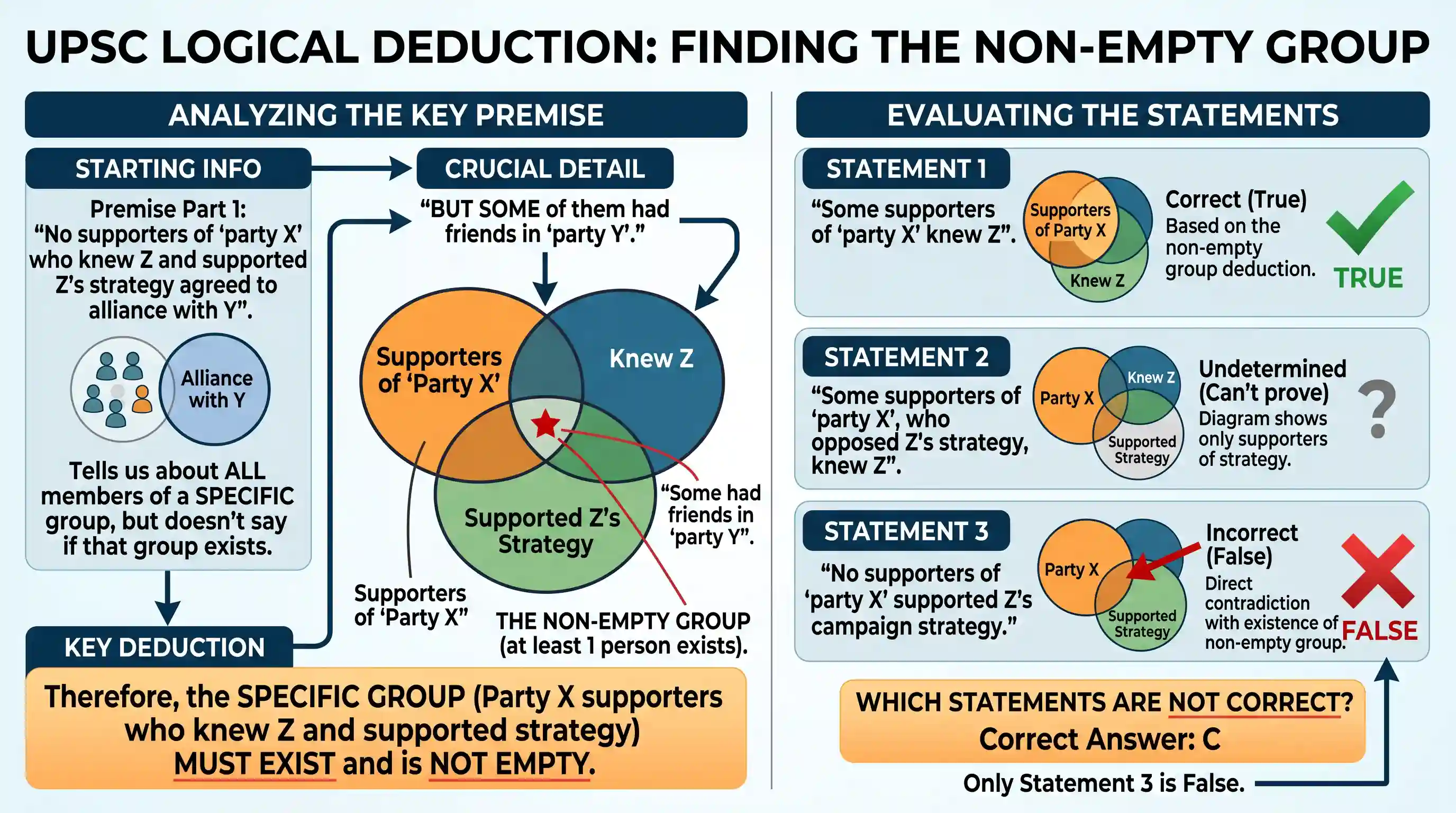
- Crucially, "some of them" (referring to this group) had friends in 'party Y'. This third part confirms that this group is not empty. There exists at least one supporter of 'party X' who knew Z and supported his campaign strategy.
Now let's evaluate each statement:
Statement 1: "Some supporters of 'party X' knew Z"
- Since the group "supporters of 'party X', who knew Z and supported his campaign strategy" is non-empty, it logically follows that there must be some supporters of 'party X' who knew Z.
- Therefore, Statement 1 is CORRECT.
Statement 2: "Some supporters of 'party X', who opposed Z's campaign strategy, knew Z."
- The given information only provides details about supporters of 'party X' who supported Z's campaign strategy. It gives no information about those who opposed Z's campaign strategy. We cannot determine from the given information whether such a group exists or not.
- Therefore, Statement 2 cannot be determined as correct or incorrect based on the provided information.
Statement 3: "No supporters of 'party X' supported Z's campaign strategy."
- From our analysis of the original information, we concluded that the group "supporters of 'party X', who knew Z and supported his campaign strategy" is non-empty. This means there is at least one supporter of 'party X' who did support Z's campaign strategy.
- This directly contradicts Statement 3.
- Therefore, Statement 3 is INCORRECT (False).
The question asks which of the statements is/are not correct. Assuming "not correct" means "false":
- Statement 1 is Correct.
- Statement 2 is Undetermined (not definitively false).
- Statement 3 is Incorrect (False).
Thus, only Statement 3 is not correct.
The final answer is C
Related questions
More UPSC Prelims practice from the same subject and topic.
- Prelims 2017CSATLogical Reasoning
Examine the following statements: 1. All colours are pleasant. 2. Some colours are pleasant. 3. No colour is pleasant. 4. Some colours are not pleasant. Given that statement 4 is true, what can be def…
- Prelims 2017CSATLogical Reasoning
In a group of six women, there are four tennis players, four postgraduates in Sociology, one postgraduate in Commerce and three bank employees. Vimala and Kamla are the bank employees while Amala and …
- Prelims 2017CSATLogical Reasoning
Consider the given statement and the two conclusions that follow: Statement: Morning walk is good for health. Conclusions: 1. All healthy people go for morning walk. 2. Morning walk is essential for m…
- Prelims 2017CSATLogical Reasoning
In a test, Randhir obtained more marks than the total marks obtained by Kunal and Debu. The total marks obtained by Kunal and Shankar are more than those of Randhir. Sonal obtained more marks than Sha…
- Prelims 2017CSATLogical Reasoning
No supporters of 'party X', who knew Z and supported his campaign strategy, agreed for the alliance with 'party Y'; but some of them had friends in 'party Y'. With reference to the above information, …
- Prelims 2017CSATLogical Reasoning
Consider the following: Statement: Good voice is a natural gift but one has to keep practising to improve and well in the field of music. Conclusions: I. Natural gifts need nurturing and care. II. Eve…