If there is a policy that 1/3rd of population of a community has migrated every year from one place, to some other place, what is the leftover population of that community after the sixth year, if there is no further growth in the population during this period?

- A16/243rd part of the population
- B32/243rd part of the population
- C32/729th part of the population
- D64/729th part of the populationCorrect
Explanation
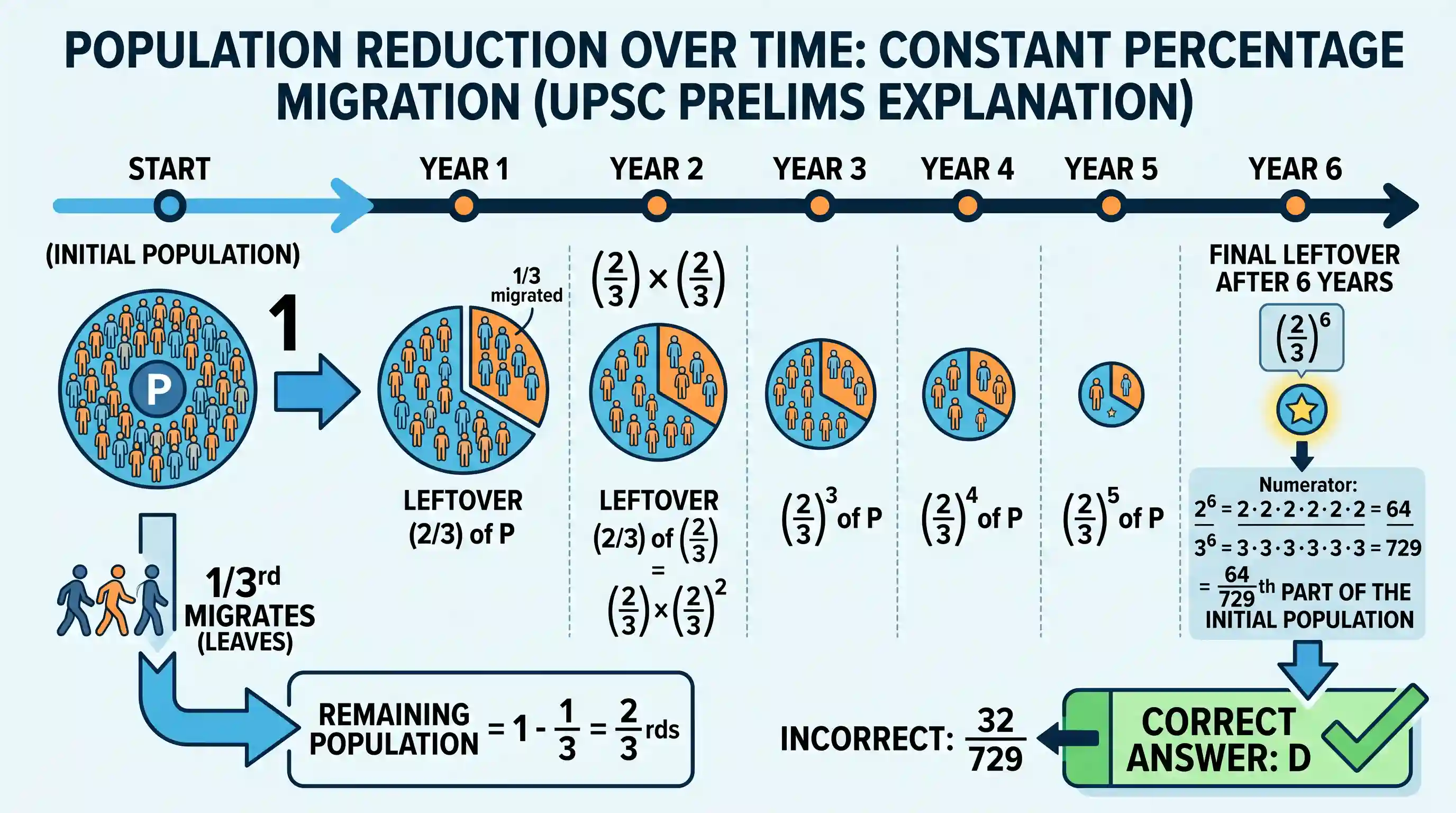
If 1/3rd of the population migrates every year, then the remaining population each year is 1 - 1/3 = 2/3rd of the population from the previous year.
Let the initial population be P. After 1st year: P * (2/3) After 2nd year: P * (2/3) * (2/3) = P * (2/3)^2 After 3rd year: P * (2/3)^3 ... After 6th year: P * (2/3)^6
Now, calculate (2/3)^6: Numerator: 2^6 = 2 * 2 * 2 * 2 * 2 * 2 = 64 Denominator: 3^6 = 3 * 3 * 3 * 3 * 3 * 3 = 729
So, the leftover population is 64/729th part of the original population.
Analyzing the options: A) 16/243rd part of the population (Incorrect. This would be (2/3)^5 / 2 or (2/3)^4 * (1/3) * 2 or similar incorrect calculation) B) 32/243rd part of the population (Incorrect. This is (2/3)^5) C) 32/729th part of the population (Incorrect. This is (2^5)/(3^6), which is 32/729) D) 64/729th part of the population (Correct. This is (2^6)/(3^6))
The final answer is D.
Related questions
More UPSC Prelims practice from the same subject and topic.
- Prelims 2017CSATQuantitative Aptitude
If for a sample data Mean < Median < Mode then the distribution is
- Prelims 2017CSATQuantitative Aptitude
The average rainfall in a city for the first four days was recorded to be 0.40 inch. The rainfall on the last two days was in the ratio of 4:3. The average of six days was 0.50 inch. What was the rain…
- Prelims 2017CSATQuantitative Aptitude
The monthly incomes of X and Y are in the ratio of 4:3 and their monthly expenses are in the ratio of 3:2. However, each saves Rs. 6,000 per month. What is their total monthly income?
- Prelims 2017CSATQuantitative Aptitude
Suppose the average weight of 9 persons is 50 kg. The average weight of the first 5 persons is 45 kg, whereas the average weight of the last 5 persons is 55 kg. Then the weight of the 5th person will …
- Prelims 2017CSATQuantitative Aptitude
In a city, 12% of households earn less than Rs. 30,000 per year, 6% households earn more than Rs. 2,00,000 per year, 22% households earn more than Rs. 1,00,000 per year and 990 households earn between…
- Prelims 2017CSATQuantitative Aptitude
There are thirteen 2-digit consecutive odd numbers. If 39 is the mean of the first live such numbers, then what is the mean of all the thirteen numbers?