There are three pillars X, Y and Z of different heights. Three spiders A, B and C start to climb on these pillars simultaneously. In one chance, A climbs on X by 6 cm but slips down 1 cm. B climbs on Y by 7 cm but slips down 3 cm. C climbs on Z by 6.5 cm but slips down 2 cm. If each of them requires 40 chances to reach the top of the pillars, what is the height of the shortest pillar?

- A161
- B163Correct
- C182
- D210
Explanation
Here's a brief explanation:
-
Calculate net climb per chance for each spider:
- Spider A: 6 cm up - 1 cm down = 5 cm net climb.
- Spider B: 7 cm up - 3 cm down = 4 cm net climb.
- Spider C: 6.5 cm up - 2 cm down = 4.5 cm net climb.
-
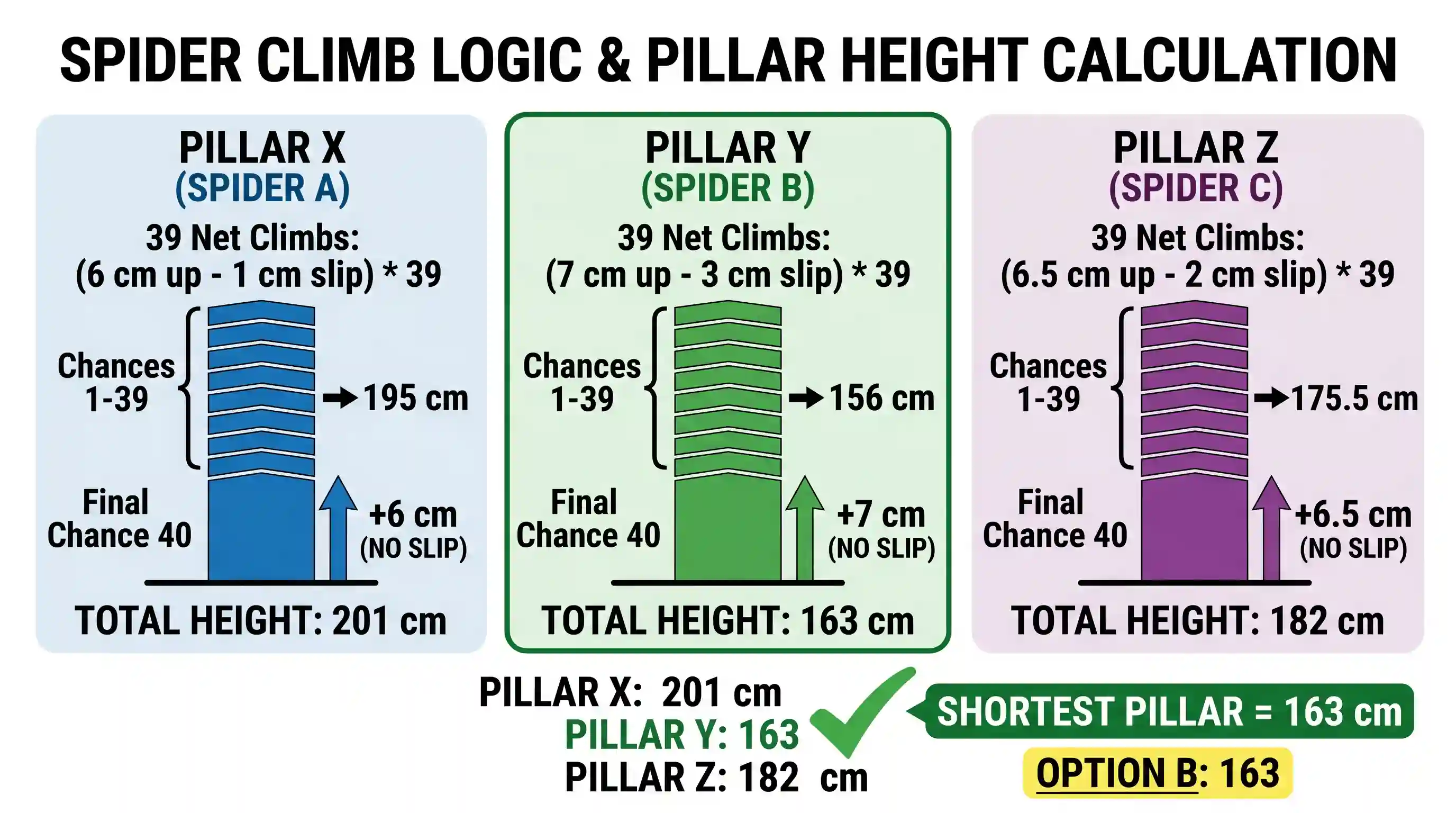
Understand the "last chance" logic: For the first 39 chances, the spider experiences the net climb and slip. In the 40th (last) chance, the spider makes its final climb and reaches the top without slipping down.
-
Calculate the height of each pillar:
- Pillar X (Spider A): (39 chances * 5 cm/chance) + 6 cm (final climb) = 195 + 6 = 201 cm.
- Pillar Y (Spider B): (39 chances * 4 cm/chance) + 7 cm (final climb) = 156 + 7 = 163 cm.
- Pillar Z (Spider C): (39 chances * 4.5 cm/chance) + 6.5 cm (final climb) = 175.5 + 6.5 = 182 cm.
-
Compare the heights:
- Pillar X = 201 cm
- Pillar Y = 163 cm
- Pillar Z = 182 cm
-
The shortest pillar is Y, with a height of 163 cm.
Therefore, option B is correct.
Related questions
More UPSC Prelims practice from the same subject and topic.
- Prelims 2017CSATQuantitative Aptitude
If for a sample data Mean < Median < Mode then the distribution is
- Prelims 2017CSATQuantitative Aptitude
The average rainfall in a city for the first four days was recorded to be 0.40 inch. The rainfall on the last two days was in the ratio of 4:3. The average of six days was 0.50 inch. What was the rain…
- Prelims 2017CSATQuantitative Aptitude
The monthly incomes of X and Y are in the ratio of 4:3 and their monthly expenses are in the ratio of 3:2. However, each saves Rs. 6,000 per month. What is their total monthly income?
- Prelims 2017CSATQuantitative Aptitude
Suppose the average weight of 9 persons is 50 kg. The average weight of the first 5 persons is 45 kg, whereas the average weight of the last 5 persons is 55 kg. Then the weight of the 5th person will …
- Prelims 2017CSATQuantitative Aptitude
In a city, 12% of households earn less than Rs. 30,000 per year, 6% households earn more than Rs. 2,00,000 per year, 22% households earn more than Rs. 1,00,000 per year and 990 households earn between…
- Prelims 2017CSATQuantitative Aptitude
There are thirteen 2-digit consecutive odd numbers. If 39 is the mean of the first live such numbers, then what is the mean of all the thirteen numbers?