The Trade Disputes Act of 1929 provided for

- Athe participation of workers in the management of industries.
- Barbitrary powers to the management to quell industrial disputes.
- Can intervention by the British Court in the event of a trade dispute.
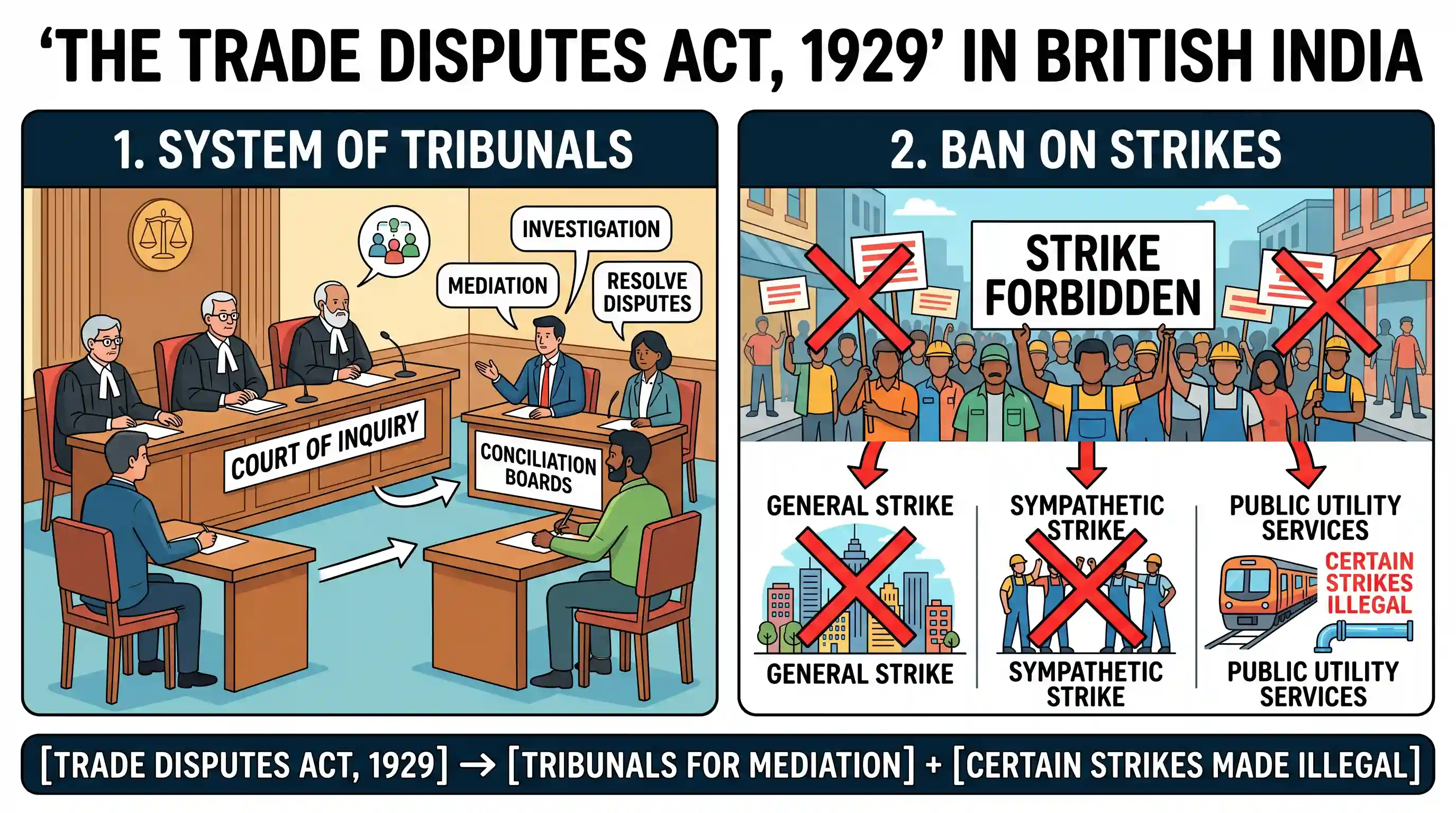
- Da system of tribunals and a ban on strikes.Correct
Explanation
The Trade Disputes Act of 1929 was enacted by the British Indian government to provide a mechanism for the investigation and settlement of industrial disputes. It introduced provisions for the establishment of Courts of Inquiry and Conciliation Boards (which function as tribunals) to mediate and resolve disputes. A significant aspect of the Act was that it made certain types of strikes and lock-outs illegal, particularly in public utility services, and generally prohibited sympathetic and general strikes, thereby effectively imposing a ban on specific forms of industrial action.
Related questions
More UPSC Prelims practice from the same subject and topic.
- Prelims 2017GS1history
Who among the following was/were associated with the introduction of Ryotwari Settlement in India during the British rule? 1. Lord Cornwallis 2. Alexander Read 3. Thomas Munro Select the correct answe…
- Prelims 2017GS1history
Consider the following statements: 1. The Factories Act, 1881 was passed with a view to fix the wages of industrial workers and to allow the workers to form trade unions. 2. N.M. Lokhande was a pionee…
- Prelims 2017GS1history
The object of the Butler Committee of 1927 was to
- Prelims 2017GS1history
Consider the following pairs: 1. Radhakanta Deb - First President of the British Indian Association 2. Gazulu Lakshminarasu Chetty - Founder of the Madras Mahajana Sabha 3. Surendranath Banerjee - Fou…
- Prelims 2017GS1history
In the context of Indian history, the principle of 'Dyarchy (diarchy)' refers to
- Prelims 2017GS1history
With reference to Indian freedom struggle, consider the following events: 1. Mutiny in Royal Indian Navy 2. Quit India Movement launched 3. Second Round Table Conference What is the correct chronologi…