Consider the following statements: 1. The Factories Act, 1881 was passed with a view to fix the wages of industrial workers and to allow the workers to form trade unions. 2. N.M. Lokhande was a pioneer in organizing the labour movement in British India. Which of the above statements is/are correct?

- A1 only
- B2 onlyCorrect
- CBoth 1 and 2
- DNeither 1 nor 2
Explanation
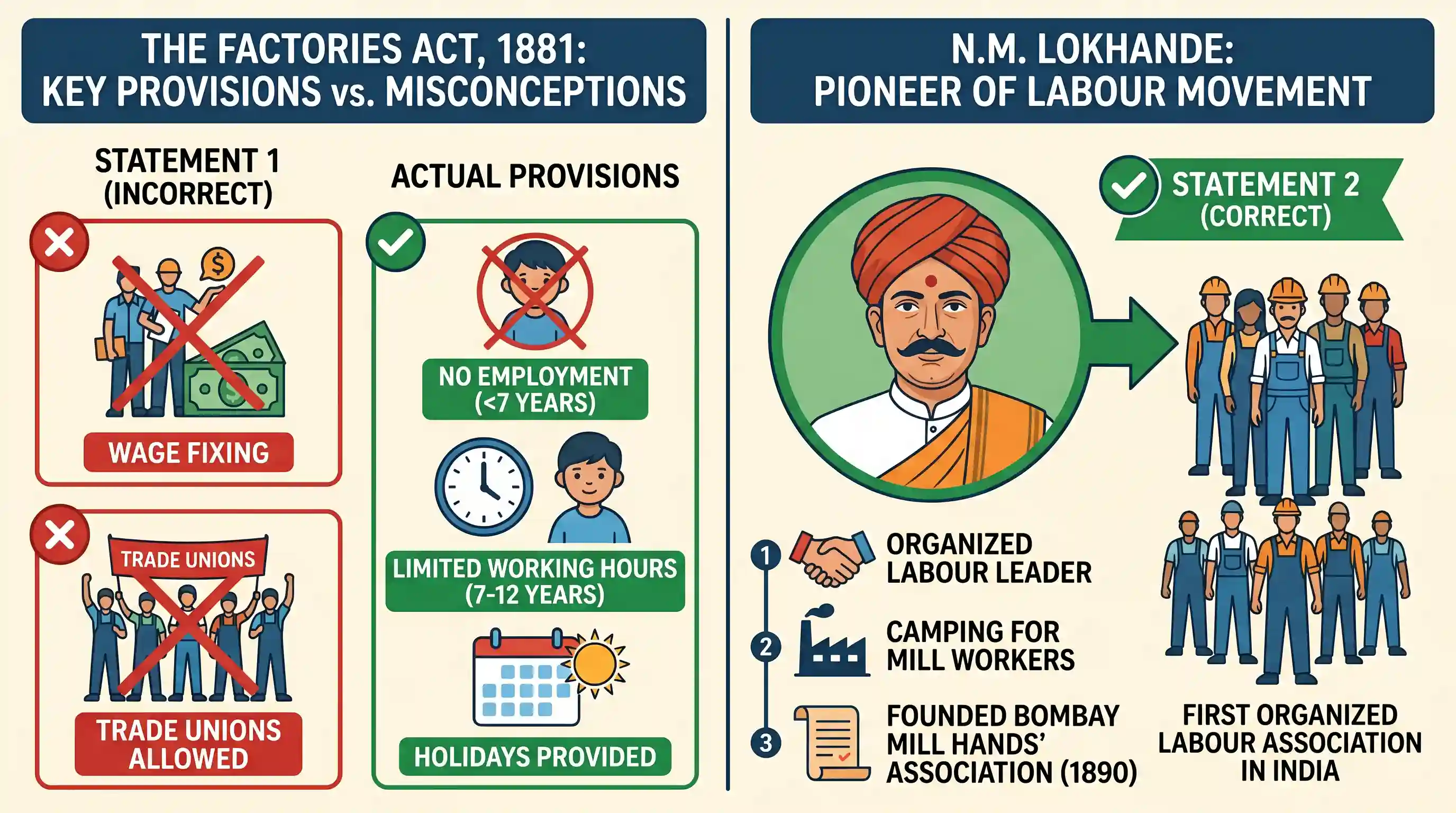
Statement 1 is incorrect: The Factories Act, 1881, was the first significant legislation concerning factory labour in British India. Its primary purpose was to regulate the working conditions of child labour (specifically, prohibiting employment of children below 7 years, limiting working hours for children aged 7-12, and providing for their holidays). It did not aim to fix wages of industrial workers or to explicitly allow the formation of trade unions; the concept of organized labour movements and union rights was still nascent and largely unaddressed by law at that time.
Statement 2 is correct: Narayan Meghaji Lokhande (N.M. Lokhande) is widely regarded as a pioneer and one of the earliest leaders of the organized labour movement in British India. He founded the Bombay Mill Hands' Association in 1890, which is often considered the first organized labour association in India, and campaigned for improved working conditions for textile mill workers.
Therefore, only statement 2 is correct.
Related questions
More UPSC Prelims practice from the same subject and topic.
- Prelims 2017GS1history
Who among the following was/were associated with the introduction of Ryotwari Settlement in India during the British rule? 1. Lord Cornwallis 2. Alexander Read 3. Thomas Munro Select the correct answe…
- Prelims 2017GS1history
The Trade Disputes Act of 1929 provided for
- Prelims 2017GS1history
The object of the Butler Committee of 1927 was to
- Prelims 2017GS1history
Consider the following pairs: 1. Radhakanta Deb - First President of the British Indian Association 2. Gazulu Lakshminarasu Chetty - Founder of the Madras Mahajana Sabha 3. Surendranath Banerjee - Fou…
- Prelims 2017GS1history
In the context of Indian history, the principle of 'Dyarchy (diarchy)' refers to
- Prelims 2017GS1history
With reference to Indian freedom struggle, consider the following events: 1. Mutiny in Royal Indian Navy 2. Quit India Movement launched 3. Second Round Table Conference What is the correct chronologi…