Consider the following statements: 1. In the election for Lok Sabha or State Assembly, the winning candidate must get at least 50 percent of the votes polled, to be declared elected. 2. According to the provisions laid down in the Constitution of India, in Lok Sabha, the Speaker's post goes to the majority. party and the Deputy Speaker's to the Opposition. Which of the statements given above is/are correct?

- A1 only
- B2 only
- CBoth 1 and 2
- DNeither 1 nor 2Correct
Explanation
Let's analyze each statement:
-
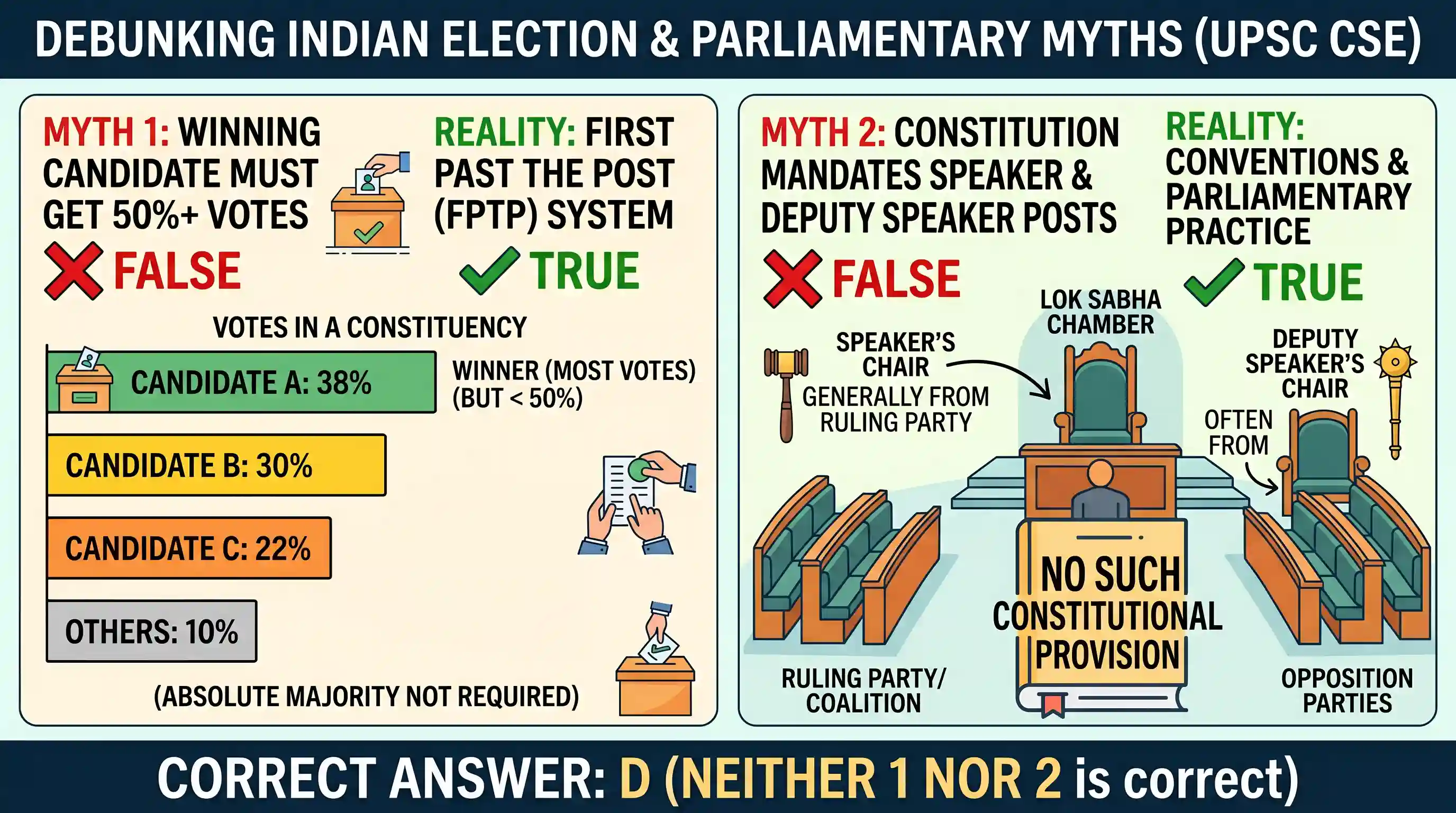
In the election for Lok Sabha or State Assembly, the winning candidate must get at least 50 percent of the votes polled, to be declared elected. This statement is incorrect. India follows the 'First Past the Post' (FPTP) system, also known as the plural electoral system. Under this system, the candidate who secures the most votes in a constituency, regardless of whether it's 50% or less, is declared the winner. There is no requirement for a candidate to secure an absolute majority (50% + 1 vote) to be elected.
-
According to the provisions laid down in the Constitution of India, in Lok Sabha, the Speaker's post goes to the majority party and the Deputy Speaker's to the Opposition. This statement is also incorrect. The Constitution of India does not explicitly lay down a provision reserving the Speaker's post for the majority party or the Deputy Speaker's post for the opposition. While it is a convention that the Speaker generally belongs to the ruling party/coalition and the Deputy Speaker's post has, at times, been offered to the opposition, this is based on parliamentary conventions and mutual understanding, not a constitutional mandate.
Therefore, neither of the statements is correct.
Related questions
More UPSC Prelims practice from the same subject and topic.
- Prelims 2017GS1polity-and-governance
Local self-government can be best explained as an exercise in
- Prelims 2017GS1polity-and-governance
With reference to the 'Prohibition of Benami Property Transactions Act, 1988 (PBPT Act)', consider the following statements: 1. A property transaction is not treated as a benami transaction if the own…
- Prelims 2017GS1polity-and-governance
Which of the following are the objectives of 'National Nutrition Mission'? 1. To create awareness relating to malnutrition among pregnant women and lactating mothers. 2. To reduce the incidence of ana…
- Prelims 2017GS1polity-and-governance
Who among the following can join the National Pension System (NPS)?
- Prelims 2017GS1polity-and-governance
According to the Wildlife (Protection) Act, 1972, which of the following animals cannot be hunted by any person except under some provisions provided by law? 1. Gharial 2. Indian wild ass 3. Wild buff…
- Prelims 2017GS1polity-and-governance
With reference to 'Quality Council of India (QCI)', consider the following statements: 1. QCI was set up jointly by the Government of India and the Indian Industry. 2. Chairman of QCI is appointed by …