What is the application of Somatic Cell Nuclear Transfer Technology?

- AProduction of biolarvicides
- BManufacture of biodegradable plastics
- CReproductive cloning of animalsCorrect
- DProduction of organisms free of diseases
Explanation
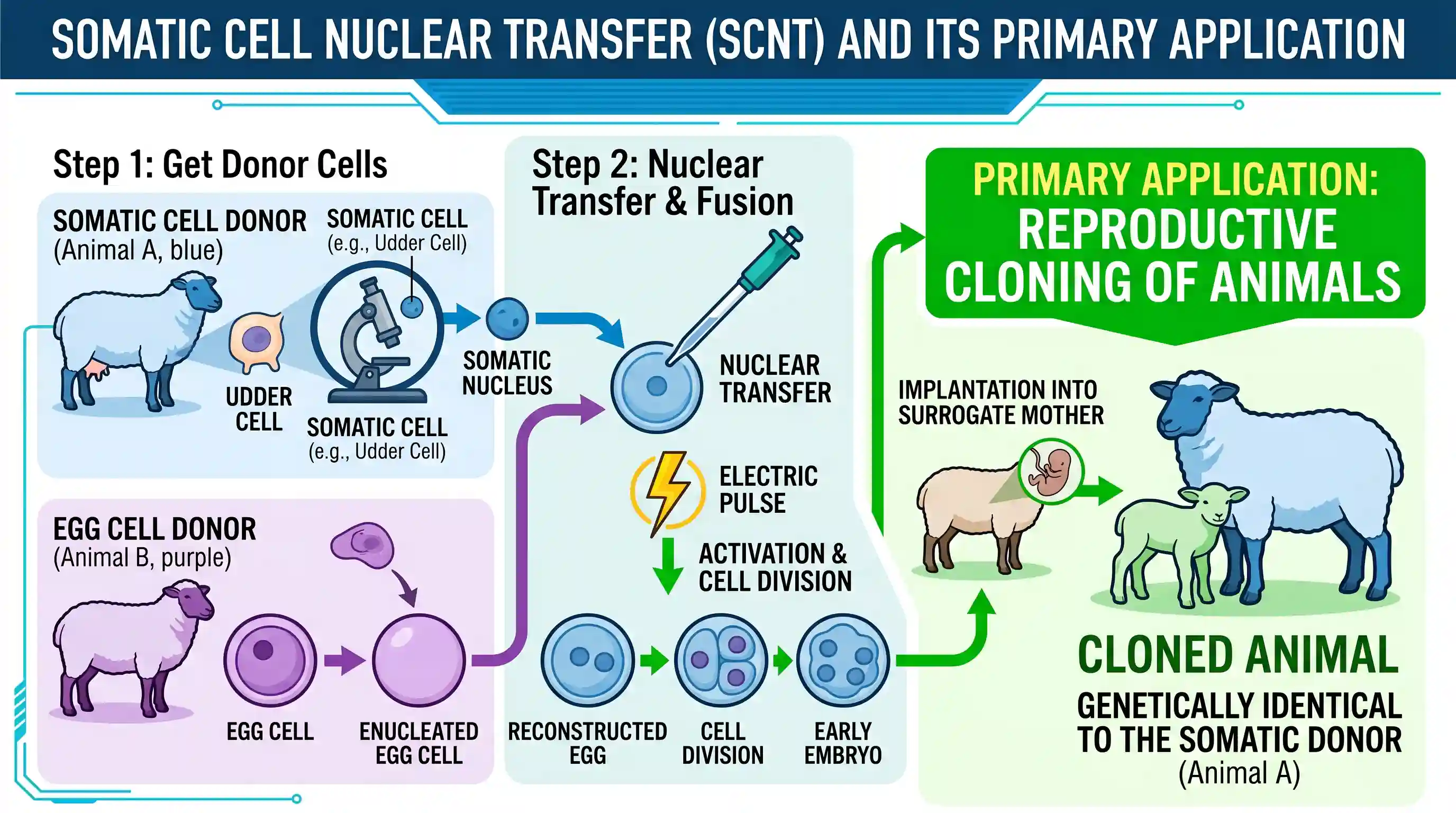
Somatic Cell Nuclear Transfer (SCNT) is a laboratory technique that involves transferring the nucleus from a somatic cell (a body cell other than a germ cell) into an enucleated egg cell (an egg cell from which the nucleus has been removed). This reconstructed egg cell is then stimulated to develop into an embryo.
The primary and most widely recognized application of SCNT is in reproductive cloning, where the goal is to create a new organism that is genetically identical to the donor of the somatic cell. The most famous example of this is Dolly the sheep, the first mammal cloned from an adult somatic cell using this technique. SCNT is also used in therapeutic cloning, where the aim is to produce embryonic stem cells for research or medical purposes, but the question specifically asks for an 'application', and reproductive cloning is a direct and definitive application.
The other options, such as the production of biolarvicides, manufacture of biodegradable plastics, or production of organisms free of diseases, are not direct applications of SCNT technology. While genetic engineering might play a role in some of these, SCNT specifically refers to the cloning process.
Related questions
More UPSC Prelims practice from the same subject and topic.
- Prelims 2017GS1science-and-technology
With reference to the 'National Intellectual Property Rights Policy', consider the following statements: 1. It reiterates India's commitment to the Doha Development Agenda and the TRIPS Agreement. 2. …
- Prelims 2017GS1science-and-technology
With reference to agriculture in India, how can the technique of 'genome sequencing', often seen in the news, be used in the immediate future? 1. Genome sequencing can be used to identify genetic mark…
- Prelims 2017GS1science-and-technology
Which of the following statements is/are correct regarding Smart India Hackathon 2017? 1. It is a centrally sponsored scheme for developing every city of our country into Smart Cities in a decade. 2. …
- Prelims 2017GS1science-and-technology
Consider the following statements: 1. The Nuclear Security Summits are periodically held under the aegis of the United Nations. 2. The International Panel on Fissile Materials is an organ of Internati…
- Prelims 2017GS1science-and-technology
Consider the following statements: 1. In tropical regions, Zika virus disease is transmitted by the same mosquito that transmits dengue. 2. Sexual transmission of Zika virus disease is possible. Which…
- Prelims 2017GS1science-and-technology
The terms 'Event Horizon', 'Singularity', 'String Theory' and 'Standard Model' are sometimes seen in the news in the context of