Consider the following statements: 1. The Election Commission of India is a five-member body. 2. Union Ministry of Home Affairs decides the election schedule for the conduct of both general elections and bye-elections. 3. Election Commission resolves the disputes relating to splits/mergers of recognised political parties. Which of the statements given above is/are correct?

- A1 and 2 only
- B2 only
- C2 and 3 only
- D3 onlyCorrect
Explanation
Let's evaluate each statement regarding the Election Commission of India (ECI):
-
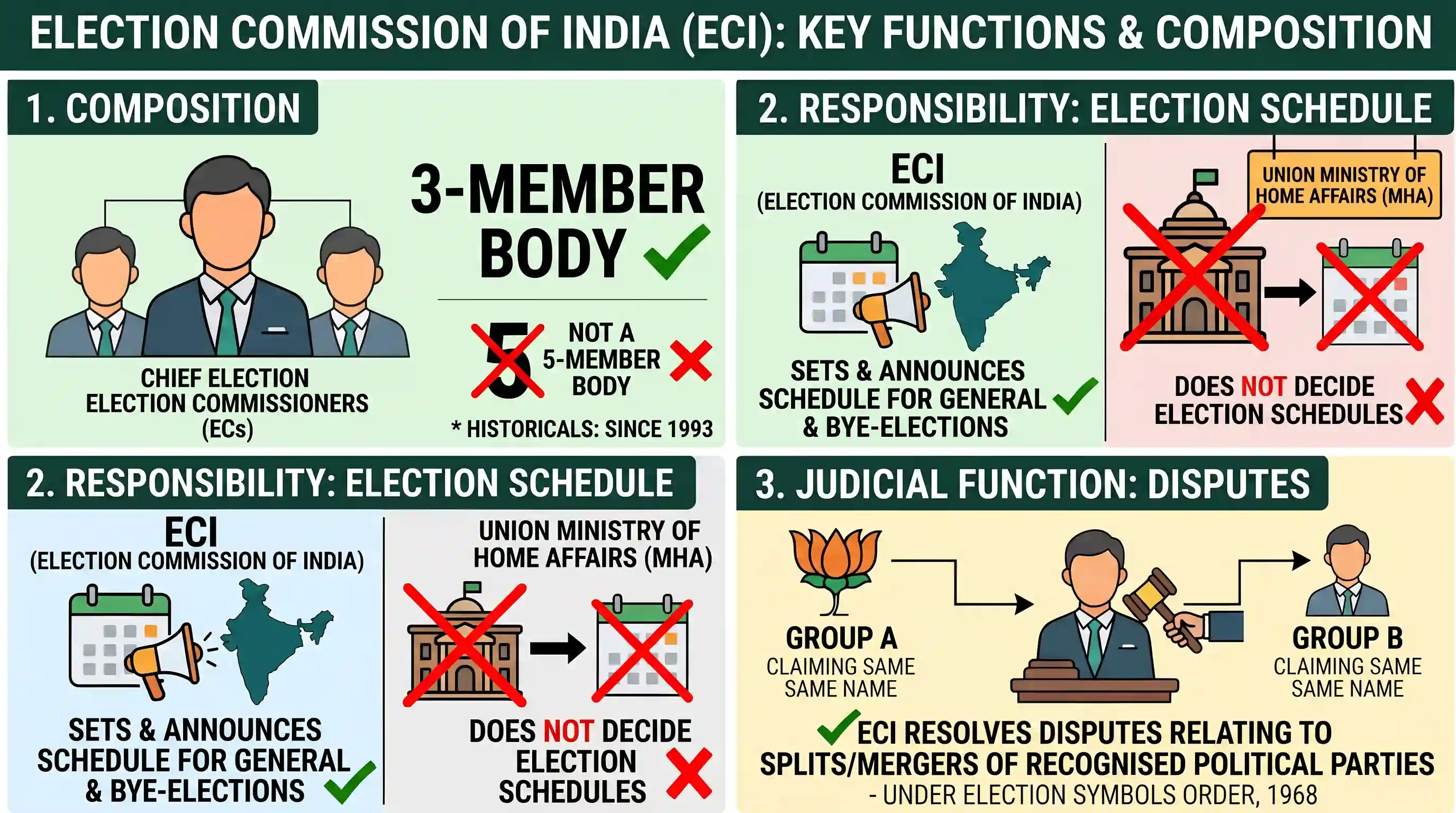
The Election Commission of India is a five-member body. This statement is incorrect. The Election Commission of India typically comprises a Chief Election Commissioner (CEC) and two Election Commissioners (ECs), making it a three-member body. The number of Election Commissioners can be fixed by the President, but it has generally been a three-member body since 1993.
-
Union Ministry of Home Affairs decides the election schedule for the conduct of both general elections and bye-elections. This statement is incorrect. The Election Commission of India is an autonomous constitutional body responsible for the superintendence, direction, and control of the preparation of electoral rolls and the conduct of all elections to Parliament, State Legislatures, and the offices of President and Vice-President. It is the ECI, not the Union Ministry of Home Affairs, that decides and announces the election schedule for both general elections and bye-elections.
-
Election Commission resolves the disputes relating to splits/mergers of recognised political parties. This statement is correct. Under the Election Symbols (Reservation and Allotment) Order, 1968, the Election Commission of India has the power to decide disputes among rival groups or factions of a recognized political party claiming to be that party. This includes disputes arising from splits or mergers of political parties, and the ECI determines which faction is the 'real' party and allocates the symbol accordingly.
Therefore, only statement 3 is correct.
Related questions
More UPSC Prelims practice from the same subject and topic.
- Prelims 2017GS1polity-and-governance
Local self-government can be best explained as an exercise in
- Prelims 2017GS1polity-and-governance
With reference to the 'Prohibition of Benami Property Transactions Act, 1988 (PBPT Act)', consider the following statements: 1. A property transaction is not treated as a benami transaction if the own…
- Prelims 2017GS1polity-and-governance
Which of the following are the objectives of 'National Nutrition Mission'? 1. To create awareness relating to malnutrition among pregnant women and lactating mothers. 2. To reduce the incidence of ana…
- Prelims 2017GS1polity-and-governance
Who among the following can join the National Pension System (NPS)?
- Prelims 2017GS1polity-and-governance
According to the Wildlife (Protection) Act, 1972, which of the following animals cannot be hunted by any person except under some provisions provided by law? 1. Gharial 2. Indian wild ass 3. Wild buff…
- Prelims 2017GS1polity-and-governance
With reference to 'Quality Council of India (QCI)', consider the following statements: 1. QCI was set up jointly by the Government of India and the Indian Industry. 2. Chairman of QCI is appointed by …