In India, if a species of tortoise is declared protected under Schedule I of the Wildlife (Protection) Act, 1972, what does it imply?

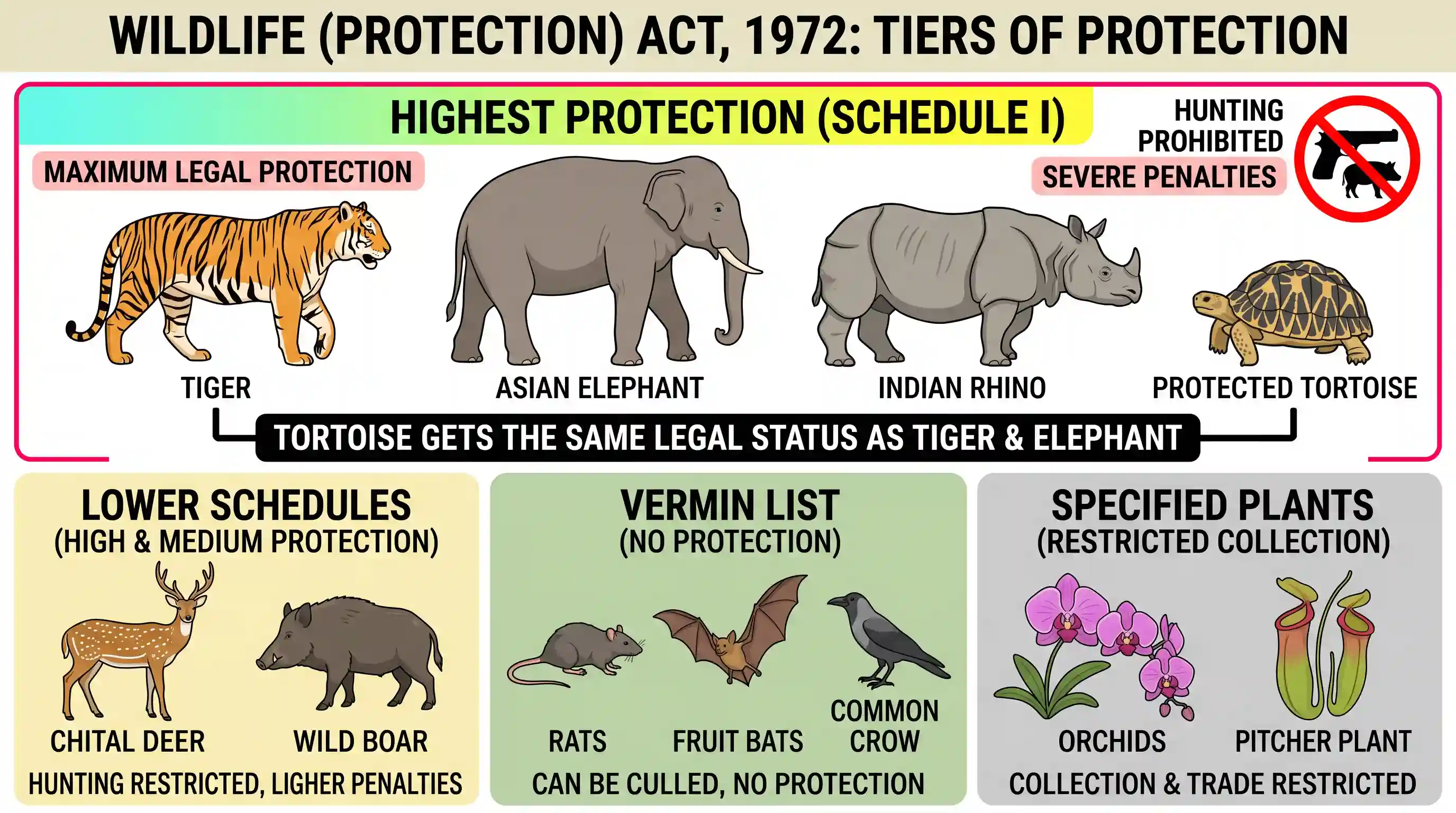
- AIt enjoys the same level of protection as the tiger.Correct
- BIt no longer exists in the wild, a few individuals are under captive protection; and now it is impossible to prevent its extinction.
- CIt is endemic to a particular region of India.
- DBoth (b) and (c) stated above are correct in this context.
Explanation
The Wildlife (Protection) Act, 1972, is India's comprehensive law for the protection of wild animals, birds, and plants. It categorizes protected species into six schedules, each offering different levels of protection.
Schedule I provides the highest level of protection under the Act. Species listed in Schedule I are considered critically endangered or highly endangered, and their hunting (poaching) is strictly prohibited, attracting the most severe penalties. This schedule includes iconic species like tigers, elephants, and rhinoceroses, among others.
Therefore, if a species of tortoise is declared protected under Schedule I, it implies that it receives the maximum legal protection available under the Act, equivalent to that afforded to a tiger or any other highly protected animal.
Options (b) and (c) are incorrect. Being listed in Schedule I does not imply extinction in the wild or endemicity to a particular region; it solely indicates the level of protection provided by the law.
Related questions
More UPSC Prelims practice from the same subject and topic.
- Prelims 2017GS1polity-and-governance
Local self-government can be best explained as an exercise in
- Prelims 2017GS1polity-and-governance
With reference to the 'Prohibition of Benami Property Transactions Act, 1988 (PBPT Act)', consider the following statements: 1. A property transaction is not treated as a benami transaction if the own…
- Prelims 2017GS1polity-and-governance
Which of the following are the objectives of 'National Nutrition Mission'? 1. To create awareness relating to malnutrition among pregnant women and lactating mothers. 2. To reduce the incidence of ana…
- Prelims 2017GS1polity-and-governance
Who among the following can join the National Pension System (NPS)?
- Prelims 2017GS1polity-and-governance
According to the Wildlife (Protection) Act, 1972, which of the following animals cannot be hunted by any person except under some provisions provided by law? 1. Gharial 2. Indian wild ass 3. Wild buff…
- Prelims 2017GS1polity-and-governance
With reference to 'Quality Council of India (QCI)', consider the following statements: 1. QCI was set up jointly by the Government of India and the Indian Industry. 2. Chairman of QCI is appointed by …