In India, Judicial Review implies

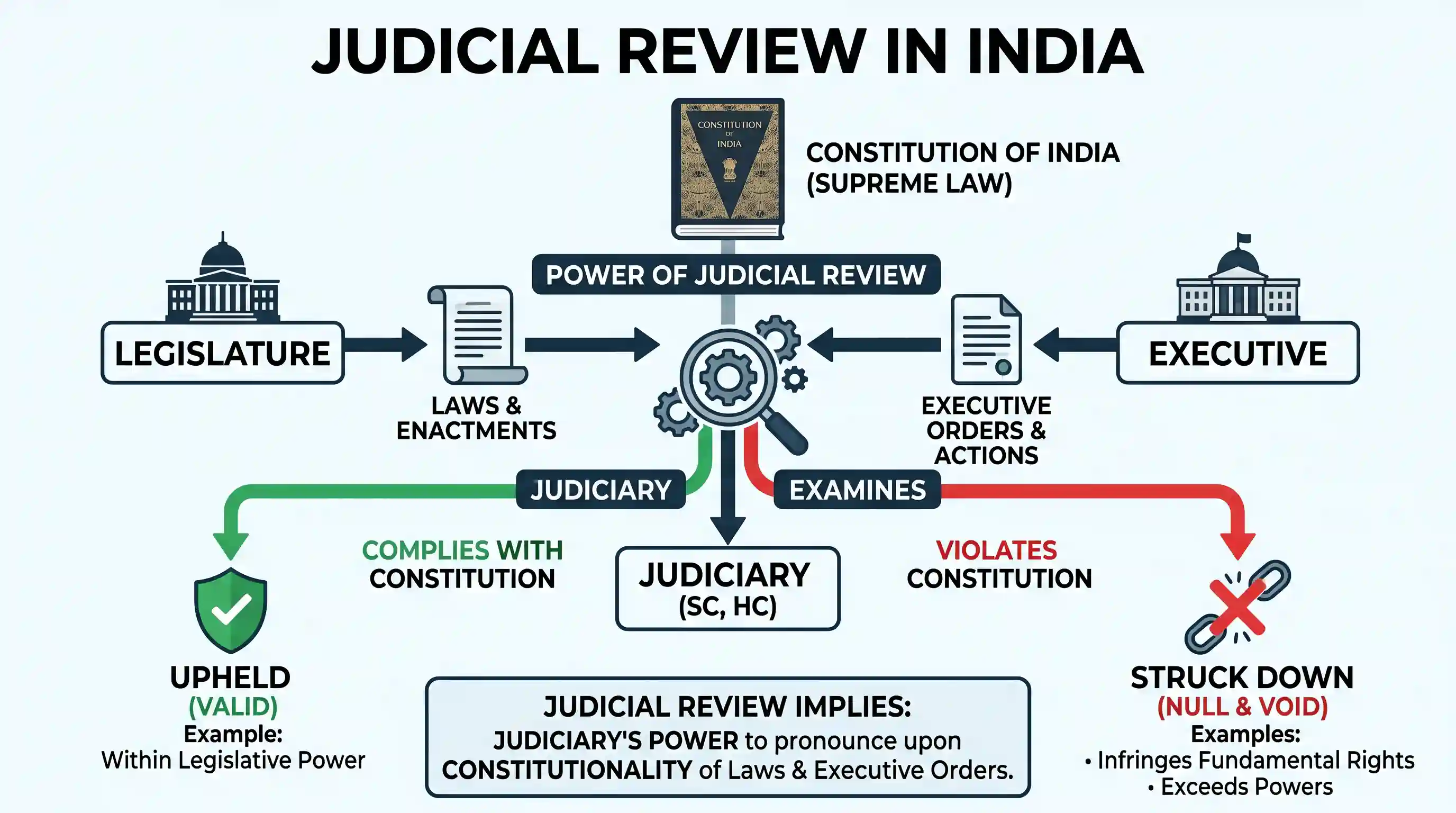
- Athe power of the Judiciary to pronounce upon the constitutionality of laws and executive orders.Correct
- Bthe power of the Judiciary to question the wisdom of the laws enacted by the Legislatures.
- Cthe power of the Judiciary to review all the legislative enactments before they are assented to by the President.
- Dthe power of the Judiciary to review its own judgements given earlier in similar or different cases.
Explanation
Judicial Review is a fundamental feature of the Indian Constitution, deeply rooted in its structure and principles. It refers to the power of the Supreme Court and the High Courts to examine the constitutionality of legislative enactments and executive orders of both the Central and State governments.
If, upon examination, they find that any law or executive order violates the provisions of the Constitution (e.g., infringes on Fundamental Rights, exceeds the legislative competence of the body that enacted it, or goes against the basic structure of the Constitution), they can declare such a law or order as unconstitutional and, therefore, null and void.
The other options describe different aspects or misinterpretations of judicial power:
B) Questioning the wisdom of laws: Judicial review is about constitutionality, not the wisdom or policy desirability of a law, though sometimes the two can overlap.
C) Reviewing enactments before Presidential assent: Laws are reviewed after enactment, not before presidential assent.
D) Reviewing its own judgments: This is the power of 'review petition' or 'curative petition', a specific aspect of the judiciary's power, but not the primary meaning of 'Judicial Review' in the context of laws and executive orders.
Related questions
More UPSC Prelims practice from the same subject and topic.
- Prelims 2017GS1polity-and-governance
With reference to the Parliament of India, consider the following statements: 1. A private member's bill is a bill presented by a Member of Parliament who is not elected but only nominated by the Pres…
- Prelims 2017GS1polity-and-governance
One of the implications of equality in society is the absence of
- Prelims 2017GS1polity-and-governance
Which principle among the following was added to the Directive Principles of State Policy by the 42nd Amendment to the Constitution?
- Prelims 2017GS1polity-and-governance
Which one of the following statements is/are correct? A) Rights are claims of the State against the citizens. B) Rights are privileges which are incorporated in the Constitution of a State. C) Rights …
- Prelims 2017GS1polity-and-governance
Which of the following gives 'Global Gender Gap Index' ranking to the countries of the world?
- Prelims 2017GS1polity-and-governance
Local self-government can be best explained as an exercise in