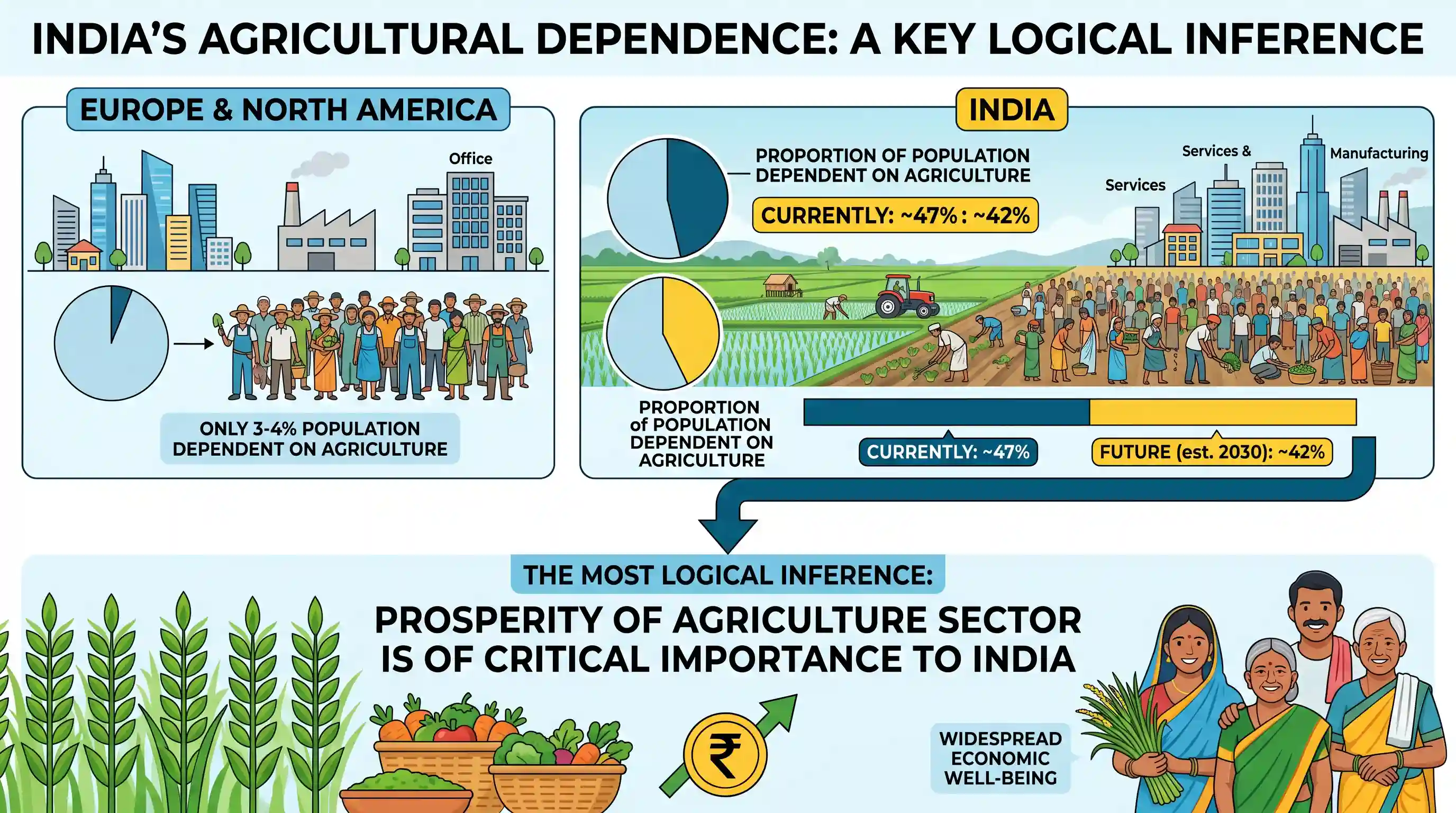
Global population was around 1.6 billion in 1990- today it is around 7.2 billion and growing. Recent estimates on population growth predict a global population of 9.6 billion in 2050 and 10.9 billion in 2100. Unlike Europe and North America, where only three to four per cent of population is engaged in agriculture, around 47 per cent of India's population is dependent upon agriculture. Even if India continues to do well in the service sector and the manufacturing sector picks up, it is expected that around 2030 when India overtakes China as the world's most populous country, nearly 42 per cent of India's population will still be predominantly dependent on agriculture. Which of the following is the most logical and rational inference that can be made from the above passage?

- AProsperity of agriculture sector is of critical importance to IndiaCorrect
- BIndian economy greatly depends on its agriculture
- CIndia should take strict measures to control its rapid population growth
- DIndia's farming communities should switch over to other occupations to improve their economic conditions.
Explanation
The passage highlights that a significant portion of India's population (47% currently, projected 42% in 2030) is and will remain dependent on agriculture.
Let's analyze the options:
A) Prosperity of agriculture sector is of critical importance to India This is a direct and logical inference. If nearly half of India's population depends on agriculture, then the well-being, livelihood, and economic stability of this massive segment of the population are directly tied to the prosperity of the agricultural sector. Therefore, the prosperity of this sector becomes critically important for the entire nation.
B) Indian economy greatly depends on its agriculture While related, this option focuses on the "economy" as a whole. The passage specifically emphasizes the percentage of population dependent on agriculture, not necessarily the sector's overall contribution to GDP (which is a different metric). While a large dependent population implies economic importance, option A is a more direct inference about the implications for India given the human dependency highlighted. The prosperity of the sector directly impacts the people dependent on it, making it critically important for the nation.
C) India should take strict measures to control its rapid population growth The passage mentions India's population growth as context, but the core argument about India is its large population's dependence on agriculture. This option proposes a solution (population control) rather than inferring a critical aspect from the given facts about agricultural dependency. It's an external suggestion, not a direct inference about the importance of agriculture itself.
D) India's farming communities should switch over to other occupations to improve their economic conditions. This is a prescriptive suggestion or a proposed solution, not a logical inference from the provided facts. The passage states that a large percentage will still be dependent on agriculture even with growth in other sectors. It doesn't suggest that switching occupations is the only or best way to improve conditions, nor does it imply this is a feasible solution for such a vast population.
Conclusion: Option A is the most logical and rational inference because the passage explicitly states that a very large percentage of India's population is dependent on agriculture. This directly implies that the health and prosperity of this sector are of critical importance to the nation's overall well-being.
The final answer is A
Related questions
More UPSC Prelims practice from the same subject and topic.
- Prelims 2018CSATReading Comprehension
Many pathogens that cause foodborne illnesses are unknown. Food contamination can occur at any stage from farm to plate. Since most cases of food poisoning go unreported, the true extent of global foo…
- Prelims 2018CSATReading Comprehension
Though I have discarded much of past tradition and custom, and am anxious that India should rid herself of all shackles that bind and contain her and divide her people, and suppress vast numbers of th…
- Prelims 2018CSATReading Comprehension
I am a scientist, privileged to be somebody who tries to understand nature using the tools of science. But it is also clear that there are some really important questions that science cannot really an…
- Prelims 2018CSATReading Comprehension
It is no longer enough for us to talk about providing for universal access to education. Making available schooling facilities is an essential prerequisite, but is insufficient to ensure that all chil…
- Prelims 2018CSATReading Comprehension
It is no longer enough for us to talk about providing for universal access to education. Making available schooling facilities is an essential prerequisite, but is insufficient to ensure that all chil…
- Prelims 2018CSATReading Comprehension
It is no longer enough for us to talk about providing for universal access to education. Making available schooling facilities is an essential prerequisite, but is insufficient to ensure that all chil…