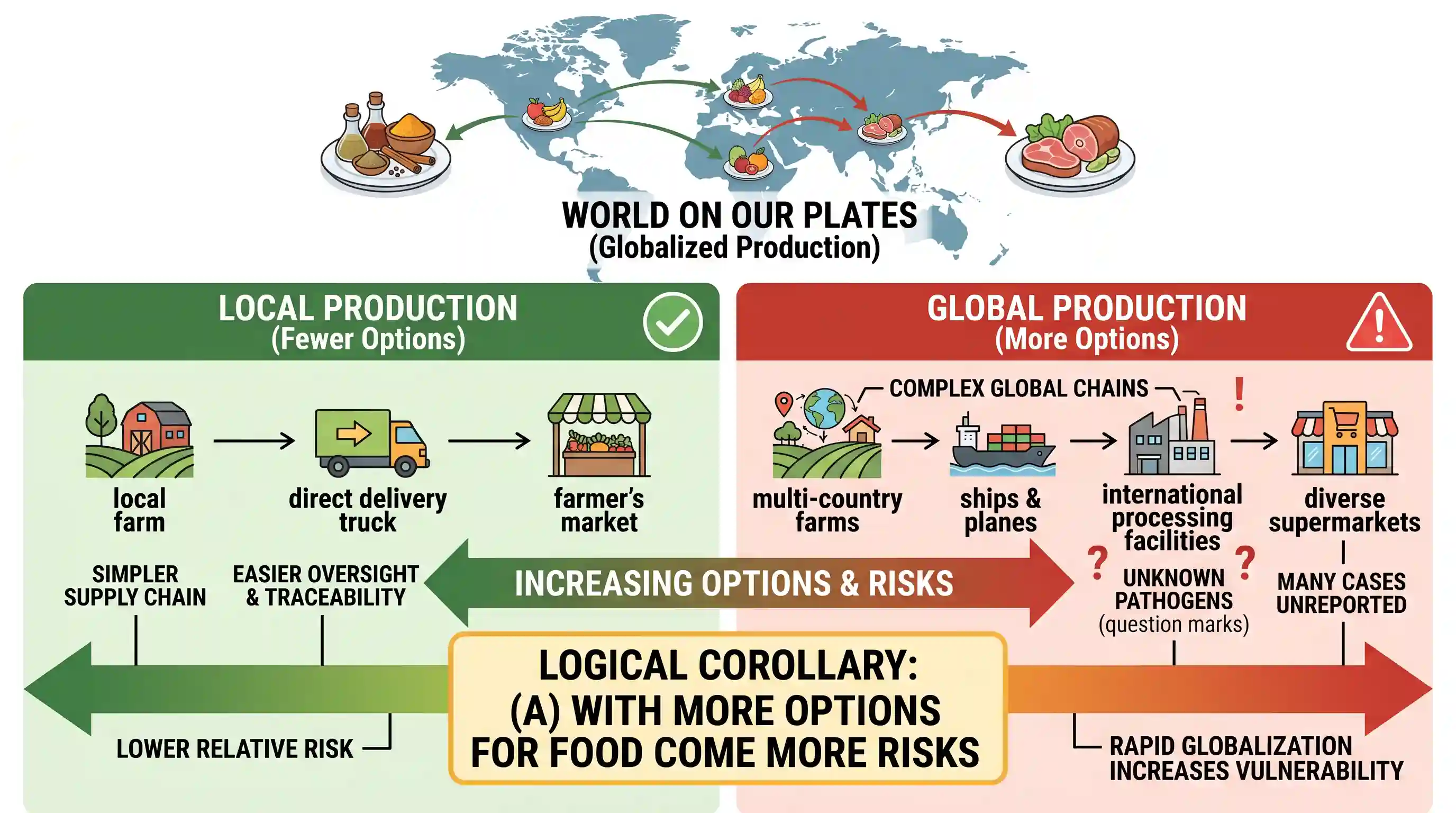
Many pathogens that cause foodborne illnesses are unknown. Food contamination can occur at any stage from farm to plate. Since most cases of food poisoning go unreported, the true extent of global foodborne illnesses is unknown. Improvements in international monitoring have led to greater public awareness, yet the rapid globalization of food production increases consumers' vulnerability by making food harder to regulate and trace. We have the world on our plates, says an official of WHO. Which of the following is the most logical corollary to the above passage?

- AWith more options for food come more risksCorrect
- BFood processing is the source of all foodborne illnesses
- CWe should depend on locally produced food only
- DGlobalization of food production should be curtailed.
Explanation
The passage highlights that the rapid globalization of food production means "we have the world on our plates," leading to increased consumer vulnerability because food becomes harder to regulate and trace.
Let's analyze the options:
A) With more options for food come more risks: This aligns perfectly with the passage. "More options for food" is a direct result of the "rapid globalization of food production" and "having the world on our plates." The passage explicitly states this globalization "increases consumers' vulnerability by making food harder to regulate and trace," which translates to "more risks." This is a logical consequence stated by the passage.
B) Food processing is the source of all foodborne illnesses: The passage states "Food contamination can occur at any stage from farm to plate." This contradicts the idea that processing is the sole source of all illnesses.
C) We should depend on locally produced food only: While the passage discusses problems with globalization, it does not prescribe a solution, especially not an exclusive one like depending only on local food. This is an inference about a potential solution, not a direct corollary of the given information.
D) Globalization of food production should be curtailed: Similar to C, this is a prescriptive recommendation or policy suggestion. The passage describes the negative effects of globalization but does not explicitly call for its curtailment. A corollary should logically follow from the given facts, not necessarily propose a solution.
Therefore, A is the most logical corollary as it directly links the consequence of globalization (more options) to the stated problem (increased risks/vulnerability).
Related questions
More UPSC Prelims practice from the same subject and topic.
- Prelims 2018CSATReading Comprehension
Global population was around 1.6 billion in 1990- today it is around 7.2 billion and growing. Recent estimates on population growth predict a global population of 9.6 billion in 2050 and 10.9 billion …
- Prelims 2018CSATReading Comprehension
Though I have discarded much of past tradition and custom, and am anxious that India should rid herself of all shackles that bind and contain her and divide her people, and suppress vast numbers of th…
- Prelims 2018CSATReading Comprehension
I am a scientist, privileged to be somebody who tries to understand nature using the tools of science. But it is also clear that there are some really important questions that science cannot really an…
- Prelims 2018CSATReading Comprehension
It is no longer enough for us to talk about providing for universal access to education. Making available schooling facilities is an essential prerequisite, but is insufficient to ensure that all chil…
- Prelims 2018CSATReading Comprehension
It is no longer enough for us to talk about providing for universal access to education. Making available schooling facilities is an essential prerequisite, but is insufficient to ensure that all chil…
- Prelims 2018CSATReading Comprehension
It is no longer enough for us to talk about providing for universal access to education. Making available schooling facilities is an essential prerequisite, but is insufficient to ensure that all chil…