It is no longer enough for us to talk about providing for universal access to education. Making available schooling facilities is an essential prerequisite, but is insufficient to ensure that all children attend school and participate in the learning process. The school may be there, but children may not attend or they may drop out after a few months. Through school and social mapping, we must address the entire gamut of social, economic, cultural and indeed linguistic and pedagogic issues, factors that prevent children from weaker sections and disadvantaged groups, as also girls, from regularly attending and complementing elementary education. The focus must be on the poorest and most vulnerable since these groups are the most disempowered and at the greatest risk of violation or denial of their right to education. The right to education goes beyond free and compulsory education to include quality education for all. Quality is an integral part of the right to education. If the education process lacks quality, children are being denied their right. The Right of Children to Free and Compulsory Education Act lays down that the curriculum should provide for learning through activities, exploration and discovery. This places an obligation on us to change our perception of children as passive receivers of knowledge, and to move beyond the convention of using textbooks as the basis of examinations. The teaching- learning process must become stress- free; and a massive programme for curricular reform should be initiated to provide for a child- friendly learning system, that is more relevant and empowering. Teacher accountability systems and processes must ensure that children are learning, and that their right to learn in a child- friendly environment is not violated. Testing and assessment systems must be reexamined and redesigned to ensure that these do not force children to struggle between school and tuition centres, and bypass childhood. According to the passage, which one of the following is critical in bringing quality in education?

- AEnsuring regular attendance of children as well as teachers in school
- BGiving pecuniary benefits to teachers to motivate them
- CUnderstanding the socio-cultural background of children
- DInculcating learning through activities and discoveryCorrect
Explanation
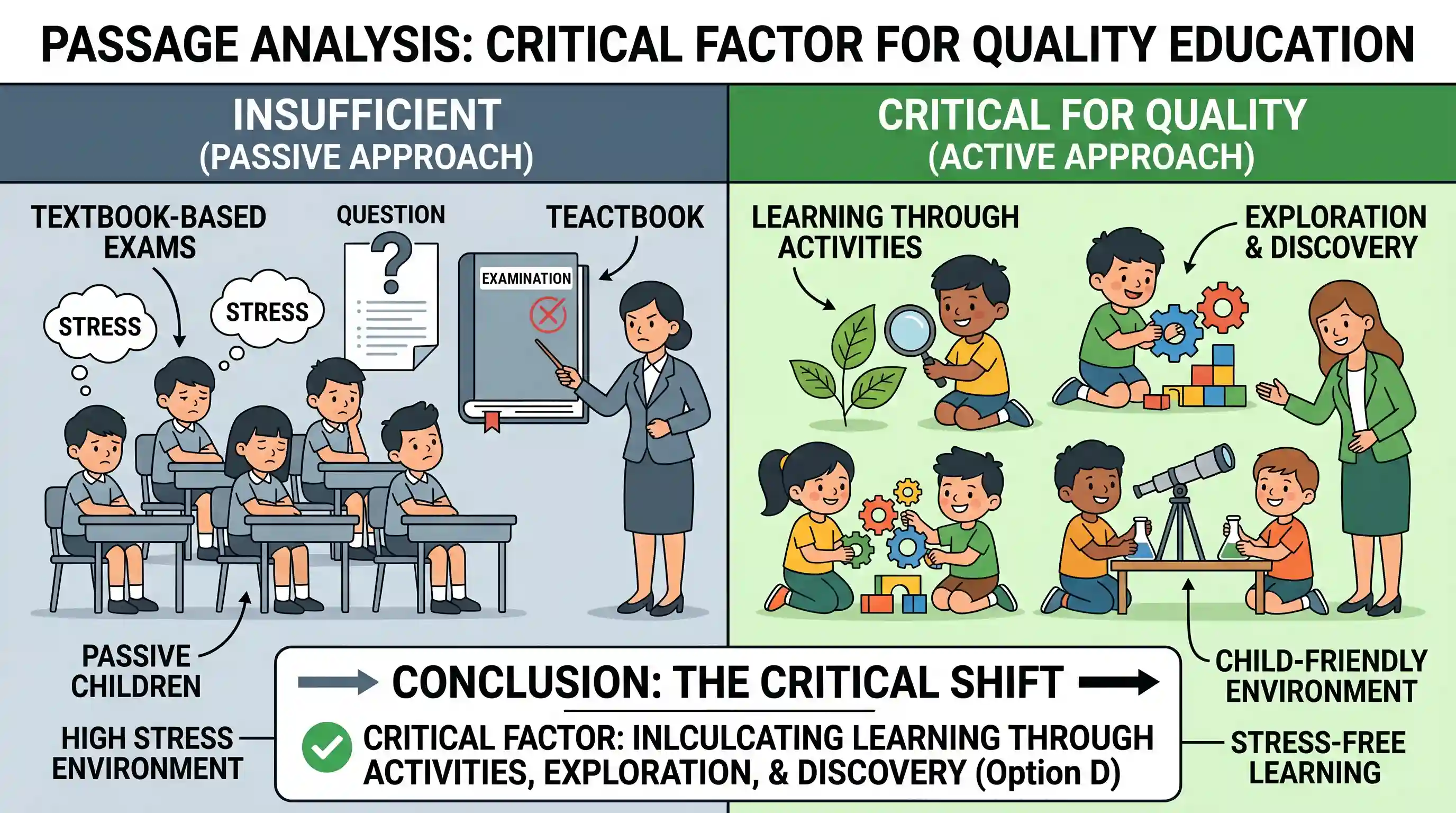
The passage explicitly states, "The Right of Children to Free and Compulsory Education Act lays down that the curriculum should provide for learning through activities, exploration and discovery. This places an obligation on us to change our perception of children as passive receivers of knowledge..." This directly follows the discussion about quality being an integral part of the right to education. Therefore, inculcating learning through activities and discovery is presented as a critical method for achieving quality education.
Analysis of options: A) Ensuring regular attendance of children as well as teachers in school: The passage mentions addressing factors that prevent children from regularly attending, but this is presented as a prerequisite for children to receive education, not the critical factor for quality within the learning process itself. Teacher accountability is mentioned, but not specifically regular attendance as the critical driver of quality. B) Giving pecuniary benefits to teachers to motivate them: This is not mentioned anywhere in the passage. C) Understanding the socio-cultural background of children: The passage states that understanding socio-cultural issues is important for addressing factors that prevent children from regularly attending and completing elementary education. While important for access and retention, it's not highlighted as the critical element for quality of the learning process itself. D) Inculcating learning through activities and discovery: The passage directly links this pedagogical approach to the RTE Act and the need to change perceptions of learning, placing it as a core component of ensuring quality education.
Related questions
More UPSC Prelims practice from the same subject and topic.
- Prelims 2018CSATReading Comprehension
Global population was around 1.6 billion in 1990- today it is around 7.2 billion and growing. Recent estimates on population growth predict a global population of 9.6 billion in 2050 and 10.9 billion …
- Prelims 2018CSATReading Comprehension
Many pathogens that cause foodborne illnesses are unknown. Food contamination can occur at any stage from farm to plate. Since most cases of food poisoning go unreported, the true extent of global foo…
- Prelims 2018CSATReading Comprehension
Though I have discarded much of past tradition and custom, and am anxious that India should rid herself of all shackles that bind and contain her and divide her people, and suppress vast numbers of th…
- Prelims 2018CSATReading Comprehension
I am a scientist, privileged to be somebody who tries to understand nature using the tools of science. But it is also clear that there are some really important questions that science cannot really an…
- Prelims 2018CSATReading Comprehension
It is no longer enough for us to talk about providing for universal access to education. Making available schooling facilities is an essential prerequisite, but is insufficient to ensure that all chil…
- Prelims 2018CSATReading Comprehension
It is no longer enough for us to talk about providing for universal access to education. Making available schooling facilities is an essential prerequisite, but is insufficient to ensure that all chil…