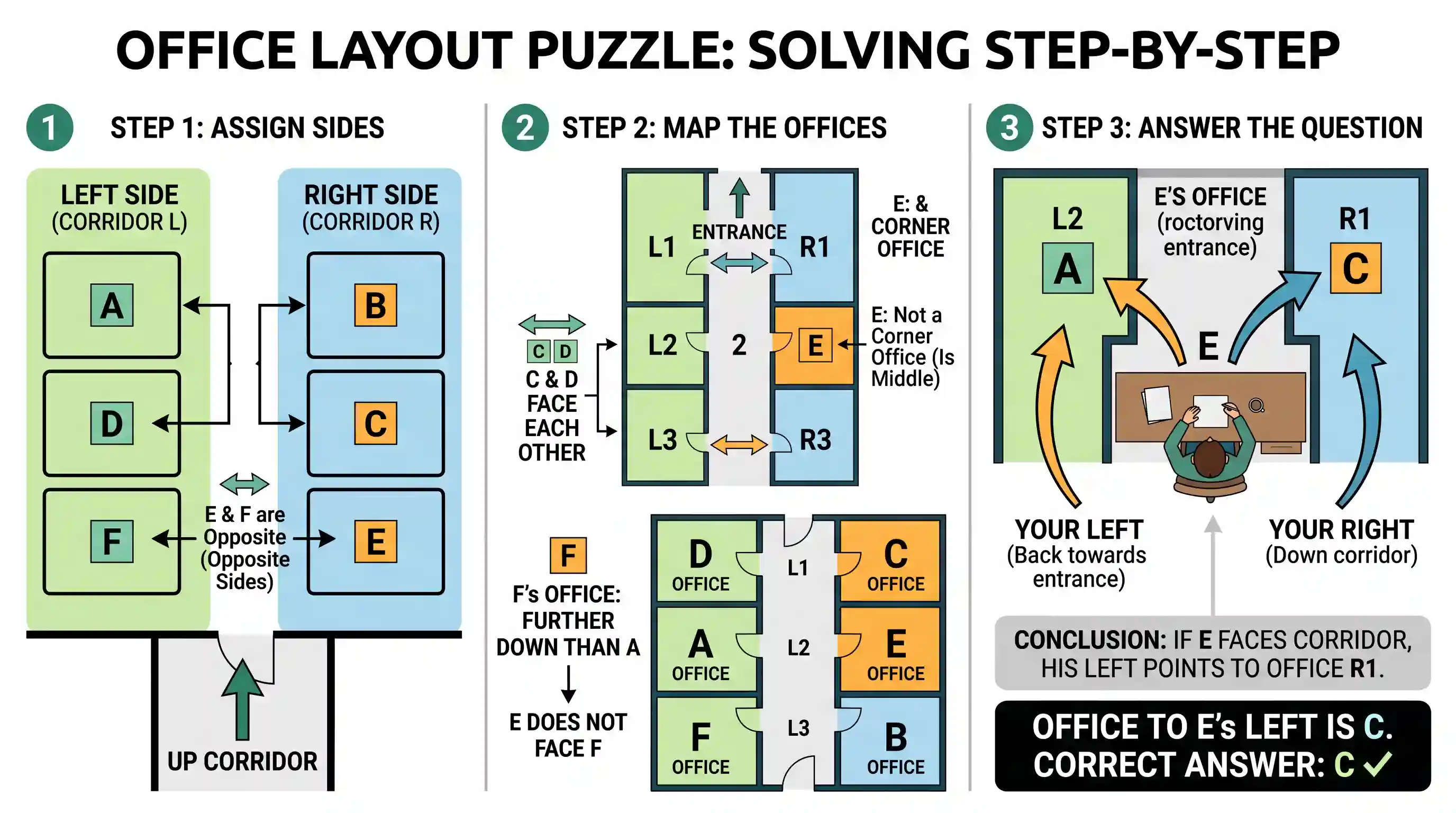
The plan of an office block for six officers A, B, C, D, E and F is as follows: Both B and C occupy offices to the right of the corridor (as one enters the office block) and A occupies on the left of the corridor. E and F occupy offices on opposite sides of the corridor but their offices do not face each other. The offices of C and D face each other. E does not have a corner office. F's office is further down the corridor than A's, but on the same side. If E sits in his office and faces the corridor, whose office is to his left?

- AA
- BB
- CCCorrect
- DD
Explanation
Let's break down the office layout step-by-step:
-
Officers on each side:
- B and C are on the Right side of the corridor (R).
- A is on the Left side of the corridor (L).
- F's office is on the same side as A (L). So, F is on the Left side.
- E and F are on opposite sides. Since F is on L, E must be on R.
- C and D face each other. Since C is on R, D must be on L.
- Summary: Left Side (L): A, D, F. Right Side (R): B, C, E.
-
E's position:
- E does not have a corner office. This implies there are at least three offices on E's side (R), and E occupies the middle one. Let's assume offices are numbered 1, 2, 3 along the corridor. So, E is in R2.
-
C and D's positions:
- C and D face each other, meaning they are at the same office number across the corridor (e.g., L1 faces R1, L2 faces R2, L3 faces R3).
- Since E is at R2, C cannot be at R2. So C is either R1 or R3.
- F does not face E. Since E is at R2, F cannot be at L2. So F is either L1 or L3.
-
F and A's positions:
- F's office is further down the corridor than A's, on the same side (L). This means A comes before F on the Left side.
-
Constructing the layout (Trial 1):
- Assume C is at R1. Then D must be at L1 (as they face each other).
- Current layout: L1: D | R1: C L2: ? | R2: E L3: ? | R3: ?
- On the Left side, we have A and F remaining. F cannot be L2 (as F does not face E). So F must be L3.
- If F is L3, then A must be L2 (since A comes before F).
- On the Right side, B is the only officer remaining, so B must be at R3.
- Proposed Layout: Side L | Side R Office 1: D | C Office 2: A | E Office 3: F | B
-
Verify the layout:
- B, C on R (C at R1, B at R3) - Yes.
- A on L (A at L2) - Yes.
- E, F opposite sides (E at R2, F at L3) - Yes.
- E, F offices do not face each other (R2 and L3 don't face) - Yes.
- C, D face each other (C at R1, D at L1) - Yes.
- E does not have a corner office (E at R2 is a middle office) - Yes.
- F's office further down than A's, same side (F at L3 is further down than A at L2) - Yes.
- This layout is consistent with all conditions.
-
Answer the question:
- "If E sits in his office and faces the corridor, whose office is to his left?"
- E is in Office R2. If E faces the corridor, he is looking across towards the Left side (L).
- From E's perspective, looking out into the corridor:
- His left is towards Office R1.
- His right is towards Office R3.
- Office R1 is occupied by C.
Therefore, C's office is to E's left.
The final answer is C
Related questions
More UPSC Prelims practice from the same subject and topic.
- Prelims 2018CSATLogical Reasoning
The plan of an office block for six officers A, B, C, D, E and F is as follows: Both B and C occupy offices to the right of the corridor (as one enters the office block) and A occupies on the left of …
- Prelims 2018CSATLogical Reasoning
A, B, C and D are students. They are studying in four different cities, viz., P, Q, R and S (not necessarily in that order). They are studying in Science college, Arts college, Commerce college and En…
- Prelims 2018CSATLogical Reasoning
A, B, C and D are students. They are studying in four different cities, viz., P, Q, R and S (not necessarily in that order). They are studying in Science college, Arts college, Commerce college and En…
- Prelims 2018CSATLogical Reasoning
A, B, C and D are students. They are studying in four different cities, viz., P, Q, R and S (not necessarily in that order). They are studying in Science college, Arts college, Commerce college and En…
- Prelims 2018CSATLogical Reasoning
A, B, C and D are students. They are studying in four different cities, viz., P, Q, R and S (not necessarily in that order). They are studying in Science college, Arts college, Commerce college and En…
- Prelims 2018CSATLogical Reasoning
A, B, C and D are students. They are studying in four different cities, viz., P, Q, R and S (not necessarily in that order). They are studying in Science college, Arts college, Commerce college and En…