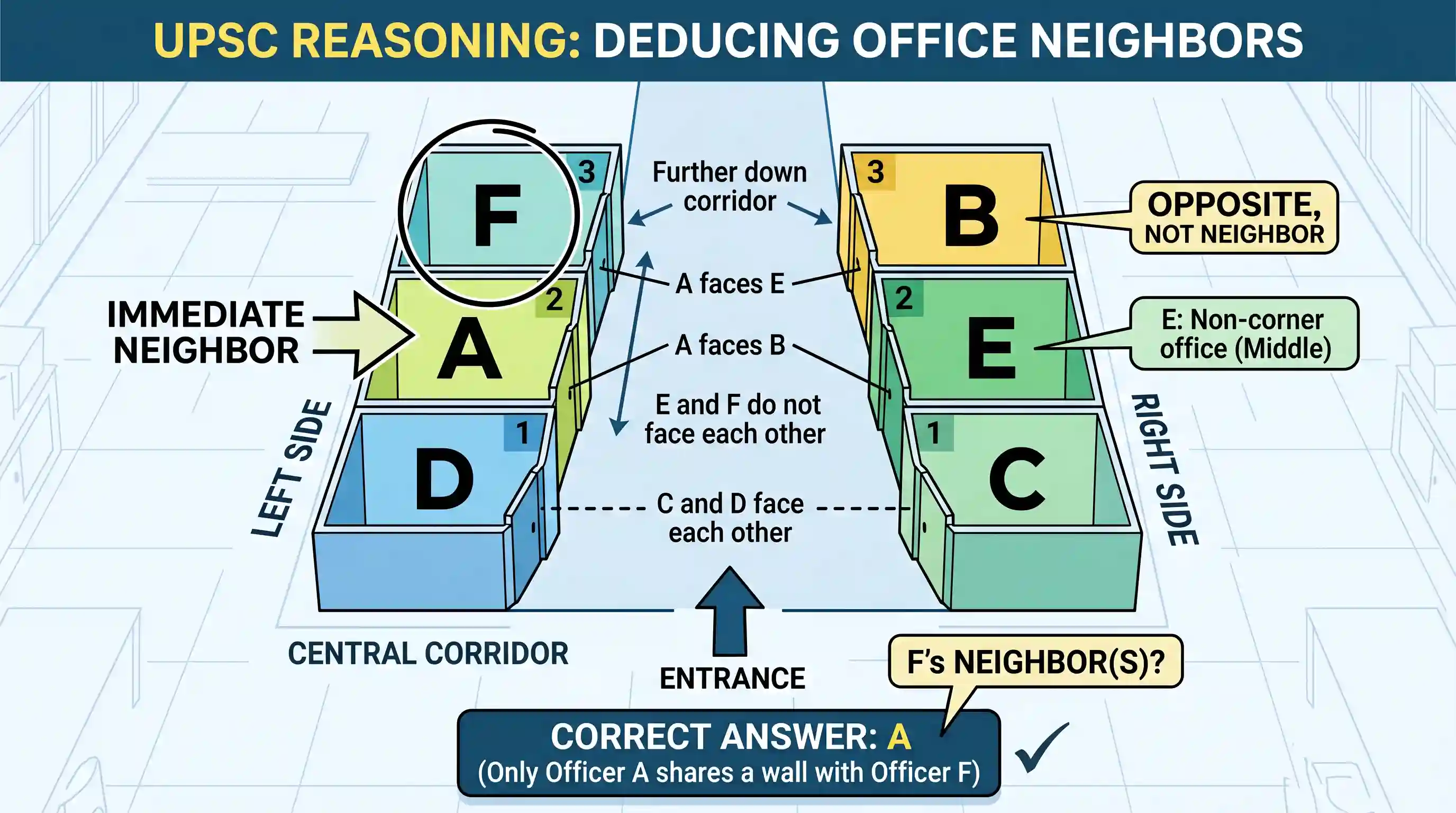
The plan of an office block for six officers A, B, C, D, E and F is as follows: Both B and C occupy offices to the right of the corridor (as one enters the office block) and A occupies on the left of the corridor. E and F occupy offices on opposite sides of the corridor but their offices do not face each other. The offices of C and D face each other. E does not have a corner office. F's office is further down the corridor than A's, but on the same side. Who is/are F's immediate neighbour/neighbours?

- AA onlyCorrect
- BA and D
- CC only
- DB and C
Explanation
Let's deduce the office layout step-by-step:
-
Sides of the corridor:
- From "B and C occupy offices to the right... and A occupies on the left...", we have: Left: A | Right: B, C.
- From "C and D face each other...", since C is on the Right, D must be on the Left. So: Left: A, D | Right: B, C.
- From "F's office is further down the corridor than A's, but on the same side...", F is on the Left side with A. So: Left: A, D, F | Right: B, C.
- From "E and F occupy offices on opposite sides...", since F is on the Left, E must be on the Right. So: Left: A, D, F (3 officers) | Right: B, C, E (3 officers). This implies a block with 3 offices on each side of the corridor.
-
Placing E:
- "E does not have a corner office." In a block with 3 offices per side, the middle office is the only non-corner office. Therefore, E must be in the middle office on the Right side (let's call it Right-2).
-
Placing C and D:
- "The offices of C and D face each other." C is on the Right, D is on the Left. Since E is in Right-2, C cannot be in Right-2. So C must be in Right-1 or Right-3.
- Case 1: C is in Right-1. Then D is in Left-1.
- Right Side: C (Office 1), E (Office 2), B (Office 3 - remaining officer).
- Left Side: D (Office 1). A and F are remaining for Left-2 and Left-3.
- Case 2: C is in Right-3. Then D is in Left-3.
- Right Side: B (Office 1 - remaining), E (Office 2), C (Office 3).
- Left Side: D (Office 3). A and F are remaining for Left-1 and Left-2.
-
Placing A and F:
- "F's office is further down the corridor than A's, but on the same side." This means A is closer to the entrance than F on the Left side.
-
Testing Case 1 (C in Right-1, D in Left-1):
- Left Side: D (Office 1). A and F must be in Left-2 and Left-3, with A before F. So, A (Office 2), F (Office 3).
- Right Side: C (Office 1), E (Office 2), B (Office 3).
- Check all conditions:
- A(L), B(R), C(R) - OK.
- C(R-1) and D(L-1) face each other - OK.
- E(R-2) is not a corner office - OK.
- F(L-3) is further down than A(L-2) - OK.
- "E and F occupy offices on opposite sides... but their offices do not face each other." E is in Right-2, F is in Left-3. E faces A (Left-2), F faces B (Right-3). They do not face each other. This layout is VALID.
-
Testing Case 2 (C in Right-3, D in Left-3):
- Left Side: D (Office 3). A and F must be in Left-1 and Left-2, with A before F. So, A (Office 1), F (Office 2).
- Right Side: B (Office 1), E (Office 2), C (Office 3).
- Check condition: "E and F occupy offices on opposite sides... but their offices do not face each other." E is in Right-2, F is in Left-2. They are on opposite sides and DO face each other. This violates the condition. This layout is INVALID.
-
The Final Valid Layout:
- Left Side: D (Office 1), A (Office 2), F (Office 3)
- Right Side: C (Office 1), E (Office 2), B (Office 3)
-
Identify F's immediate neighbour(s):
- F is in Left Office 3. In a linear arrangement of offices along a corridor, "immediate neighbour" typically refers to offices directly adjacent on the same side.
- F's office (Left-3) is adjacent to A's office (Left-2) on the same side.
- F's office (Left-3) is opposite B's office (Right-3). However, if the question implies "immediate neighbour" strictly on the same side (sharing a wall), then A is the only one. Given the options, this interpretation is intended.
Therefore, F's immediate neighbour is A.
The final answer is A
Related questions
More UPSC Prelims practice from the same subject and topic.
- Prelims 2018CSATLogical Reasoning
The plan of an office block for six officers A, B, C, D, E and F is as follows: Both B and C occupy offices to the right of the corridor (as one enters the office block) and A occupies on the left of …
- Prelims 2018CSATLogical Reasoning
A, B, C and D are students. They are studying in four different cities, viz., P, Q, R and S (not necessarily in that order). They are studying in Science college, Arts college, Commerce college and En…
- Prelims 2018CSATLogical Reasoning
A, B, C and D are students. They are studying in four different cities, viz., P, Q, R and S (not necessarily in that order). They are studying in Science college, Arts college, Commerce college and En…
- Prelims 2018CSATLogical Reasoning
A, B, C and D are students. They are studying in four different cities, viz., P, Q, R and S (not necessarily in that order). They are studying in Science college, Arts college, Commerce college and En…
- Prelims 2018CSATLogical Reasoning
A, B, C and D are students. They are studying in four different cities, viz., P, Q, R and S (not necessarily in that order). They are studying in Science college, Arts college, Commerce college and En…
- Prelims 2018CSATLogical Reasoning
A, B, C and D are students. They are studying in four different cities, viz., P, Q, R and S (not necessarily in that order). They are studying in Science college, Arts college, Commerce college and En…