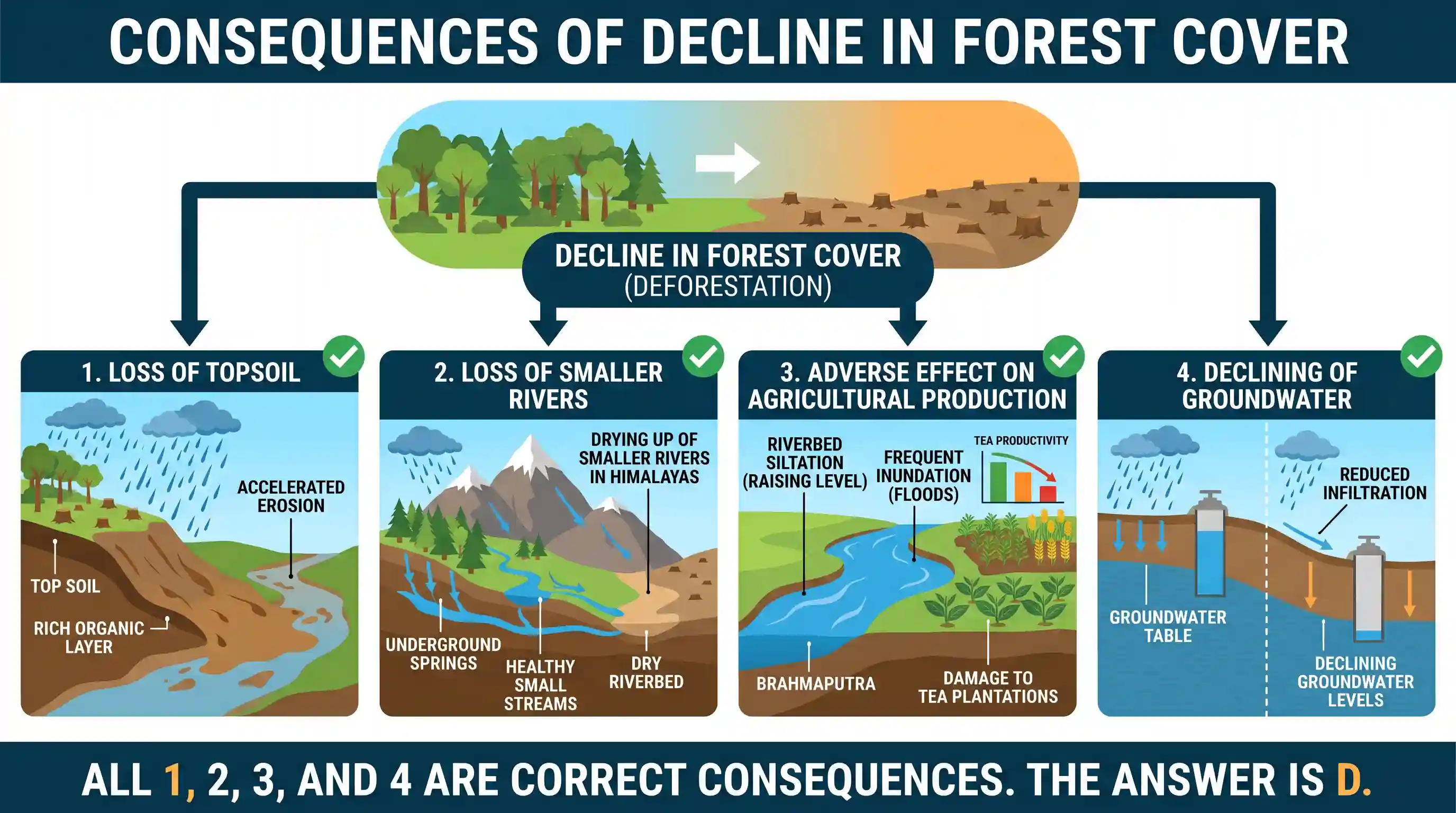
Desertification is a term used to explain a process of decline in the biological productivity of an ecosystem, leading to total loss of productivity. While this phenomenon is often linked to the arid, semi- arid and sub- humid ecosystems, even in the humid tropics, the impact could be most dramatic. Impoverishment of human- impacted terrestrial ecosystems may exhibit itself in a variety of ways: accelerated erosion as in the mountain regions of the country, salinization of land as in the semi- arid and arid 'green revolution' areas of the country, e.g., Haryana and western Uttar Pradesh, and site quality decline- a common phenomenon due to general decline in tree cover and monotonous monoculture of rice/wheat across the Indian plains. A major consequence of deforestation is that it relates to adverse alterations in the hydrology and related soil and nutrient losses. The consequences of deforestation invariably arise out of site degradation through erosive losses. Tropical Asia, Africa and South America have the highest levels of erosion. The already high rates for the tropics are increasing at an alarming rate (e.g., through the major river systems- Ganga and Brahmaputra, in the Indian context), due to deforestation and ill- suited land management practices subsequent to forest clearing. In the mountain context, the declining moisture retention of the mountain soils, drying up of the underground springs and smaller rivers in the Himalayan region could be attributed to drastic changes in the forest cover. An indirect consequence is drastic alteration in the upland- lowland interaction, mediated through water. The current concern the tea planter of Assam has is about the damage to tea plantations due to frequent inundation along the flood- plains of Brahmaputra, and the damage to tea plantation and the consequent loss in tea productivity is due to rising level of the river bottom because of siltation and the changing course of the river system. The ultimate consequences of site desertification are soil degradation, alteration in available water and its quality, and the consequent decline in food, fodder and fuel- wood yields essential for the economic well- being of rural communities. According to the passage, which of the following are the consequences of decline in forest cover? 1. Loss of topsoil 2. Loss of smaller rivers 3. Adverse effect on agricultural production 4. Declining of groundwater Select the correct answer using the code given below

- A1, 2 and 3 only
- B2, 3 and 4 only
- C1 and 4 only
- D1, 2, 3 and 4Correct
Explanation
The passage explicitly links the decline in forest cover to all four consequences:
- Loss of topsoil: The passage states, "The consequences of deforestation invariably arise out of site degradation through erosive losses." Erosion directly leads to the loss of topsoil.
- Loss of smaller rivers: The passage mentions, "drying up of the underground springs and smaller rivers in the Himalayan region could be attributed to drastic changes in the forest cover."
- Adverse effect on agricultural production: The passage discusses "damage to tea plantations due to frequent inundation along the flood-plains of Brahmaputra, and the damage to tea plantation and the consequent loss in tea productivity" due to deforestation-related issues. It also mentions "decline in food, fodder and fuel-wood yields."
- Declining of groundwater: The passage refers to "drying up of the underground springs" due to changes in forest cover. Underground springs are fed by groundwater, so their drying up indicates a decline in groundwater.
Since all four statements are directly supported by the text as consequences of declining forest cover, option D is correct.
Related questions
More UPSC Prelims practice from the same subject and topic.
- Prelims 2018CSATReading Comprehension
Global population was around 1.6 billion in 1990- today it is around 7.2 billion and growing. Recent estimates on population growth predict a global population of 9.6 billion in 2050 and 10.9 billion …
- Prelims 2018CSATReading Comprehension
Many pathogens that cause foodborne illnesses are unknown. Food contamination can occur at any stage from farm to plate. Since most cases of food poisoning go unreported, the true extent of global foo…
- Prelims 2018CSATReading Comprehension
Though I have discarded much of past tradition and custom, and am anxious that India should rid herself of all shackles that bind and contain her and divide her people, and suppress vast numbers of th…
- Prelims 2018CSATReading Comprehension
I am a scientist, privileged to be somebody who tries to understand nature using the tools of science. But it is also clear that there are some really important questions that science cannot really an…
- Prelims 2018CSATReading Comprehension
It is no longer enough for us to talk about providing for universal access to education. Making available schooling facilities is an essential prerequisite, but is insufficient to ensure that all chil…
- Prelims 2018CSATReading Comprehension
It is no longer enough for us to talk about providing for universal access to education. Making available schooling facilities is an essential prerequisite, but is insufficient to ensure that all chil…