A diversity of natural assets will be needed to cope with climate change and ensure productive agriculture, forestry, and fisheries. For example, crop varieties are needed that perform well under drought, heat, and enhanced CO_2 . But the private- sector and farmer- led process of choosing crops favours homogeneity adapted to past or current conditions, not varieties capable of producing consistently high yields in warmer, wetter, or drier conditions. Accelerated breeding programmes are needed to conserve a wider pool of genetic resources of existing crops, breeds, and their wild relatives. Relatively intact ecosystems, such as forested catchments, mangroves, wetlands, can buffer the impacts of climate change. Under a changing climate, these ecosystems are themselves at risk, and management approaches will need to be more proactive and adaptive. Connections between natural areas, such as migration corridors, may be needed to facilitate species movements to keep up with the change in climate. With reference to the above passage, the following assumptions have been made: 1. Diversification of livelihoods acts as a coping strategy for climate change. 2. Adoption of monopropping practice leads to the extinction of plant varieties and their wild relatives. Which of the above assumptions is/are valid?

- A1 only
- B2 only
- CBoth 1 and 2Correct
- DNeither 1 nor 2
Explanation
The passage supports both assumptions.
-
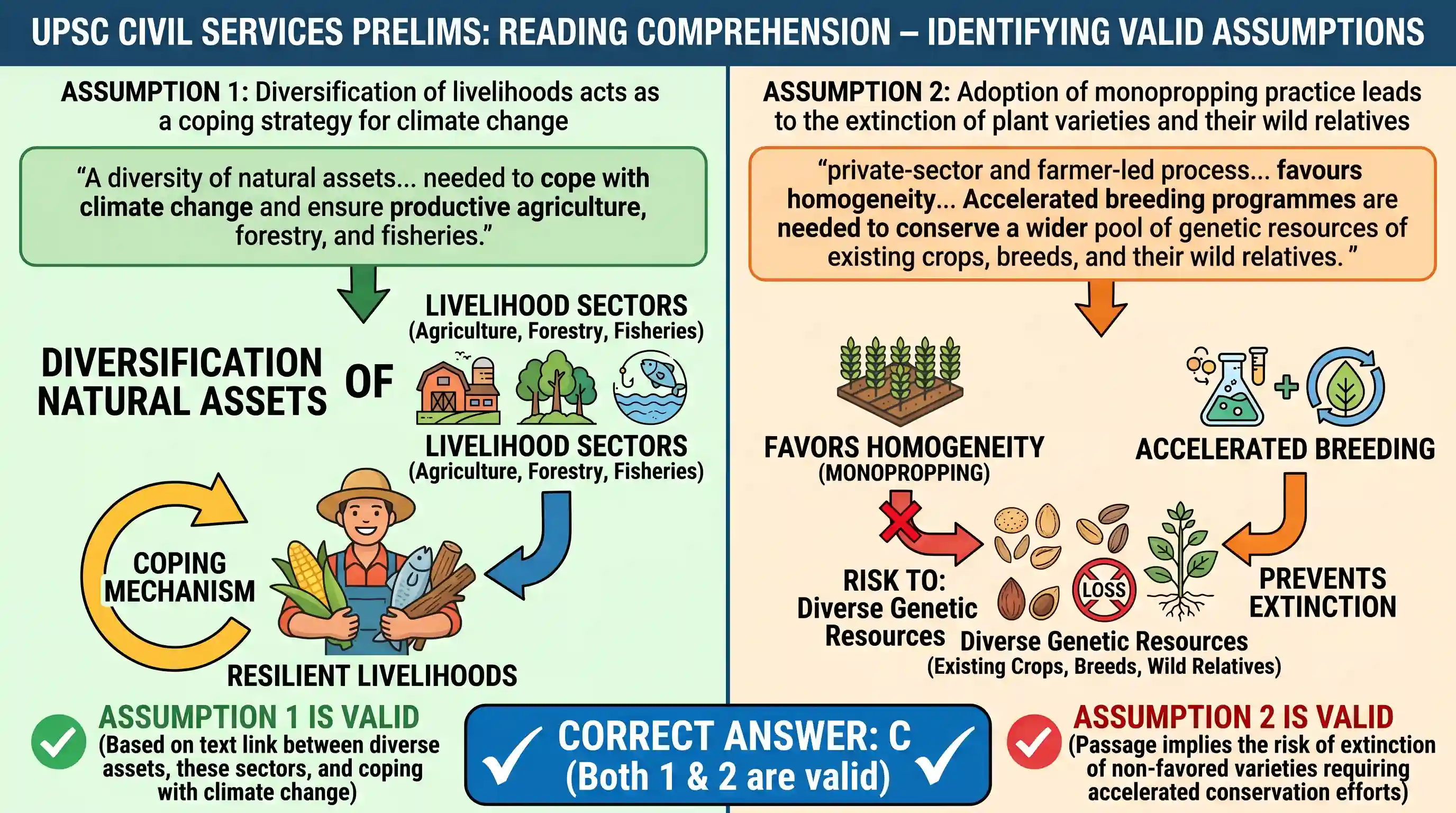
Diversification of livelihoods acts as a coping strategy for climate change. The passage states, "A diversity of natural assets will be needed to cope with climate change and ensure productive agriculture, forestry, and fisheries." Agriculture, forestry, and fisheries are key livelihood sectors. By promoting diversity in these sectors to cope with climate change and ensure productivity, the passage implicitly suggests that diversifying these livelihood bases acts as a coping strategy. If one crop fails due to climate change, a diverse set of crops or other natural assets provides resilience for the livelihood dependent on them.
-
Adoption of monopropping practice leads to the extinction of plant varieties and their wild relatives. The passage mentions that the "private-sector and farmer-led process of choosing crops favours homogeneity" (which is essentially monopropping or lack of diversity). It then immediately states that "Accelerated breeding programmes are needed to conserve a wider pool of genetic resources of existing crops, breeds, and their wild relatives." This implies that the practice of favoring homogeneity (monopropping) puts the diverse genetic resources (varieties and their wild relatives) at risk, necessitating conservation efforts. Without such conservation, these non-favored varieties face loss, which can lead to extinction.
Both statements are reasonable inferences drawn from the text.
The final answer is C
Related questions
More UPSC Prelims practice from the same subject and topic.
- Prelims 2018CSATReading Comprehension
Global population was around 1.6 billion in 1990- today it is around 7.2 billion and growing. Recent estimates on population growth predict a global population of 9.6 billion in 2050 and 10.9 billion …
- Prelims 2018CSATReading Comprehension
Many pathogens that cause foodborne illnesses are unknown. Food contamination can occur at any stage from farm to plate. Since most cases of food poisoning go unreported, the true extent of global foo…
- Prelims 2018CSATReading Comprehension
Though I have discarded much of past tradition and custom, and am anxious that India should rid herself of all shackles that bind and contain her and divide her people, and suppress vast numbers of th…
- Prelims 2018CSATReading Comprehension
I am a scientist, privileged to be somebody who tries to understand nature using the tools of science. But it is also clear that there are some really important questions that science cannot really an…
- Prelims 2018CSATReading Comprehension
It is no longer enough for us to talk about providing for universal access to education. Making available schooling facilities is an essential prerequisite, but is insufficient to ensure that all chil…
- Prelims 2018CSATReading Comprehension
It is no longer enough for us to talk about providing for universal access to education. Making available schooling facilities is an essential prerequisite, but is insufficient to ensure that all chil…