A number consists of three digits of which the middle one is zero and their sum is 4. If the number formed by interchanging the first and last digits is greater than the number itself by 198, then the difference between the first and last digits is

- A1
- B2Correct
- C3
- D4
Explanation
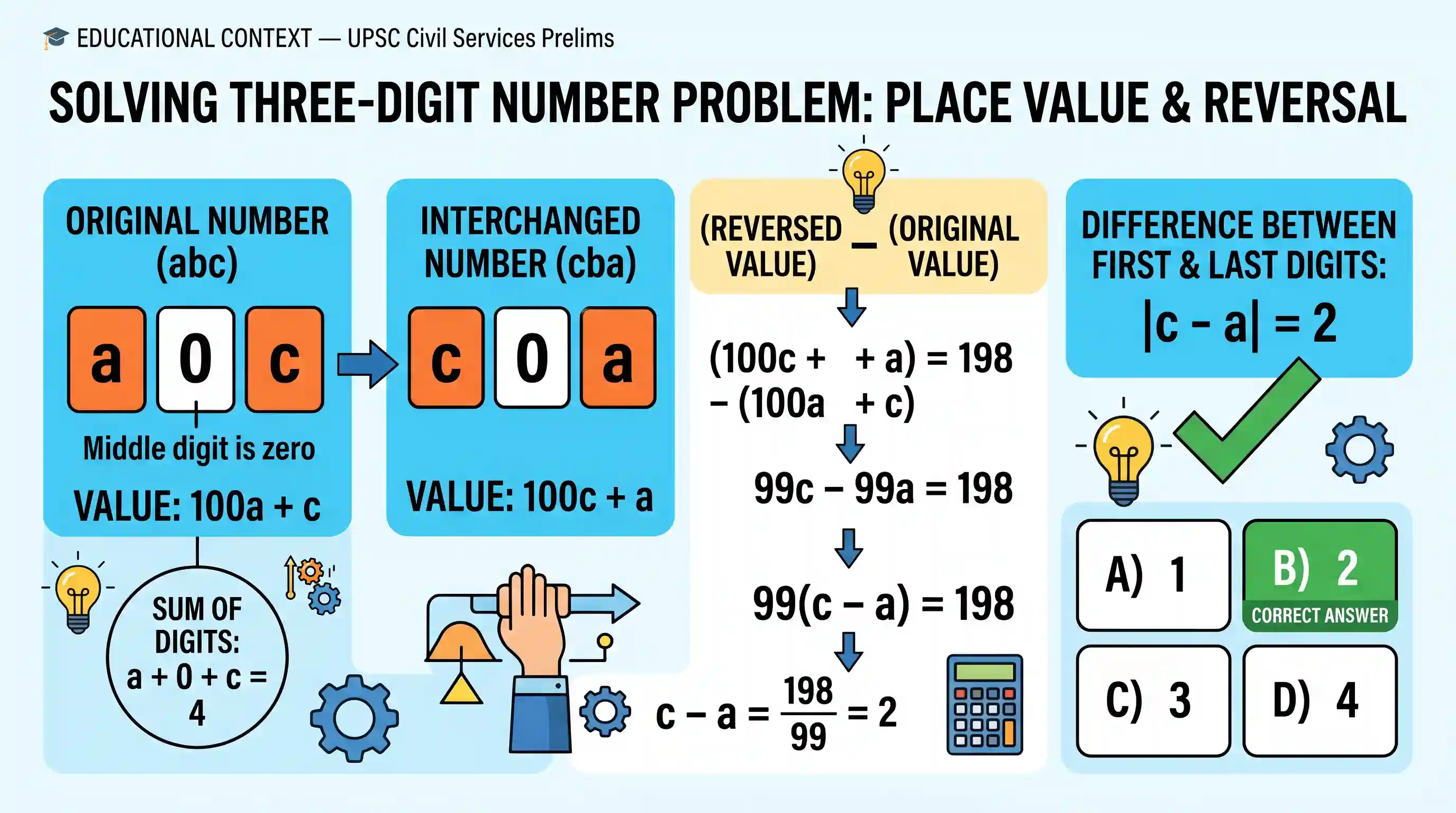
Let the three-digit number be represented as 100a + 10b + c, where a, b, and c are the digits.
- "the middle one is zero": So, b = 0. The number is 100a + c.
- "their sum is 4": a + b + c = 4. Since b = 0, we have a + c = 4.
- "interchanging the first and last digits": The new number is 100c + 10b + a. Since b = 0, the new number is 100c + a.
- "new number is greater than the number itself by 198": (100c + a) - (100a + c) = 198 100c + a - 100a - c = 198 99c - 99a = 198 99(c - a) = 198 c - a = 198 / 99 c - a = 2
The question asks for "the difference between the first and last digits", which is |c - a|. From our calculation, c - a = 2.
Therefore, the difference between the first and last digits is 2.
The final answer is B.
Related questions
More UPSC Prelims practice from the same subject and topic.
- Prelims 2018CSATQuantitative Aptitude
Consider the following sum: • +1• +2• +• 3 + • 1 = 21• In the above sum, • stands for
- Prelims 2018CSATQuantitative Aptitude
X and Y are natural numbers other than 1, and Y is greater than X. Which of the following represents the largest number?
- Prelims 2018CSATQuantitative Aptitude
While writing all the numbers from 700 to 1000, how many numbers occur in which the digit at hundred's place is greater than the digit at ten's place, and the digit at ten's place is greater than the …
- Prelims 2018CSATQuantitative Aptitude
How many diagonals can be drawn by joining the vertices of an octagon?
- Prelims 2018CSATQuantitative Aptitude
A train 200 metres long is moving at the rate of 40 kmph. In how many seconds will it cross a man standing near the railway line?
- Prelims 2018CSATQuantitative Aptitude
If X is between -3 and -1, and Y is between -1 and 1, then X ² - Y² is in between which of the following?