A solid cube of 3 cm side, painted on all its faces, is cut up into small cubes of 1 cm side. How many of the small cubes will have exactly two painted faces?

- A12Correct
- B8
- C6
- D4
Explanation
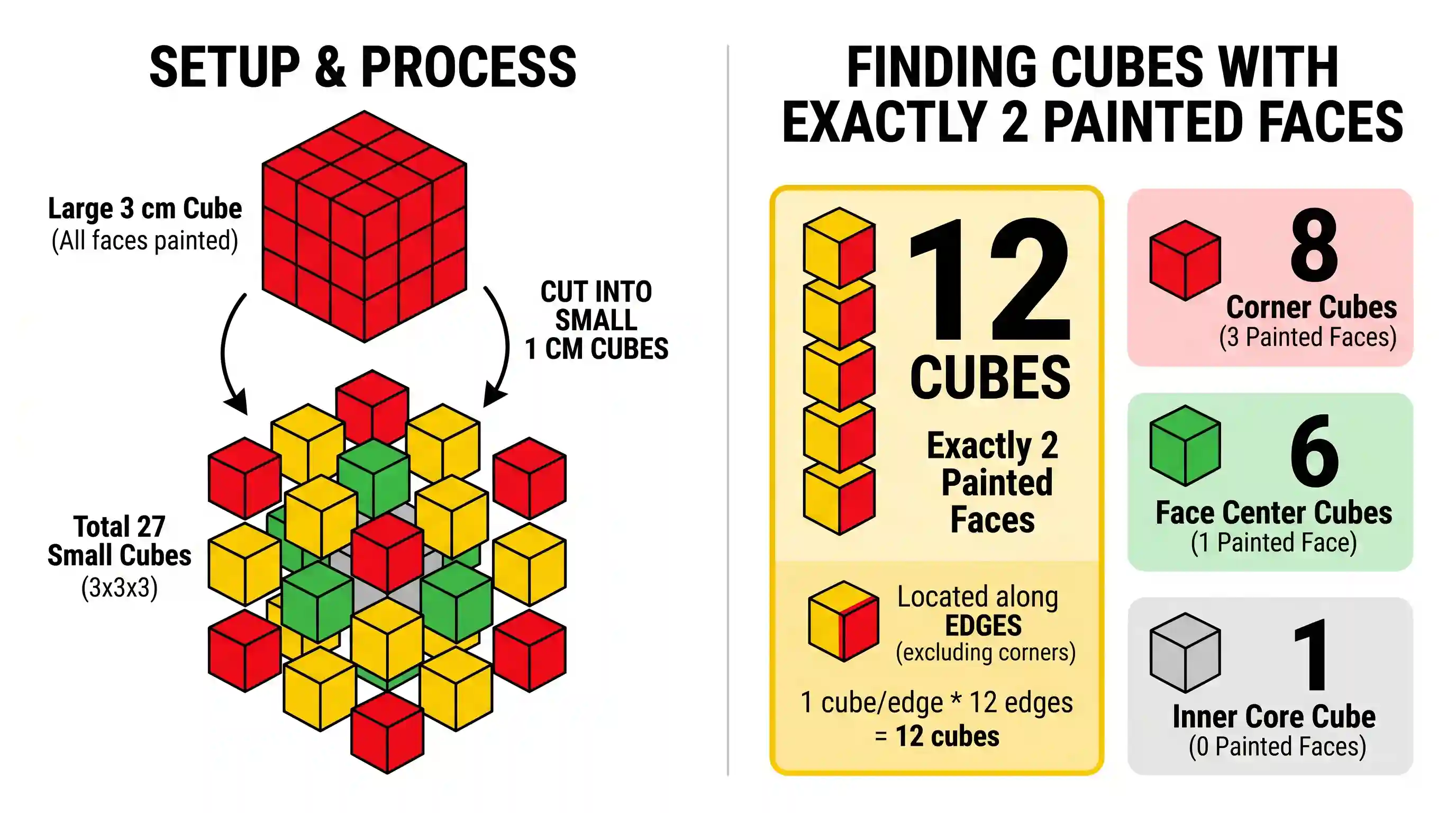
The large cube has a side of 3 cm and is cut into small cubes of 1 cm side. This means the large cube is divided into 3x3x3 = 27 smaller cubes.
Cubes with exactly two painted faces are located on the edges of the original large cube, but not at the corners.
- A cube has 12 edges.
- Each edge of the 3 cm cube contains 3 small cubes (since 3 cm / 1 cm = 3).
- The two cubes at the ends of each edge are corner cubes, which have three painted faces.
- Therefore, for each edge, the number of cubes with exactly two painted faces is (Total cubes along an edge) - (2 corner cubes) = 3 - 2 = 1 cube.
- Since there are 12 edges, the total number of small cubes with exactly two painted faces is 12 edges * 1 cube/edge = 12.
Analyzing the options: A) 12: This matches our calculation for cubes with exactly two painted faces. B) 8: This is the number of corner cubes, which have exactly three painted faces. C) 6: This is the number of cubes with exactly one painted face (1 cube per face * 6 faces). D) 4: This is not a direct category for a 3x3x3 cube.
The final answer is A.
Related questions
More UPSC Prelims practice from the same subject and topic.
- Prelims 2018CSATQuantitative Aptitude
How many diagonals can be drawn by joining the vertices of an octagon?
- Prelims 2018CSATQuantitative Aptitude
Twelve equal squares are placed to fit in a rectangle of diagonal 5 cm. There are three rows containing four squares each. No gaps are left between adjacent squares. What is the area of each square?
- Prelims 2018CSATQuantitative Aptitude
Consider the following sum: • +1• +2• +• 3 + • 1 = 21• In the above sum, • stands for
- Prelims 2018CSATQuantitative Aptitude
A train 200 metres long is moving at the rate of 40 kmph. In how many seconds will it cross a man standing near the railway line?
- Prelims 2018CSATQuantitative Aptitude
If X is between -3 and -1, and Y is between -1 and 1, then X ² - Y² is in between which of the following?
- Prelims 2018CSATQuantitative Aptitude
X and Y are natural numbers other than 1, and Y is greater than X. Which of the following represents the largest number?