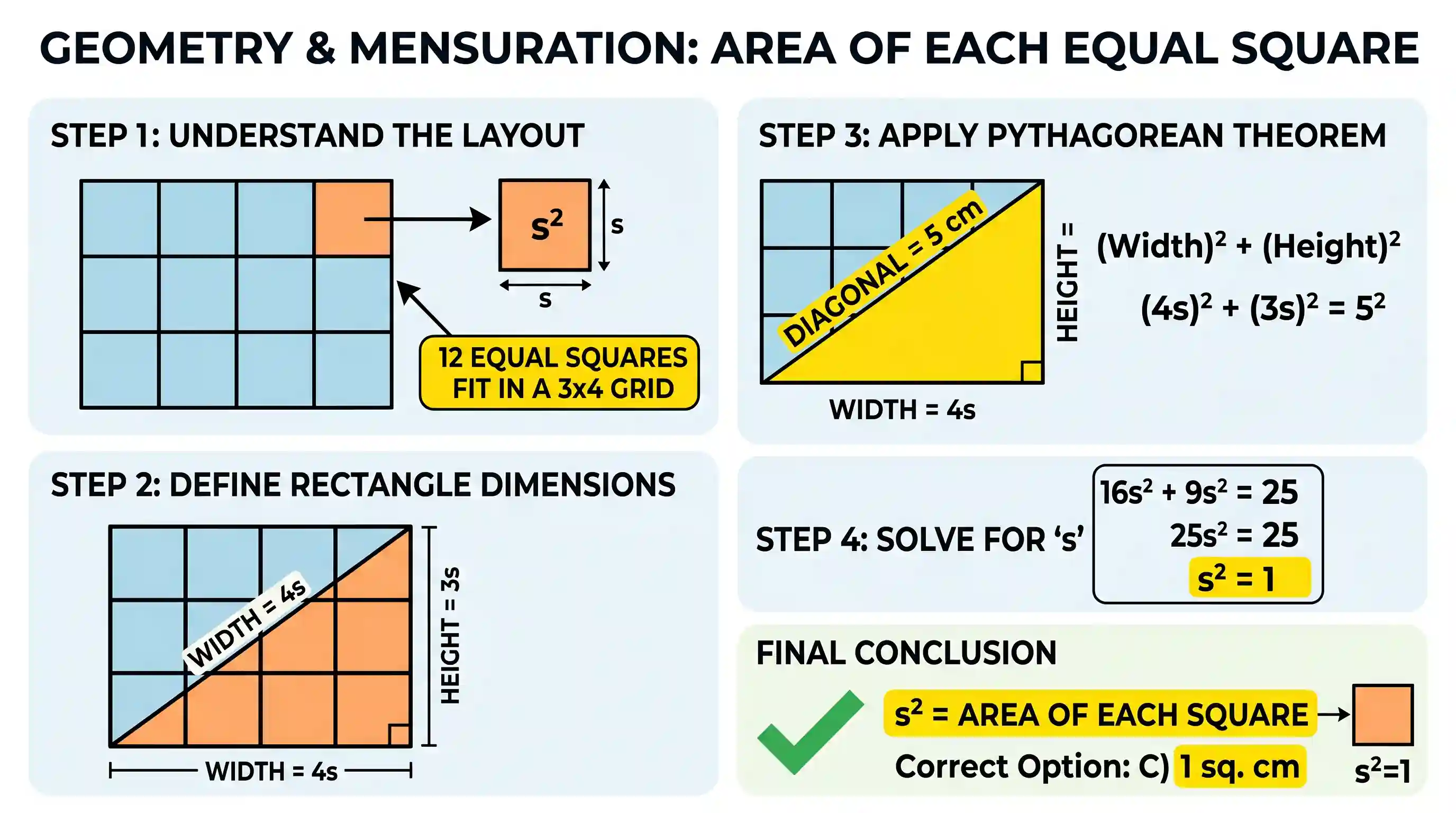
Twelve equal squares are placed to fit in a rectangle of diagonal 5 cm. There are three rows containing four squares each. No gaps are left between adjacent squares. What is the area of each square?

- A(5)/(7)sq.cm
- B(5)/(8)sq.cm
- C1 sq. cmCorrect
- D(25)/(12)sq.cm
Explanation
Let 's' be the side length of each equal square. The rectangle has 3 rows and 4 columns of squares. Therefore, the width of the rectangle is 4s. The height of the rectangle is 3s.
The diagonal of a rectangle can be found using the Pythagorean theorem: diagonal^2 = width^2 + height^2. We are given that the diagonal is 5 cm. So, 5^2 = (4s)^2 + (3s)^2 25 = 16s^2 + 9s^2 25 = 25s^2 s^2 = 25 / 25 s^2 = 1
The area of each square is s^2. Thus, the area of each square is 1 sq. cm.
Analyzing the options: A) (5)/(7)sq.cm - Incorrect. This value does not match our calculation. B) (5)/(8)sq.cm - Incorrect. This value does not match our calculation. C) 1 sq. cm - Correct. Our calculation shows the area of each square is 1 sq. cm. D) (25)/(12)sq.cm - Incorrect. This value does not match our calculation.
The final answer is C.
Related questions
More UPSC Prelims practice from the same subject and topic.
- Prelims 2018CSATQuantitative Aptitude
How many diagonals can be drawn by joining the vertices of an octagon?
- Prelims 2018CSATQuantitative Aptitude
A solid cube of 3 cm side, painted on all its faces, is cut up into small cubes of 1 cm side. How many of the small cubes will have exactly two painted faces?
- Prelims 2018CSATQuantitative Aptitude
Consider the following sum: • +1• +2• +• 3 + • 1 = 21• In the above sum, • stands for
- Prelims 2018CSATQuantitative Aptitude
A train 200 metres long is moving at the rate of 40 kmph. In how many seconds will it cross a man standing near the railway line?
- Prelims 2018CSATQuantitative Aptitude
If X is between -3 and -1, and Y is between -1 and 1, then X ² - Y² is in between which of the following?
- Prelims 2018CSATQuantitative Aptitude
X and Y are natural numbers other than 1, and Y is greater than X. Which of the following represents the largest number?