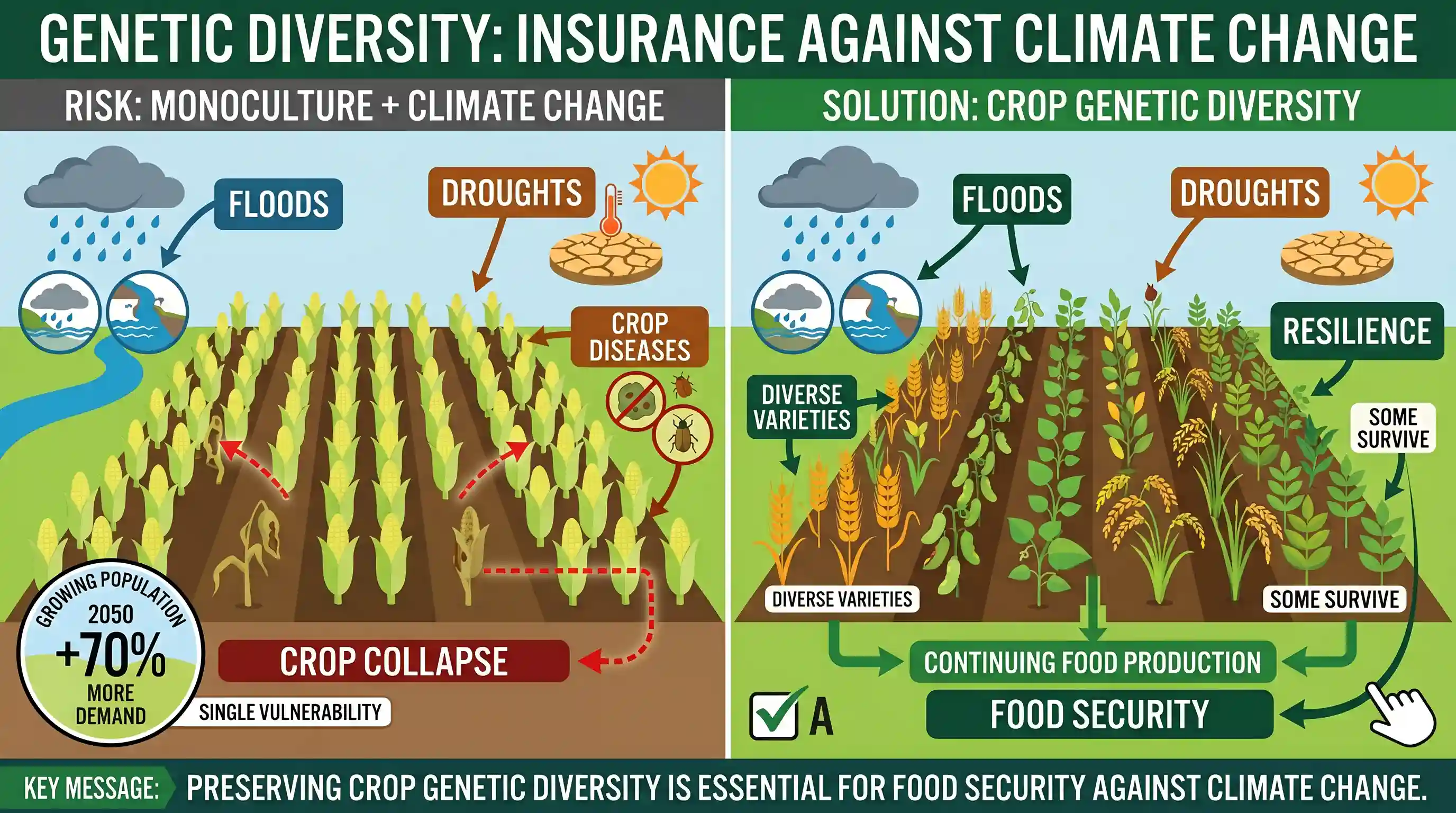
Monoculture carries great risks. A single disease or pest can wipe out swathes of the world's food production, an alarming prospect given that its growing and wealthier population will eat 70% more by 2050. The risks are magnified by the changing climate. As the planet warms and monsoon rains intensify, farmlands in Asia will flood. North America will suffer more intense droughts, and crop diseases will spread to new latitudes. Which of the following is the most logical, rational and crucial message given by the passage?

- APreserving crop genetic diversity is an insurance against the effects of climate changeCorrect
- BDespite great risks, monoculture is the only way to ensure food security in the world
- CMore and more genetically modified crops only can save the world from impending shortages of food
- DAsia and North America will be worst sufferers from climate change and the consequent shortage of food.
Explanation
The passage highlights the extreme risks of monoculture (lack of genetic diversity) in food production, especially when combined with the challenges of climate change (diseases, droughts, floods).
Analysis of Options:
A) Preserving crop genetic diversity is an insurance against the effects of climate change. This option directly addresses the core problem identified: monoculture's vulnerability to a single disease or pest. By preserving diversity, crops become more resilient to new diseases, changing climates, and extreme weather events, acting as an "insurance" against widespread failure. This is the most logical and crucial message for mitigating the risks described.
B) Despite great risks, monoculture is the only way to ensure food security in the world. The passage explicitly warns about the "great risks" of monoculture and does not suggest it is the "only way." In fact, it implies the opposite – that monoculture is a dangerous practice.
C) More and more genetically modified crops only can save the world from impending shortages of food. The passage does not mention genetically modified crops (GMCs) at all. This is an external idea not supported by the text.
D) Asia and North America will be worst sufferers from climate change and the consequent shortage of food. While the passage mentions these continents as examples of regions that will suffer specific impacts, this is a detail illustrating the problem, not the overall "most logical, rational and crucial message" about how to address the problem of monoculture and climate change on a global scale. The crucial message is about the underlying vulnerability and the need for resilience.
Therefore, A is the correct answer as it provides the most logical and crucial solution to the risks presented by monoculture and climate change.
Related questions
More UPSC Prelims practice from the same subject and topic.
- Prelims 2018CSATReading Comprehension
Global population was around 1.6 billion in 1990- today it is around 7.2 billion and growing. Recent estimates on population growth predict a global population of 9.6 billion in 2050 and 10.9 billion …
- Prelims 2018CSATReading Comprehension
Many pathogens that cause foodborne illnesses are unknown. Food contamination can occur at any stage from farm to plate. Since most cases of food poisoning go unreported, the true extent of global foo…
- Prelims 2018CSATReading Comprehension
Though I have discarded much of past tradition and custom, and am anxious that India should rid herself of all shackles that bind and contain her and divide her people, and suppress vast numbers of th…
- Prelims 2018CSATReading Comprehension
I am a scientist, privileged to be somebody who tries to understand nature using the tools of science. But it is also clear that there are some really important questions that science cannot really an…
- Prelims 2018CSATReading Comprehension
It is no longer enough for us to talk about providing for universal access to education. Making available schooling facilities is an essential prerequisite, but is insufficient to ensure that all chil…
- Prelims 2018CSATReading Comprehension
It is no longer enough for us to talk about providing for universal access to education. Making available schooling facilities is an essential prerequisite, but is insufficient to ensure that all chil…