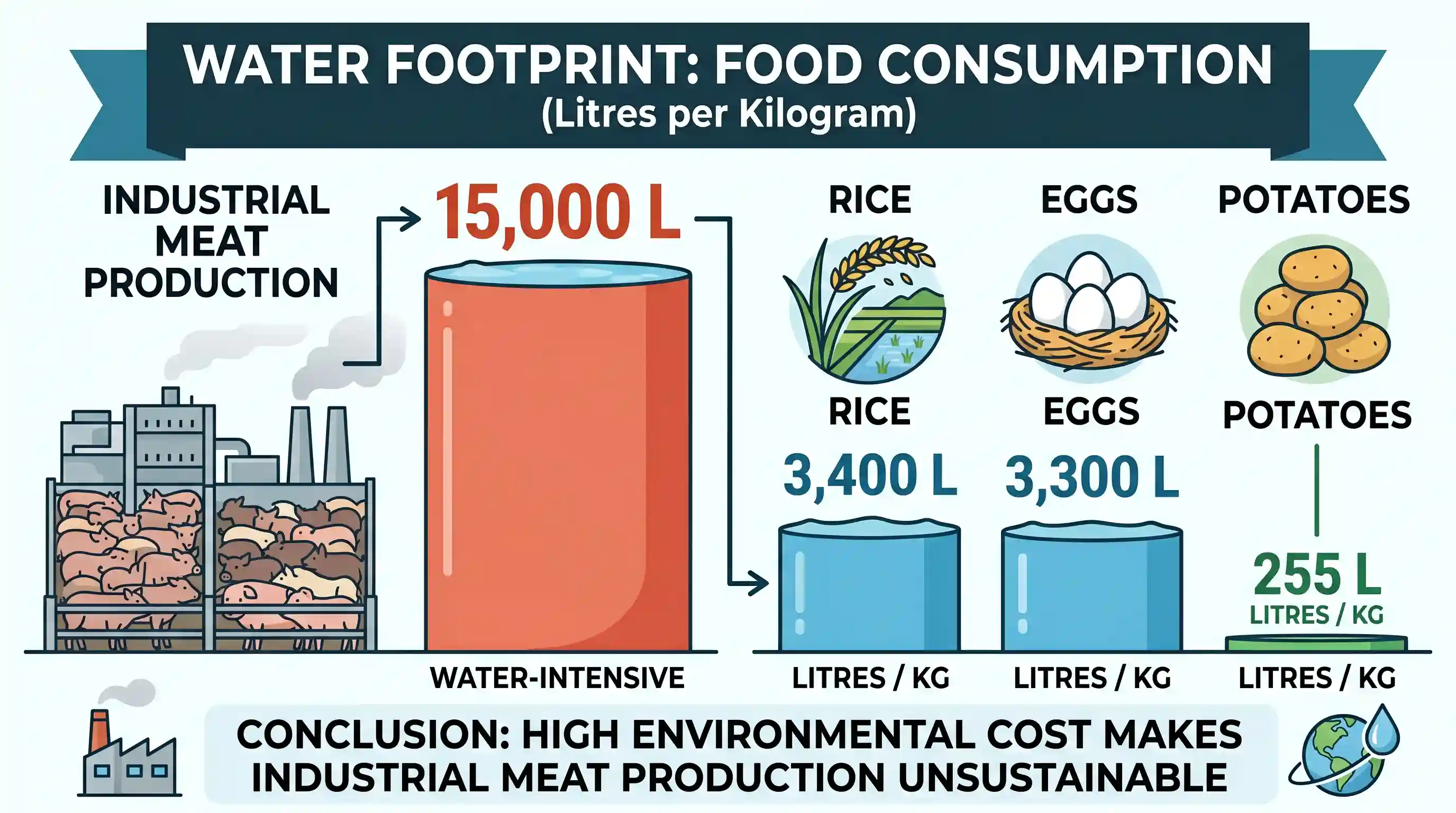
Read the following passage and answer the item that follows. Your answer to this item should be based on the passage only. The quest for cheap and plentiful meat has resulted in factory farms where more and more animals are squeezed into smaller lots in cruel and shocking conditions. Such practices have resulted in many of the world's health pandemics such as the avian flu. Worldwide, livestock are increasingly raised in cruel, cramped conditions, where animals spend their short lives under artificial light, pumped full of antibiotics and growth hormones, until the day they are slaughtered. Meat production is water-intensive. 15000 litres of water is needed for every kilogram of meat compared with 3400 litres for rice, 3300 litres for eggs and 255 litres for a kilogram of potatoes. What is the most rational and crucial message given by the passage?

- AMass production of meat through industrial farming is cheap and is suitable for providing protein nutrition to poor countries
- BMeat-producing industry violates the laws against cruelty to animals
- CMass production of meat through industrial farming is undesirable and should be stopped immediately
- DEnvironmental cost of meat production is unsustainable when it is produced through industrial farming.Correct
Explanation
The passage highlights several negative aspects of industrial meat production:
- Cruelty to animals: Animals are kept in "cruel and shocking conditions," "cramped conditions," under artificial light, pumped with antibiotics and growth hormones.
- Health pandemics: Such practices have resulted in "many of the world's health pandemics such as the avian flu."
- Environmental cost (water intensity): "Meat production is water-intensive. 15000 litres of water is needed for every kilogram of meat compared with 3400 litres for rice, 3300 litres for eggs and 255 litres for a kilogram of potatoes."
Let's analyze the options:
-
A) Mass production of meat through industrial farming is cheap and is suitable for providing protein nutrition to poor countries.
- The passage mentions the "quest for cheap and plentiful meat" as the reason for factory farms, but it immediately follows with the negative consequences. It does not endorse it as suitable for poor countries or discuss protein nutrition. This option misrepresents the passage's overall message.
-
B) Meat-producing industry violates the laws against cruelty to animals.
- The passage clearly states that animals are kept in "cruel and shocking conditions." However, it does not state that these practices violate any specific laws. It describes the conditions but makes no legal judgment.
-
C) Mass production of meat through industrial farming is undesirable and should be stopped immediately.
- The passage certainly implies that industrial farming is undesirable by listing its negative impacts. However, the phrase "should be stopped immediately" is a strong prescriptive statement that is not explicitly made or directly supported by the passage. The passage describes the problems but doesn't issue such a direct call to action.
-
D) Environmental cost of meat production is unsustainable when it is produced through industrial farming.
- The passage provides concrete, quantifiable data regarding the water intensity of meat production (15000 litres for 1 kg of meat vs. much less for other foods). This extremely high water usage is a significant environmental cost. The comparison strongly suggests that such resource consumption, especially for mass production ("industrial farming"), is not sustainable in the long run. While cruelty and health pandemics are also mentioned, the detailed water usage figures provide the most direct and quantifiable evidence for an "environmental cost" leading to "unsustainability." This option captures a crucial and rationally supported message from the passage.
Therefore, option D is the most rational and crucial message given by the passage.
Related questions
More UPSC Prelims practice from the same subject and topic.
- Prelims 2018CSATReading Comprehension
Global population was around 1.6 billion in 1990- today it is around 7.2 billion and growing. Recent estimates on population growth predict a global population of 9.6 billion in 2050 and 10.9 billion …
- Prelims 2018CSATReading Comprehension
Many pathogens that cause foodborne illnesses are unknown. Food contamination can occur at any stage from farm to plate. Since most cases of food poisoning go unreported, the true extent of global foo…
- Prelims 2018CSATReading Comprehension
Though I have discarded much of past tradition and custom, and am anxious that India should rid herself of all shackles that bind and contain her and divide her people, and suppress vast numbers of th…
- Prelims 2018CSATReading Comprehension
I am a scientist, privileged to be somebody who tries to understand nature using the tools of science. But it is also clear that there are some really important questions that science cannot really an…
- Prelims 2018CSATReading Comprehension
It is no longer enough for us to talk about providing for universal access to education. Making available schooling facilities is an essential prerequisite, but is insufficient to ensure that all chil…
- Prelims 2018CSATReading Comprehension
It is no longer enough for us to talk about providing for universal access to education. Making available schooling facilities is an essential prerequisite, but is insufficient to ensure that all chil…