Consider the following statements: 1. The Parliament of India can place a particular law in the Ninth Schedule of the Constitution of India. 2. The validity of a law placed in the Ninth Schedule cannot be examined by any court and no judgement can be made on it. Which of the statements given above is/are correct?

- A1 onlyCorrect
- B2 only
- CBoth 1 and 2
- DNeither 1 nor 2
Explanation
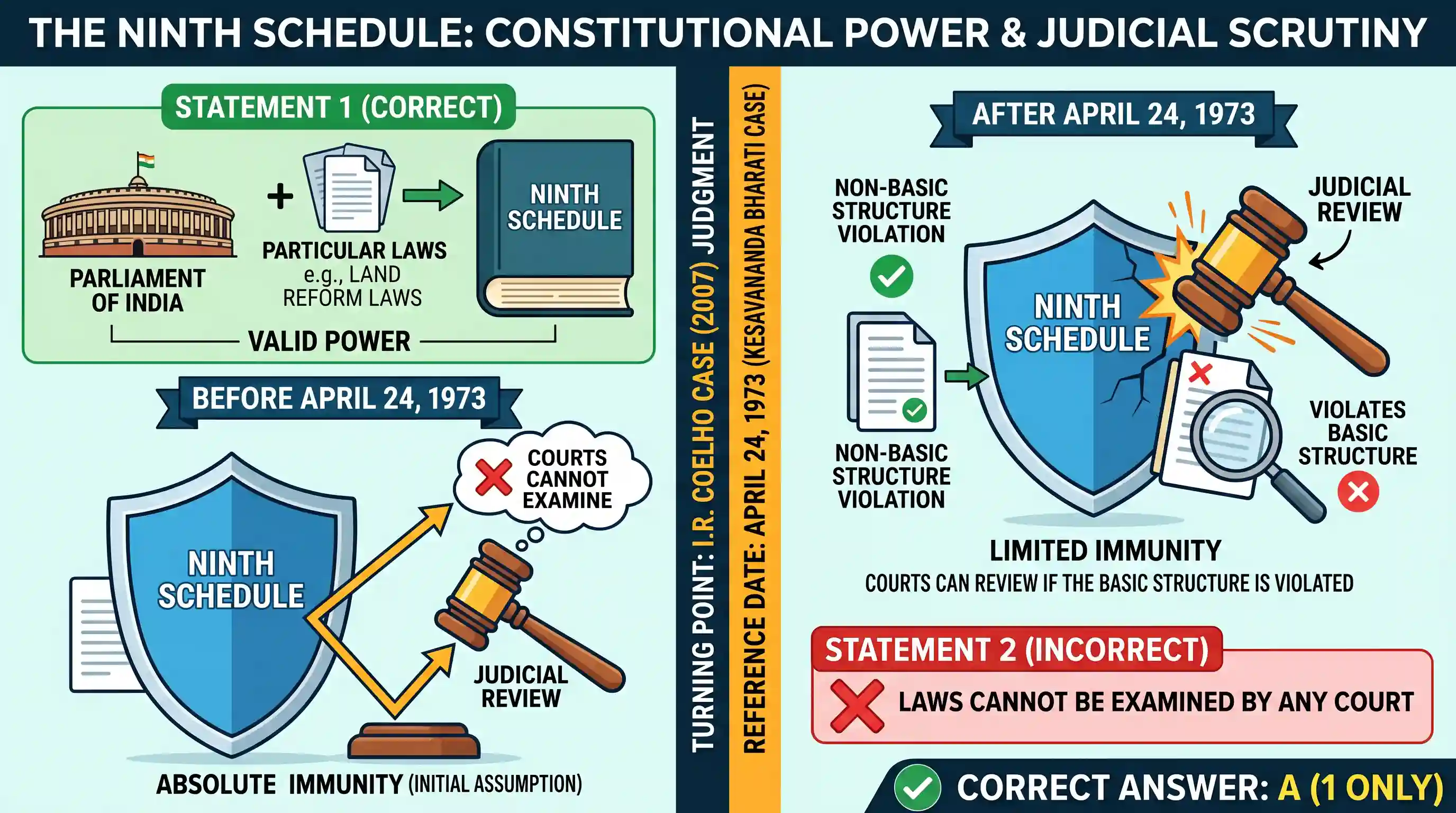
Statement 1 is correct: The Parliament of India, through constitutional amendment acts, has the power to place certain laws in the Ninth Schedule of the Constitution. The Ninth Schedule was added by the First Amendment Act, 1951, primarily to protect land reform laws from judicial review.
Statement 2 is incorrect: While laws placed in the Ninth Schedule were initially considered beyond judicial review, the Supreme Court, in its landmark judgment in I.R. Coelho v. State of Tamil Nadu (2007), ruled that laws placed in the Ninth Schedule after April 24, 1973 (the date of the Kesavananda Bharati judgment) are open to judicial review if they violate the basic structure of the Constitution. This judgment made it clear that the Ninth Schedule does not grant absolute immunity from judicial scrutiny.
Related questions
More UPSC Prelims practice from the same subject and topic.
- Prelims 2018GS1polity-and-governance
Regarding Money Bill, which of the following statements is not correct?
- Prelims 2018GS1polity-and-governance
With reference to the election of the President of India, consider the following statements: 1. The value of the vote of each MLA varies from State to State. 2. The value of the vote of MPs of the Lok…
- Prelims 2018GS1polity-and-governance
Right to Privacy is protected as an intrinsic part of Right to Life and Personal Liberty. Which of the following in the Constitution of India correctly and appropriately imply the above statement?
- Prelims 2018GS1polity-and-governance
Consider the following statements: 1. In the first Lok Sabha, the single largest party in the opposition was the Swatantra Party. 2. In the Lok Sabha, a "Leader of the Opposition" was recognised for t…
- Prelims 2018GS1polity-and-governance
How is the National Green Tribunal (NGT) different from the Central Pollution Control Board (CPCB)? 1. The NGT has been established by an Act whereas the CPCB has been created by an executive order of…
- Prelims 2018GS1polity-and-governance
Consider the following statements: 1. Aadhaar card can be used as a proof of citizenship or domicile. 2. Once issued, Aadhaar number cannot be deactivated or omitted by the Issuing Authority. Which of…