Right to Privacy is protected as an intrinsic part of Right to Life and Personal Liberty. Which of the following in the Constitution of India correctly and appropriately imply the above statement?

- AArticle 14 and the provisions under the 42nd Amendment to the Constitution
- BArticle 17 and the Directive Principles of State Policy in Part IV
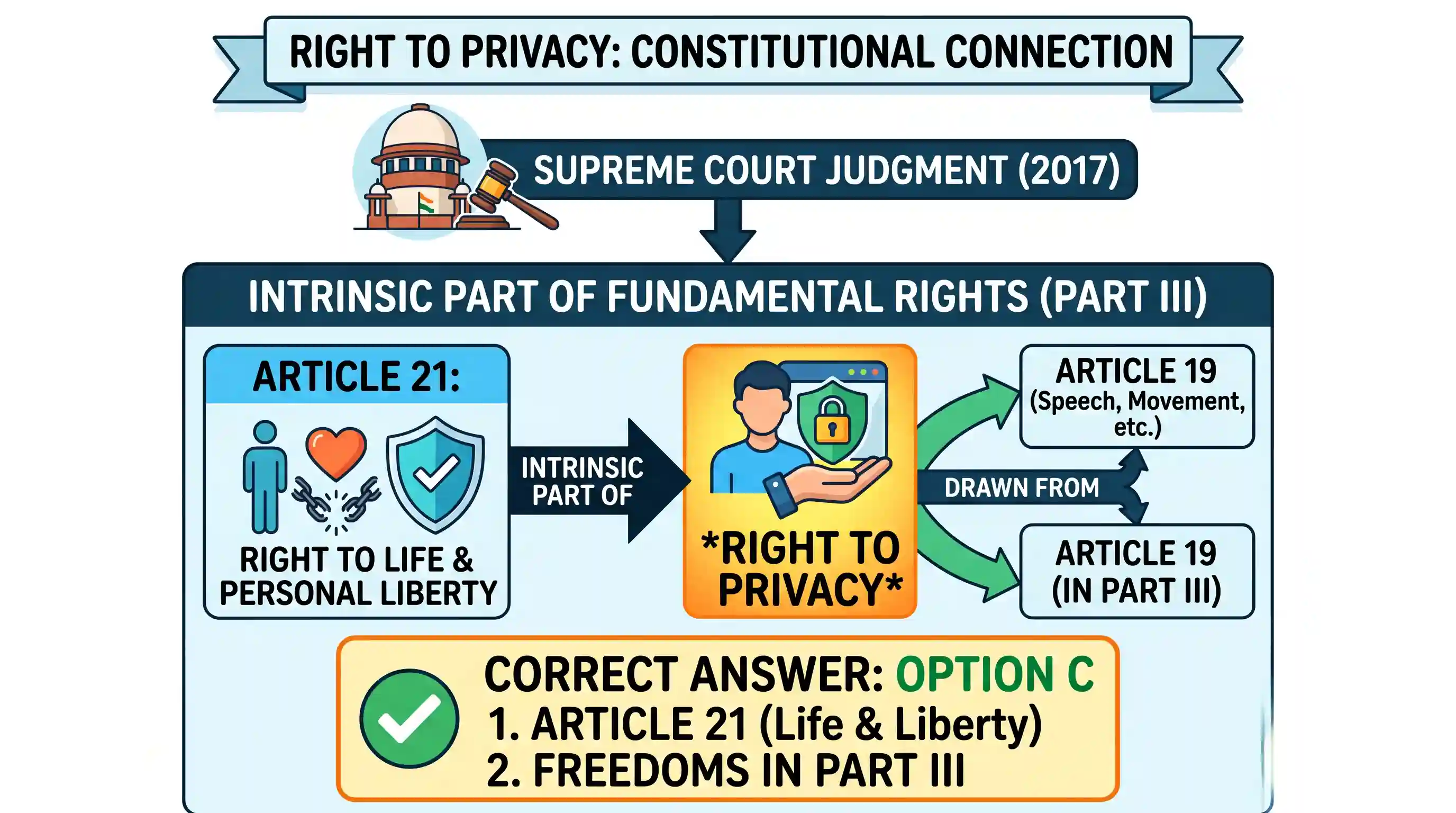
- CArticle 21 and the freedoms guaranteed in Part IIICorrect
- DArticle 24 and the provisions under the 44th Amendment to the Constitution
Explanation
The question asks which part of the Constitution correctly and appropriately implies that the Right to Privacy is protected as an intrinsic part of Right to Life and Personal Liberty.
The Supreme Court of India, in its landmark judgment in K.S. Puttaswamy v. Union of India (2017), unanimously declared the Right to Privacy as a Fundamental Right. The Court held that privacy is an intrinsic part of the Right to Life and Personal Liberty guaranteed under Article 21 of the Constitution. Furthermore, the Court also noted that various aspects of privacy are protected under other freedoms guaranteed in Part III of the Constitution (Fundamental Rights), such as Article 19 (freedom of speech and expression, movement, etc.). Therefore, the Right to Privacy draws its essence from both Article 21 and the broader framework of Fundamental Rights in Part III.
Let's look at why other options are incorrect:
A) Article 14 and the provisions under the 42nd Amendment to the Constitution: Article 14 deals with equality before law. The 42nd Amendment primarily dealt with emergency provisions, fundamental duties, and changes to the Preamble, not directly the Right to Privacy. B) Article 17 and the Directive Principles of State Policy in Part IV: Article 17 deals with the abolition of untouchability. Directive Principles are non-justiciable and do not directly deal with the Right to Privacy as a fundamental right. D) Article 24 and the provisions under the 44th Amendment to the Constitution: Article 24 prohibits child labor. The 44th Amendment primarily dealt with emergency provisions and property rights. Thus, Article 21 and the freedoms guaranteed in Part III are the most appropriate and direct implications for the Right to Privacy.
Related questions
More UPSC Prelims practice from the same subject and topic.
- Prelims 2018GS1polity-and-governance
Consider the following statements: 1. The Parliament of India can place a particular law in the Ninth Schedule of the Constitution of India. 2. The validity of a law placed in the Ninth Schedule canno…
- Prelims 2018GS1polity-and-governance
Regarding Money Bill, which of the following statements is not correct?
- Prelims 2018GS1polity-and-governance
With reference to the election of the President of India, consider the following statements: 1. The value of the vote of each MLA varies from State to State. 2. The value of the vote of MPs of the Lok…
- Prelims 2018GS1polity-and-governance
Consider the following statements: 1. In the first Lok Sabha, the single largest party in the opposition was the Swatantra Party. 2. In the Lok Sabha, a "Leader of the Opposition" was recognised for t…
- Prelims 2018GS1polity-and-governance
How is the National Green Tribunal (NGT) different from the Central Pollution Control Board (CPCB)? 1. The NGT has been established by an Act whereas the CPCB has been created by an executive order of…
- Prelims 2018GS1polity-and-governance
Consider the following statements: 1. Aadhaar card can be used as a proof of citizenship or domicile. 2. Once issued, Aadhaar number cannot be deactivated or omitted by the Issuing Authority. Which of…