Which of the following is/are the aim/aims of "Digital India" Plan of the Government of India? 1. Formation of India's own Internet companies like China did. 2. Establish a policy framework to encourage overseas multinational corporations that collect Big Data to build their large data centres within our national geographical boundaries. 3. Connect many of our villages to the Internet and bring Wi-Fi to many of our schools, public places and major tourist centres. Select the correct answer using the code given below:

- A1 and 2 only
- B3 onlyCorrect
- C2 and 3 only
- D1, 2 and 3
Explanation
The "Digital India" Plan is a flagship program of the Government of India with a vision to transform India into a digitally empowered society and knowledge economy. Its main aims are clearly defined:
-
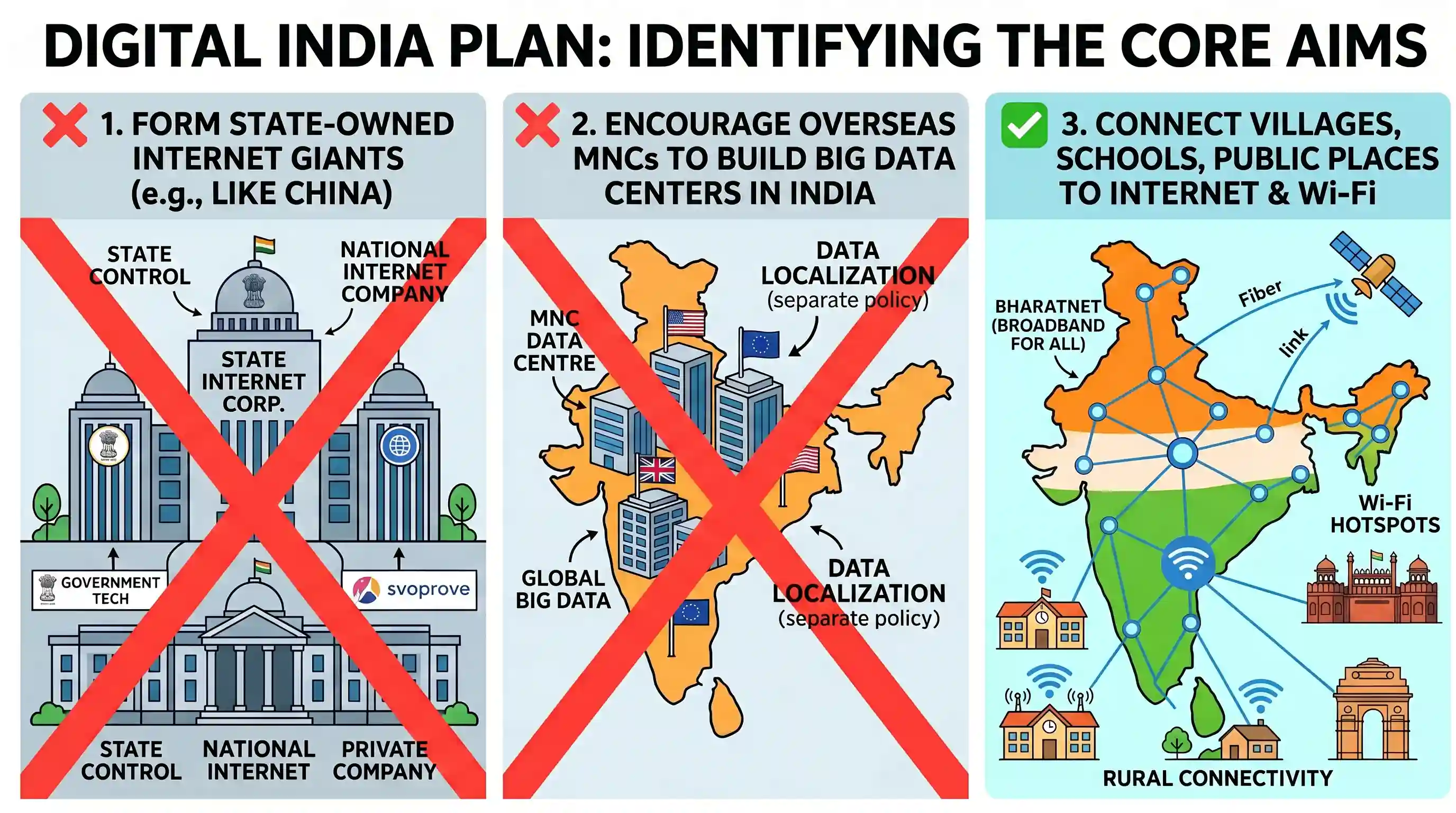
Formation of India's own Internet companies like China did. This is not a stated aim of the Digital India Plan. While the plan aims to foster innovation and create an ecosystem for digital businesses, it does not explicitly focus on creating state-controlled or state-backed internet companies to rival others, unlike some models seen in other countries. The focus is more on enabling and facilitating a digital environment.
-
Establish a policy framework to encourage overseas multinational corporations that collect Big Data to build their large data centres within our national geographical boundaries. While data localization and securing data are emerging policy concerns that may lead to such frameworks, this specific objective of encouraging MNCs to build data centres within national boundaries is not one of the primary, explicit aims listed under the core pillars of the original Digital India program. Digital India is more about broad digital infrastructure, service delivery, and digital literacy.
-
Connect many of our villages to the Internet and bring Wi-Fi to many of our schools, public places and major tourist centres. This is a core and explicit objective of the Digital India program, falling under its 'Broadband Highways' and 'Public Internet Access Programme' pillars. The aim is to ensure widespread internet connectivity and digital access, especially in rural and public areas.
Therefore, only statement 3 correctly reflects an aim of the "Digital India" Plan.
Related questions
More UPSC Prelims practice from the same subject and topic.
- Prelims 2018GS1polity-and-governance
Consider the following statements: 1. In the first Lok Sabha, the single largest party in the opposition was the Swatantra Party. 2. In the Lok Sabha, a "Leader of the Opposition" was recognised for t…
- Prelims 2018GS1polity-and-governance
How is the National Green Tribunal (NGT) different from the Central Pollution Control Board (CPCB)? 1. The NGT has been established by an Act whereas the CPCB has been created by an executive order of…
- Prelims 2018GS1polity-and-governance
Consider the following statements: 1. Aadhaar card can be used as a proof of citizenship or domicile. 2. Once issued, Aadhaar number cannot be deactivated or omitted by the Issuing Authority. Which of…
- Prelims 2018GS1polity-and-governance
The identity platform 'Aadhaar' provides open "Application Programming Interfaces (APIs)". What does it imply? 1. It can be integrated into any electronic device. 2. Online authentication using iris i…
- Prelims 2018GS1polity-and-governance
Consider the following statements: 1. As per the Right to Education (RTE) Act, to be eligible for appointment as a teacher in a State, a person would be required to possess the minimum qualification l…
- Prelims 2018GS1polity-and-governance
Consider the following statements: 1. The Food Safety and Standards Act, 2006 replaced the Prevention of Food Adulteration Act, 1954. 2. The Food Safety and Standards Authority of India (FSSAI) is und…