Which one of the following reflects the most appropriate relationship between law and liberty?

- AIf there are more laws, there is less liberty.
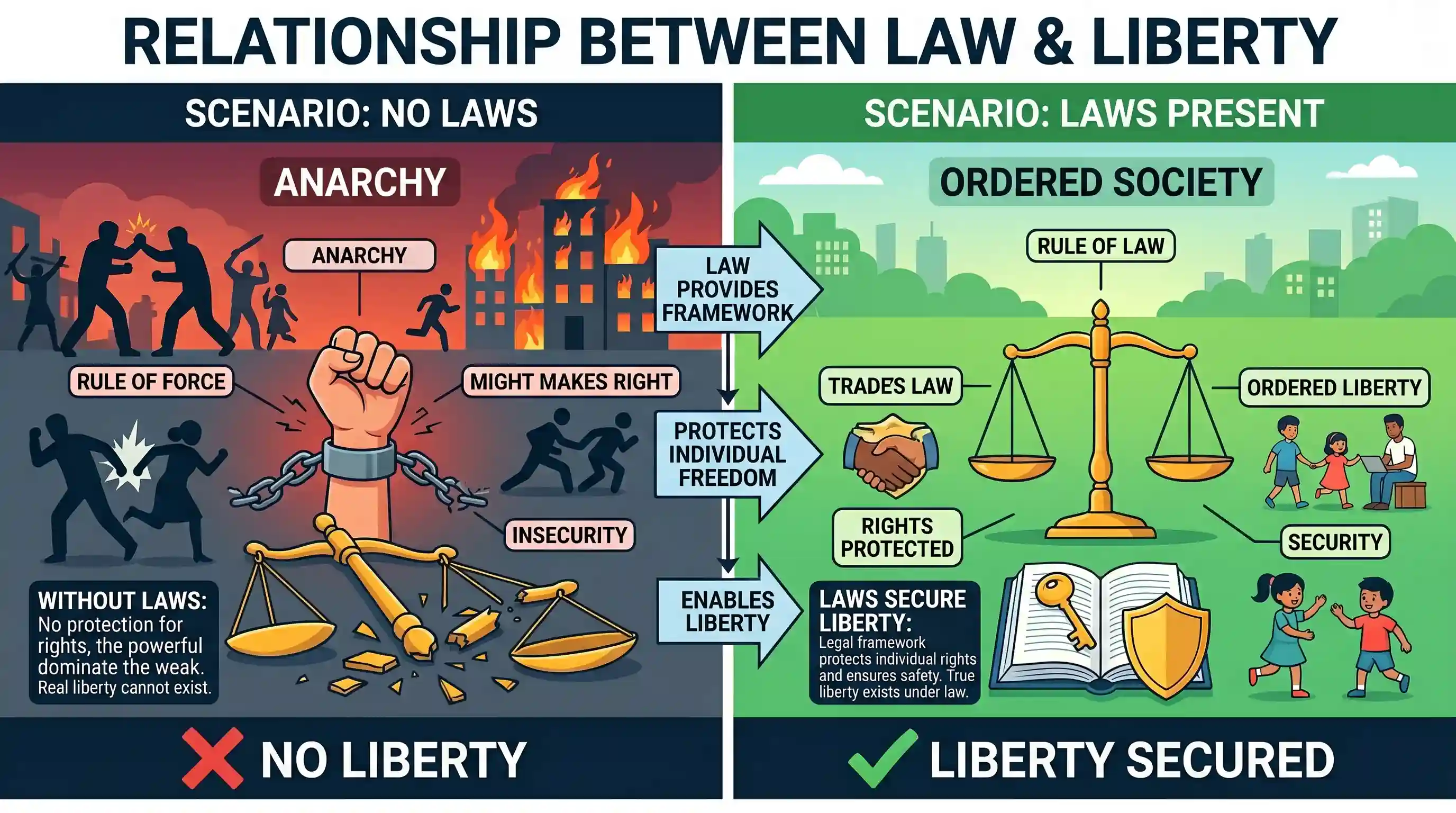
- BIf there are no laws, there is no liberty.Correct
- CIf there is liberty, laws have to be made by the people.
- DIf laws are changed too often, liberty is in danger.
Explanation
This question explores the intricate relationship between law and liberty in a societal context:
A) If there are more laws, there is less liberty. This is not necessarily true. While excessive or restrictive laws can curtail liberty, laws that protect rights, establish order, and prevent harm (e.g., laws against theft, violence) actually secure and enhance liberty by creating a safe and predictable environment for individuals to exercise their freedoms without fear.
B) If there are no laws, there is no liberty. This statement reflects a fundamental tenet of political philosophy. In a state of anarchy, without any laws, there would be no protection for individual rights or freedoms. The powerful would dominate the weak, leading to a state where true liberty, understood as freedom within a framework of rights, would be impossible to secure. Laws provide the framework for ordered liberty, ensuring that one person's freedom does not unduly infringe upon another's.
C) If there is liberty, laws have to be made by the people. While democratic law-making (laws made by the people) is a desirable feature that enhances liberty and self-governance, the fundamental principle that laws are necessary for liberty does not strictly require popular law-making. Even in non-democratic systems, some laws exist that can protect certain aspects of individual freedom, though the overall scope of liberty might be limited.
D) If laws are changed too often, liberty is in danger. Frequent changes in laws can lead to legal uncertainty and instability, which can indirectly affect the exercise of liberty. However, this is a secondary concern compared to the fundamental absence of laws. The primary threat to liberty is the lack of a legal framework altogether.
Therefore, the most appropriate relationship is that laws create the necessary conditions for liberty to exist and be protected.
Related questions
More UPSC Prelims practice from the same subject and topic.
- Prelims 2018GS1polity-and-governance
Consider the following statements: 1. In the first Lok Sabha, the single largest party in the opposition was the Swatantra Party. 2. In the Lok Sabha, a "Leader of the Opposition" was recognised for t…
- Prelims 2018GS1polity-and-governance
How is the National Green Tribunal (NGT) different from the Central Pollution Control Board (CPCB)? 1. The NGT has been established by an Act whereas the CPCB has been created by an executive order of…
- Prelims 2018GS1polity-and-governance
Consider the following statements: 1. Aadhaar card can be used as a proof of citizenship or domicile. 2. Once issued, Aadhaar number cannot be deactivated or omitted by the Issuing Authority. Which of…
- Prelims 2018GS1polity-and-governance
The identity platform 'Aadhaar' provides open "Application Programming Interfaces (APIs)". What does it imply? 1. It can be integrated into any electronic device. 2. Online authentication using iris i…
- Prelims 2018GS1polity-and-governance
Consider the following statements: 1. As per the Right to Education (RTE) Act, to be eligible for appointment as a teacher in a State, a person would be required to possess the minimum qualification l…
- Prelims 2018GS1polity-and-governance
Consider the following statements: 1. The Food Safety and Standards Act, 2006 replaced the Prevention of Food Adulteration Act, 1954. 2. The Food Safety and Standards Authority of India (FSSAI) is und…