With reference to the circumstances in Indian agriculture, the concept of "Conservation Agriculture" assumes significance. Which of the following fall under the Conservation Agriculture? 1. Avoiding the monoculture practices 2. Adopting minimum tillage 3. Avoiding the cultivation of plantation crops 4. Using crop residues to cover soil surface 5. Adopting spatial and temporal crop sequencing/crop rotations Select the correct answer using the code given below:

- A1, 3 and 4
- B2, 3, 4 and 5
- C2, 4 and 5Correct
- D1, 2, 3 and 5
Explanation
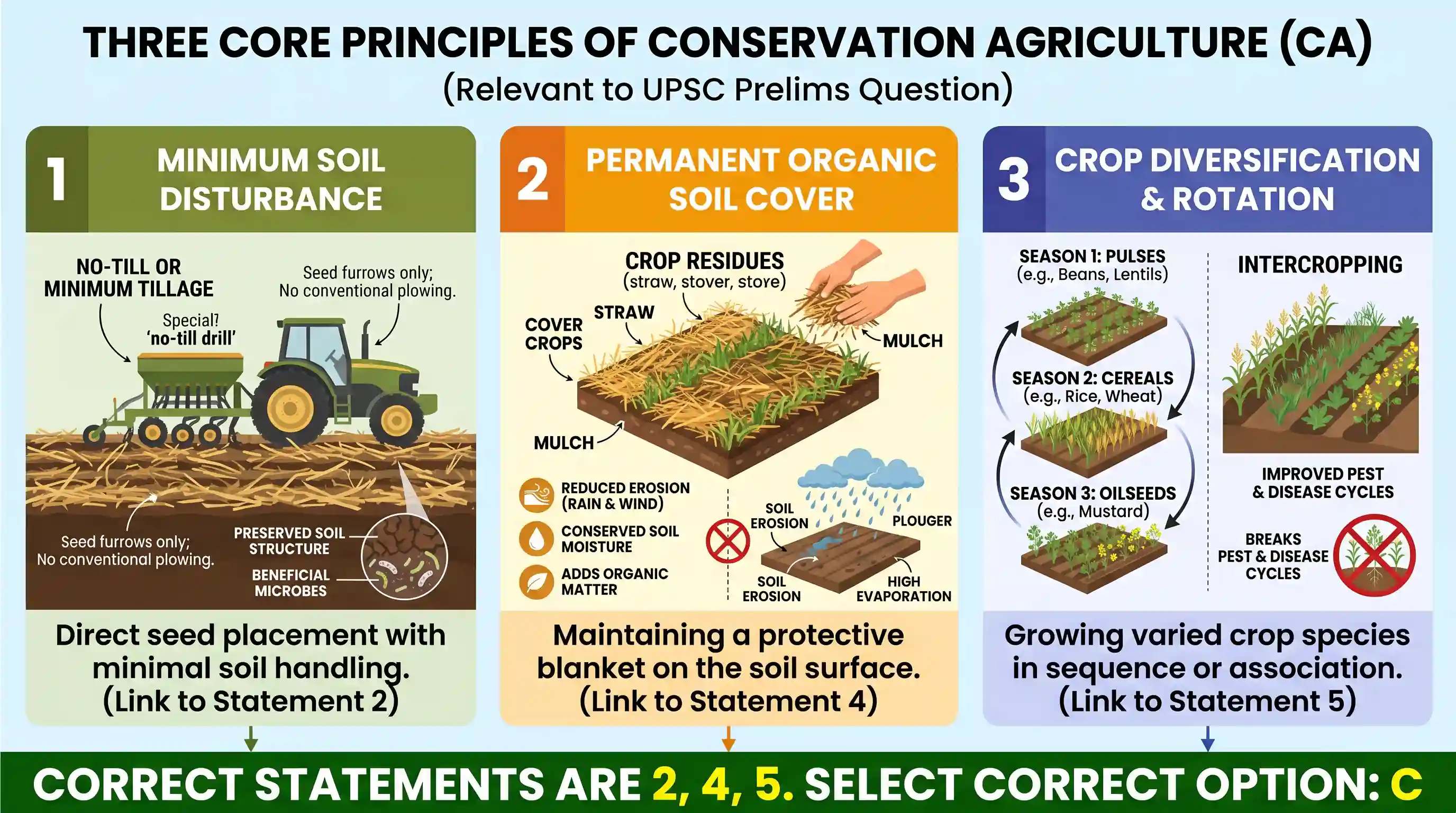
Conservation Agriculture (CA) is an approach to managing agro-ecosystems for improved and sustained productivity, increased profits and food security while preserving and enhancing the natural resource base. It is typically characterized by three core principles:
-
Minimum mechanical soil disturbance (No-till or Minimum tillage): This involves reducing or eliminating plowing, harrowing, or other forms of soil disturbance. Statement 2, 'Adopting minimum tillage', directly aligns with this principle.
-
Permanent organic soil cover (Residue retention): This means keeping the soil covered with crop residues, mulches, or cover crops. Statement 4, 'Using crop residues to cover soil surface', directly aligns with this principle.
-
Diversification of crop species (Crop rotation/sequencing): This involves growing a variety of crops in sequence or combination over time and space. Statement 5, 'Adopting spatial and temporal crop sequencing/crop rotations', directly aligns with this principle.
Regarding other options:
-
Avoiding the monoculture practices: While avoiding monoculture is generally a good agricultural practice that fits within the spirit of diversification in CA, it is a broader concept, and 'spatial and temporal crop sequencing/crop rotations' (Statement 5) more specifically captures the CA principle.
-
Avoiding the cultivation of plantation crops: This is not a principle of Conservation Agriculture. CA principles can be applied to various types of crops, including perennial plantation crops, to minimize soil disturbance and maintain soil health.
Thus, statements 2, 4, and 5 are the most accurate representations of the core practices of Conservation Agriculture.
Related questions
More UPSC Prelims practice from the same subject and topic.
- Prelims 2018GS1geography
Which of the following leaf modifications occur(s) in the desert areas to inhibit water loss? 1. Hard and waxy leaves 2. Tiny leaves 3. Thorns instead of leaves Select the correct answer using the cod…
- Prelims 2018GS1geography
Which of the following has/have shrunk immensely/dried up in the recent past due to human activities? 1. Aral Sea 2. Black Sea 3. Lake Baikal Select the correct answer using the code given below:
- Prelims 2018GS1geography
With reference to the 'Global Alliance for Climate-Smart Agriculture (GACSA)', which of the following statements is/are correct? 1. GACSA is an outcome of the Climate Summit held in Paris in 2015. 2. …
- Prelims 2018GS1geography
The term "sixth mass extinction/sixth extinction" is often mentioned in the news in the context of the discussion of
- Prelims 2018GS1geography
Which of the following statements best describes "carbon fertilization"?
- Prelims 2018GS1geography
Which of the following is/are the possible consequence/s of heavy sand mining in riverbeds? 1. Decreased salinity in the river 2. Pollution of groundwater 3. Lowering of the water-table Select the cor…