Which of the following is/are the possible consequence/s of heavy sand mining in riverbeds? 1. Decreased salinity in the river 2. Pollution of groundwater 3. Lowering of the water-table Select the correct answer using the code given below:

- A1 only
- B2 and 3 onlyCorrect
- C1 and 3 only
- D1, 2 and 3
Explanation
Let's analyze the possible consequences of heavy sand mining in riverbeds:
-
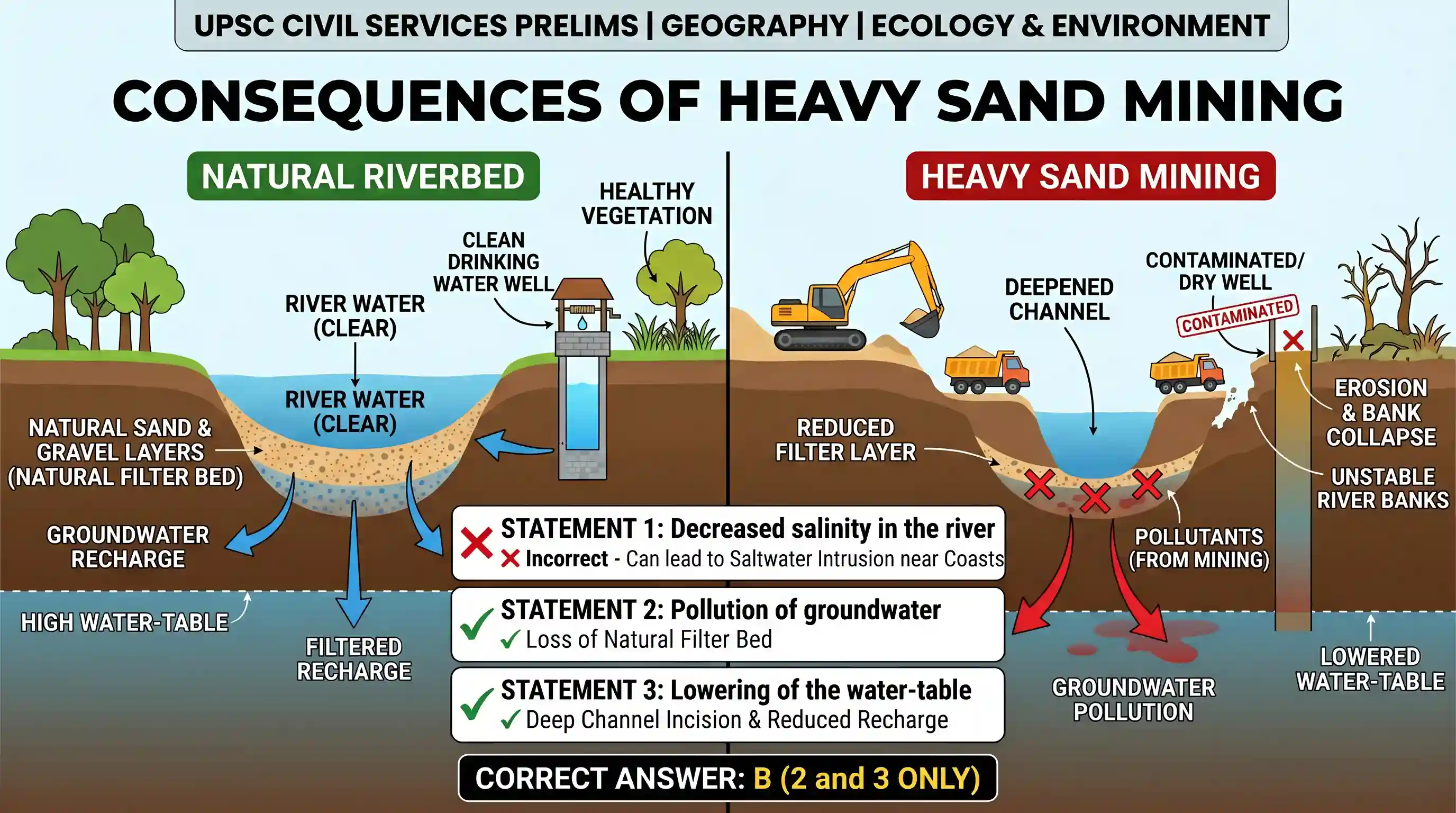
Decreased salinity in the river: This statement is incorrect. Heavy sand mining does not generally decrease salinity in the river. In fact, if mining occurs near coastal areas or estuaries, it can lead to saltwater intrusion into freshwater aquifers and rivers, potentially increasing salinity in some stretches, not decreasing it.
-
Pollution of groundwater: This statement is correct. Riverbeds naturally act as a filter for water percolating into the groundwater. Removal of sand and gravel, which are natural filters, can reduce the riverbed's ability to filter pollutants. This allows contaminants from the river water to easily seep into and pollute the groundwater table. Additionally, mining activities themselves can introduce pollutants.
-
Lowering of the water-table: This statement is correct. Excessive sand mining deepens the river channel. A deepened riverbed can lead to a drop in the water level of the river, which in turn reduces the recharge of the surrounding aquifers. Consequently, the groundwater table in adjacent areas can decline, affecting wells and vegetation dependent on that water.
Therefore, 2 and 3 are correct consequences of heavy sand mining.
Related questions
More UPSC Prelims practice from the same subject and topic.
- Prelims 2018GS1geography
Which of the following leaf modifications occur(s) in the desert areas to inhibit water loss? 1. Hard and waxy leaves 2. Tiny leaves 3. Thorns instead of leaves Select the correct answer using the cod…
- Prelims 2018GS1geography
Which of the following has/have shrunk immensely/dried up in the recent past due to human activities? 1. Aral Sea 2. Black Sea 3. Lake Baikal Select the correct answer using the code given below:
- Prelims 2018GS1geography
With reference to the 'Global Alliance for Climate-Smart Agriculture (GACSA)', which of the following statements is/are correct? 1. GACSA is an outcome of the Climate Summit held in Paris in 2015. 2. …
- Prelims 2018GS1geography
With reference to the circumstances in Indian agriculture, the concept of "Conservation Agriculture" assumes significance. Which of the following fall under the Conservation Agriculture? 1. Avoiding t…
- Prelims 2018GS1geography
The term "sixth mass extinction/sixth extinction" is often mentioned in the news in the context of the discussion of
- Prelims 2018GS1geography
Which of the following statements best describes "carbon fertilization"?