With reference to the Genetically Modified mustard (GM mustard) developed in India, consider the following statements: 1. GM mustard has the genes of a soil bacterium that give the plant the property of pest-resistance to a wide variety of pests. 2. GM mustard has the genes that allow the plant cross-pollination and hybridization. 3. GM mustard has been developed jointly by the IARI and Punjab Agricultural University. Which of the statements given above is/are correct?

- A1 and 3 only
- B2 onlyCorrect
- C2 and 3 only
- D1, 2 and 3
Explanation
Let's analyze the statements regarding Genetically Modified (GM) mustard, specifically DMH-11 (Dhara Mustard Hybrid-11), developed in India:
-
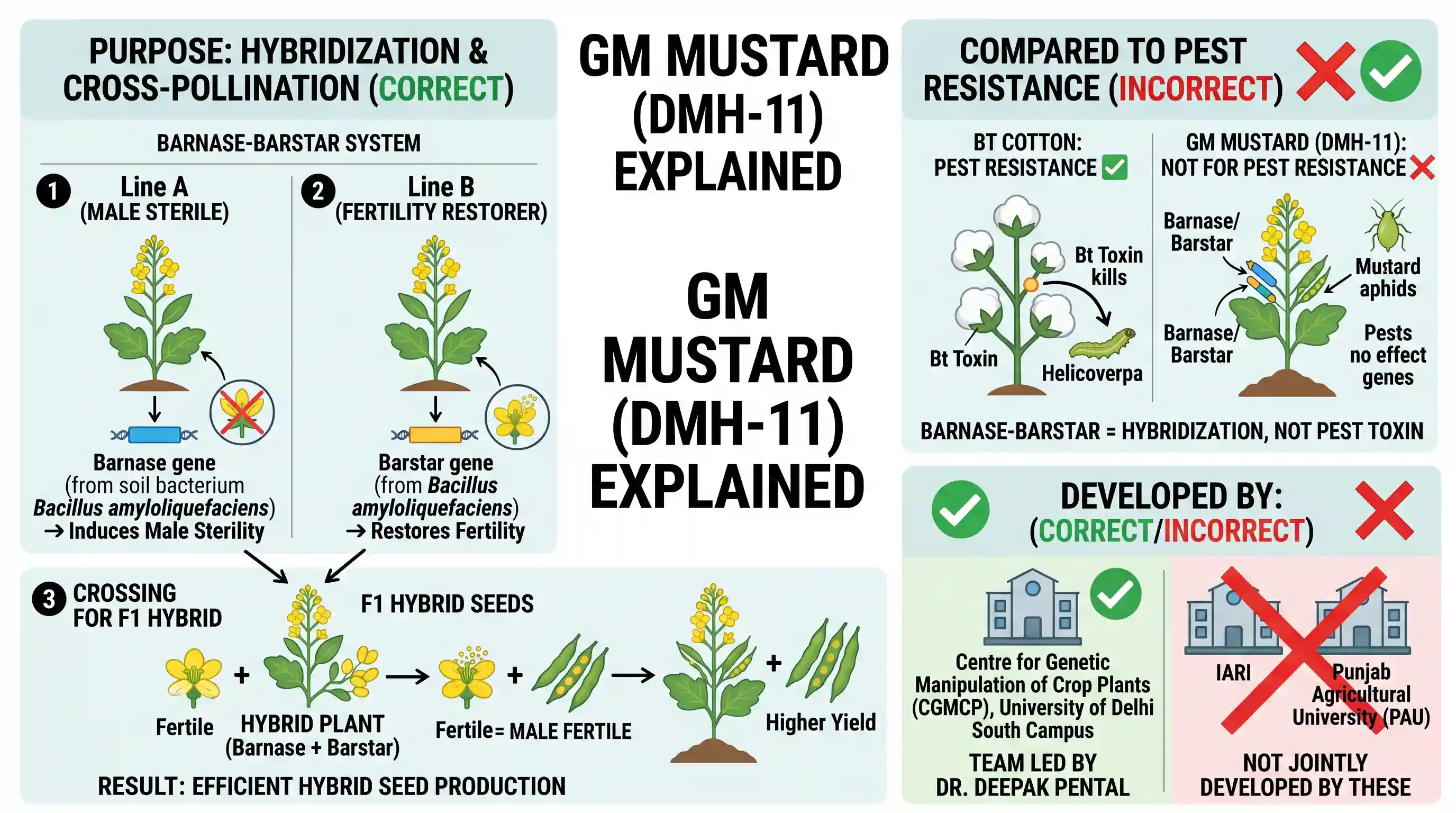
GM mustard has the genes of a soil bacterium that give the plant the property of pest-resistance to a wide variety of pests. This statement is incorrect. DMH-11 does not primarily have genes for pest resistance. Unlike Bt cotton, which incorporates a gene from the bacterium Bacillus thuringiensis (Bt) for pest resistance, GM mustard uses two genes, Barnase and Barstar, derived from the soil bacterium Bacillus amyloliquefaciens for creating a male-sterile line and restoring fertility, which is crucial for hybrid seed production. It is not engineered for pest resistance.
-
GM mustard has the genes that allow the plant cross-pollination and hybridization. This statement is correct. The Barnase-Barstar system in DMH-11 is a genetic engineering technique that enables controlled cross-pollination and the efficient production of hybrid mustard varieties. Barnase induces male sterility, and Barstar restores fertility in the hybrid, facilitating cross-pollination for higher yield hybrids.
-
GM mustard has been developed jointly by the IARI and Punjab Agricultural University. This statement is incorrect. DMH-11 was developed by a team of scientists at the Centre for Genetic Manipulation of Crop Plants (CGMCP), University of Delhi South Campus, led by Dr. Deepak Pental. It was not a joint development by IARI (Indian Agricultural Research Institute) and Punjab Agricultural University.
Therefore, only statement 2 is correct.
Related questions
More UPSC Prelims practice from the same subject and topic.
- Prelims 2018GS1science-and-technology
What is/are the consequence/consequences of a country becoming the member of the 'Nuclear Suppliers Group'? 1. It will have access to the latest and most efficient nuclear technologies. 2. It automati…
- Prelims 2018GS1science-and-technology
In the Indian context, what is the implication of ratifying the 'Additional Protocol' with the 'International Atomic Energy Agency (IAEA)'?
- Prelims 2018GS1science-and-technology
What is "Terminal High Altitude Area Defense (THAAD)", sometimes seen in the news?
- Prelims 2018GS1science-and-technology
In which of the following areas can GPS technology be used? 1. Mobile phone operations 2. Banking operations 3. Controlling the power grids Select the correct answer using the code given below:
- Prelims 2018GS1science-and-technology
The terms 'WannaCry, Petya and EternalBlue' sometimes mentioned in the news recently are related to
- Prelims 2018GS1science-and-technology
With reference to the Indian Regional Navigation Satellite System (IRNSS), consider the following statements: 1. IRNSS has three satellites in geostationary and four satellites in geosynchronous orbit…