The staple commodities of export by the English East India Company from Bengal in the middle of the 18th century were

- ARaw cotton, oil-seeds and opium
- BSugar, salt, zinc and lead
- CCopper, silver, gold, spices and tea
- DCotton, silk, saltpetre and opiumCorrect
Explanation
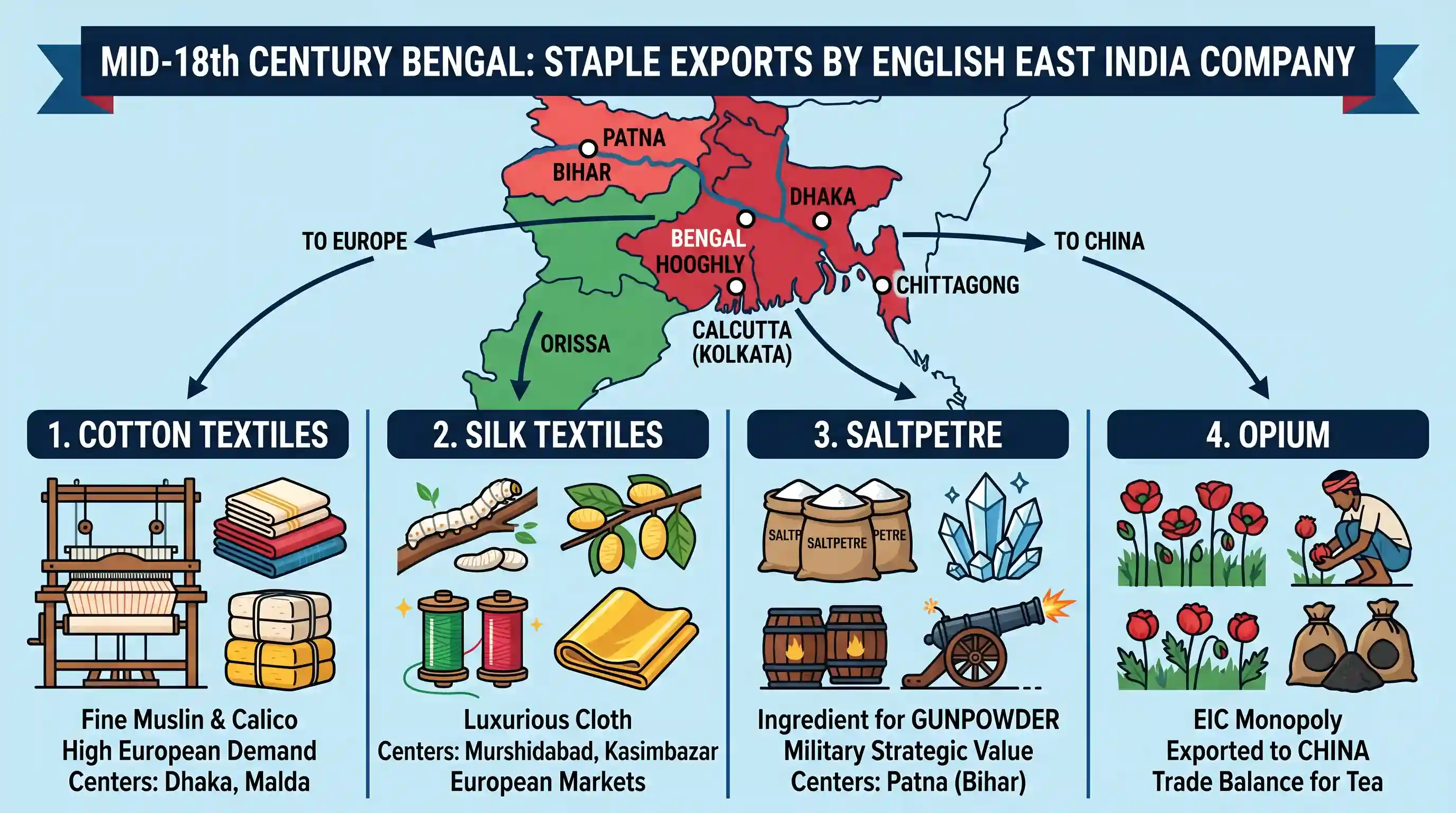
In the middle of the 18th century, Bengal was a highly valuable province for the English East India Company due to its rich resources and established trade networks. The primary staple commodities of export from Bengal by the Company were:
Cotton and Silk: Bengal was a major textile-producing region, known for its fine cotton and silk fabrics. These were in high demand in European markets. Saltpetre: This was a crucial ingredient for gunpowder production and was strategically important. Bengal was a significant source of saltpetre. Opium: While controversial, opium became a highly profitable commodity. The Company monopolized its production in Bengal and exported it primarily to China to balance its trade deficits, particularly in tea. Other options include commodities that were either not primary exports from Bengal during that specific period (e.g., oil-seeds as a staple export, zinc, lead, copper, silver, gold as exports rather than imports) or were of lesser significance compared to textiles, saltpetre, and opium.
Related questions
More UPSC Prelims practice from the same subject and topic.
- Prelims 2018GS1history
He wrote biographies of Mazzini, Garibaldi, Shivaji and Shrikrishna; stayed in America for some time; and was also elected to the Central Assembly. He was
- Prelims 2018GS1history
Regarding Wood's Dispatch, which of the following statements are true? 1. Grants-in-Aid system was introduced. 2. Establishment of universities was recommended. 3. English as a medium of instruction a…
- Prelims 2018GS1history
After the Santhal Uprising subsided, what was/were the measure/measures taken by the colonial government? 1. The territories called 'Santhal Paraganas' were created. 2. It became illegal for a Santhal…
- Prelims 2018GS1history
Economically, one of the results of the British rule in India in the 19th century was the
- Prelims 2018GS1history
Which one of the following is a very significant aspect of the Champaran Satyagraha?
- Prelims 2018GS1history
Who among the following were the founders of the "Hind Mazdoor Sabha" established in 1948?