Economically, one of the results of the British rule in India in the 19th century was the

- Aincrease in the export of Indian handicrafts
- Bgrowth in the number of Indian owned factories
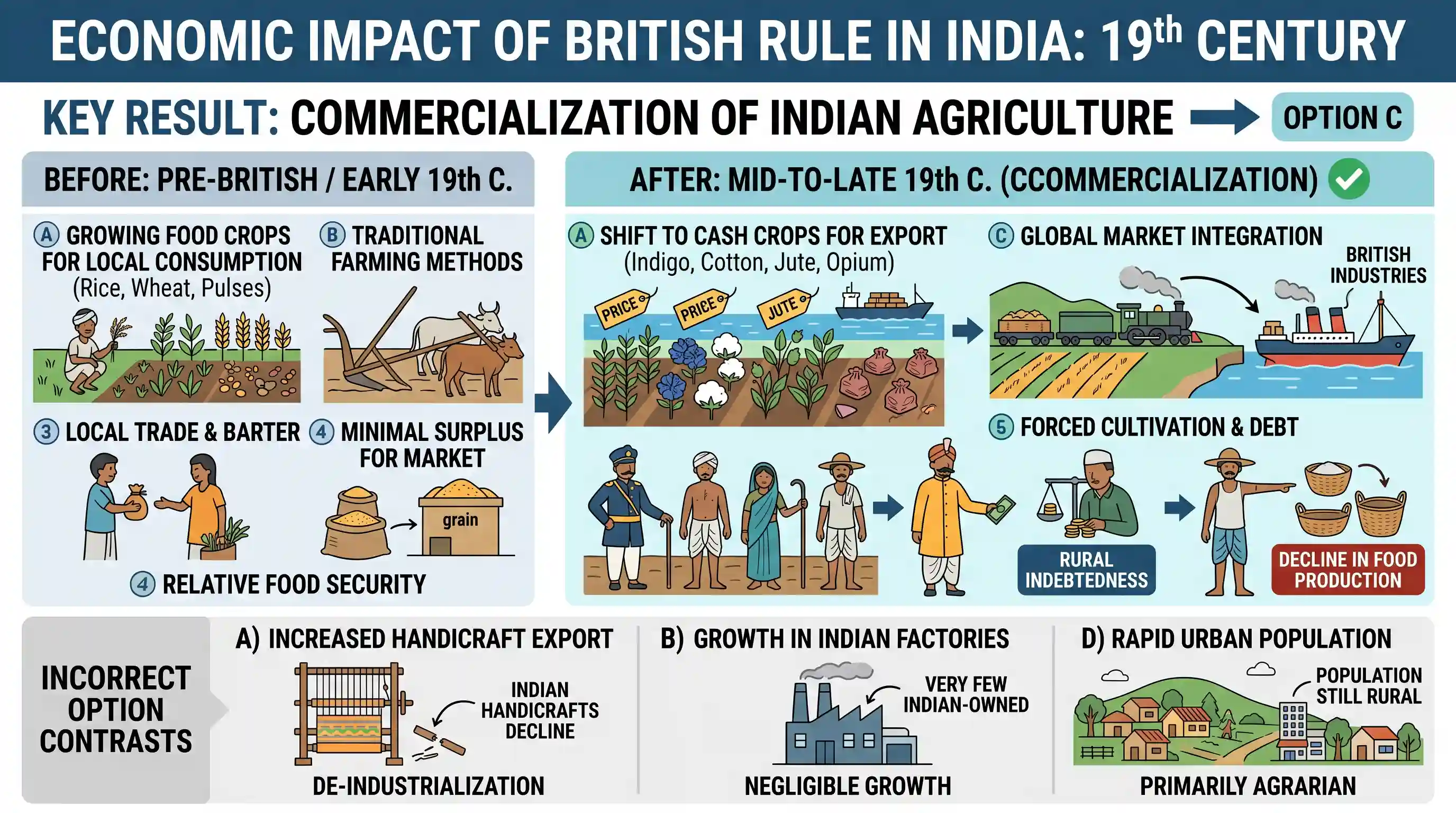
- Ccommercialization of Indian agricultureCorrect
- Drapid increase in the urban population
Explanation
One of the most profound economic transformations brought about by British rule in India during the 19th century was the commercialization of agriculture. Prior to British rule, Indian agriculture was largely subsistence-oriented, with farmers growing food crops primarily for their own consumption.
Under British policies, driven by the need for raw materials for British industries and revenue generation, there was a significant shift towards the cultivation of cash crops for export, such as indigo, cotton, jute, opium, and sugarcane. Farmers were often coerced or incentivized to grow these commercial crops instead of food grains. This led to a decline in food production, increased rural indebtedness, and made the Indian economy more susceptible to global market fluctuations. This process also contributed to the de-industrialization of traditional Indian handicrafts, rather than their increase in export. The growth of Indian-owned factories was negligible in the 19th century, and while urbanization occurred, it was not the primary economic result of agricultural policies.
Related questions
More UPSC Prelims practice from the same subject and topic.
- Prelims 2018GS1history
He wrote biographies of Mazzini, Garibaldi, Shivaji and Shrikrishna; stayed in America for some time; and was also elected to the Central Assembly. He was
- Prelims 2018GS1history
Regarding Wood's Dispatch, which of the following statements are true? 1. Grants-in-Aid system was introduced. 2. Establishment of universities was recommended. 3. English as a medium of instruction a…
- Prelims 2018GS1history
After the Santhal Uprising subsided, what was/were the measure/measures taken by the colonial government? 1. The territories called 'Santhal Paraganas' were created. 2. It became illegal for a Santhal…
- Prelims 2018GS1history
The staple commodities of export by the English East India Company from Bengal in the middle of the 18th century were
- Prelims 2018GS1history
Which one of the following is a very significant aspect of the Champaran Satyagraha?
- Prelims 2018GS1history
Who among the following were the founders of the "Hind Mazdoor Sabha" established in 1948?