If the President of India exercises his power as provided under Article 356 of the Constitution in respect of a particular State, then

- Athe Assembly of the State is automatically dissolved.
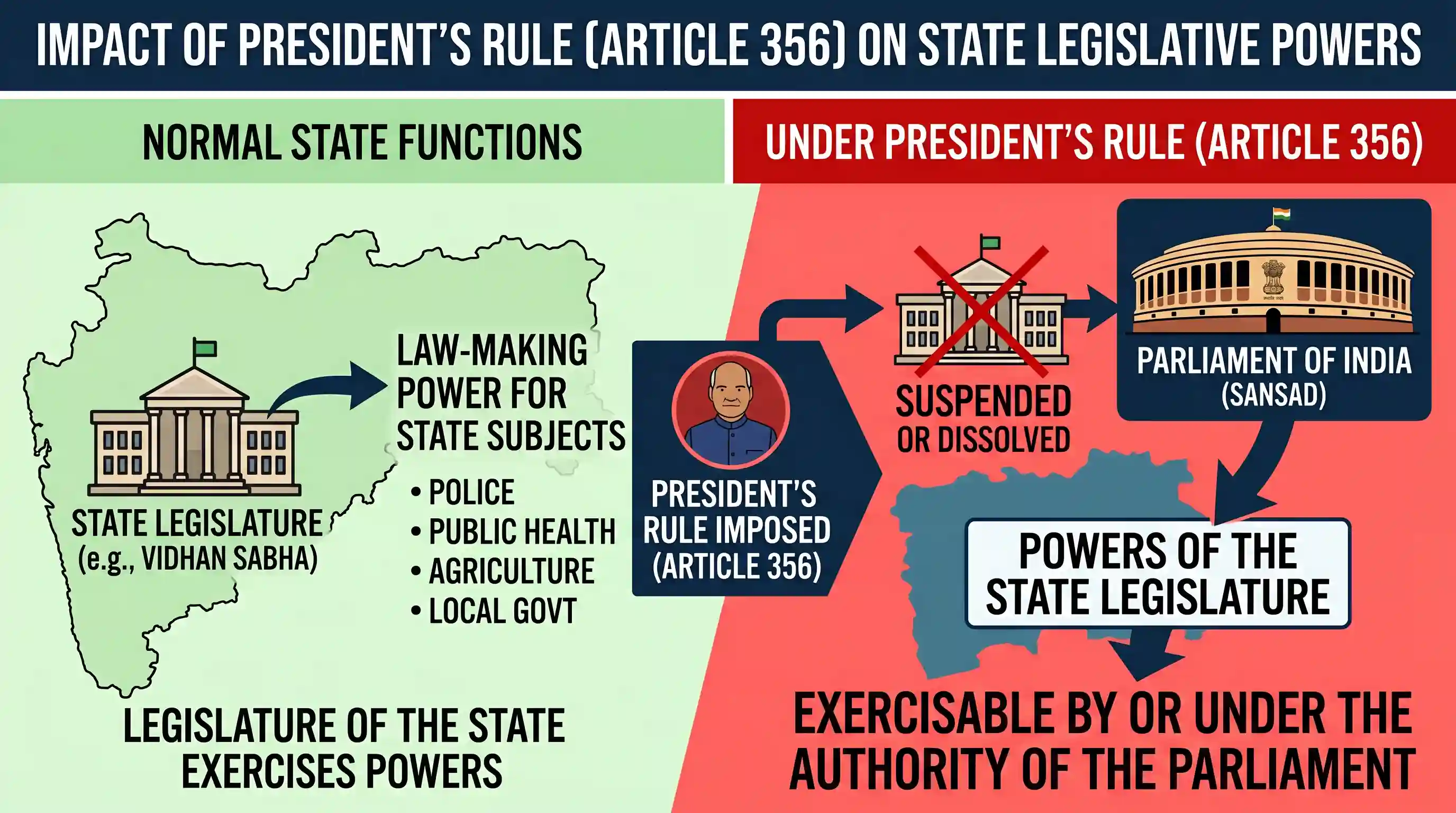
- Bthe powers of the Legislature of that State shall be exercisable by or under the authority of the Parliament.Correct
- CArticle 19 is suspended in that State.
- Dthe President can make laws relating to that State.
Explanation
Article 356 of the Constitution deals with the imposition of President's Rule in a state due to the failure of constitutional machinery. When the President exercises this power, the immediate and most significant consequence regarding the state's legislative powers is that:
The powers of the Legislature of that State shall be exercisable by or under the authority of the Parliament. This means that Parliament effectively takes over the legislative functions of the state. The President does not directly make laws; rather, Parliament may confer the power to make laws for the state on the President, or Parliament itself can make such laws.
Other options are incorrect: The Assembly of the State is not automatically dissolved; it can be suspended first and then dissolved later by the President. Article 19 (which deals with fundamental freedoms) is suspended during a National Emergency (under Article 352), not specifically during President's Rule (Article 356).
Related questions
More UPSC Prelims practice from the same subject and topic.
- Prelims 2018GS1polity-and-governance
In the Federation established by The Government of India Act of 1935, residuary powers were given to the
- Prelims 2018GS1polity-and-governance
Consider the following statements: 1. In the first Lok Sabha, the single largest party in the opposition was the Swatantra Party. 2. In the Lok Sabha, a "Leader of the Opposition" was recognised for t…
- Prelims 2018GS1polity-and-governance
How is the National Green Tribunal (NGT) different from the Central Pollution Control Board (CPCB)? 1. The NGT has been established by an Act whereas the CPCB has been created by an executive order of…
- Prelims 2018GS1polity-and-governance
Consider the following statements: 1. The Parliament of India can place a particular law in the Ninth Schedule of the Constitution of India. 2. The validity of a law placed in the Ninth Schedule canno…
- Prelims 2018GS1polity-and-governance
Consider the following statements: 1. Aadhaar card can be used as a proof of citizenship or domicile. 2. Once issued, Aadhaar number cannot be deactivated or omitted by the Issuing Authority. Which of…
- Prelims 2018GS1polity-and-governance
"Rule of Law Index" is released by which of the following?