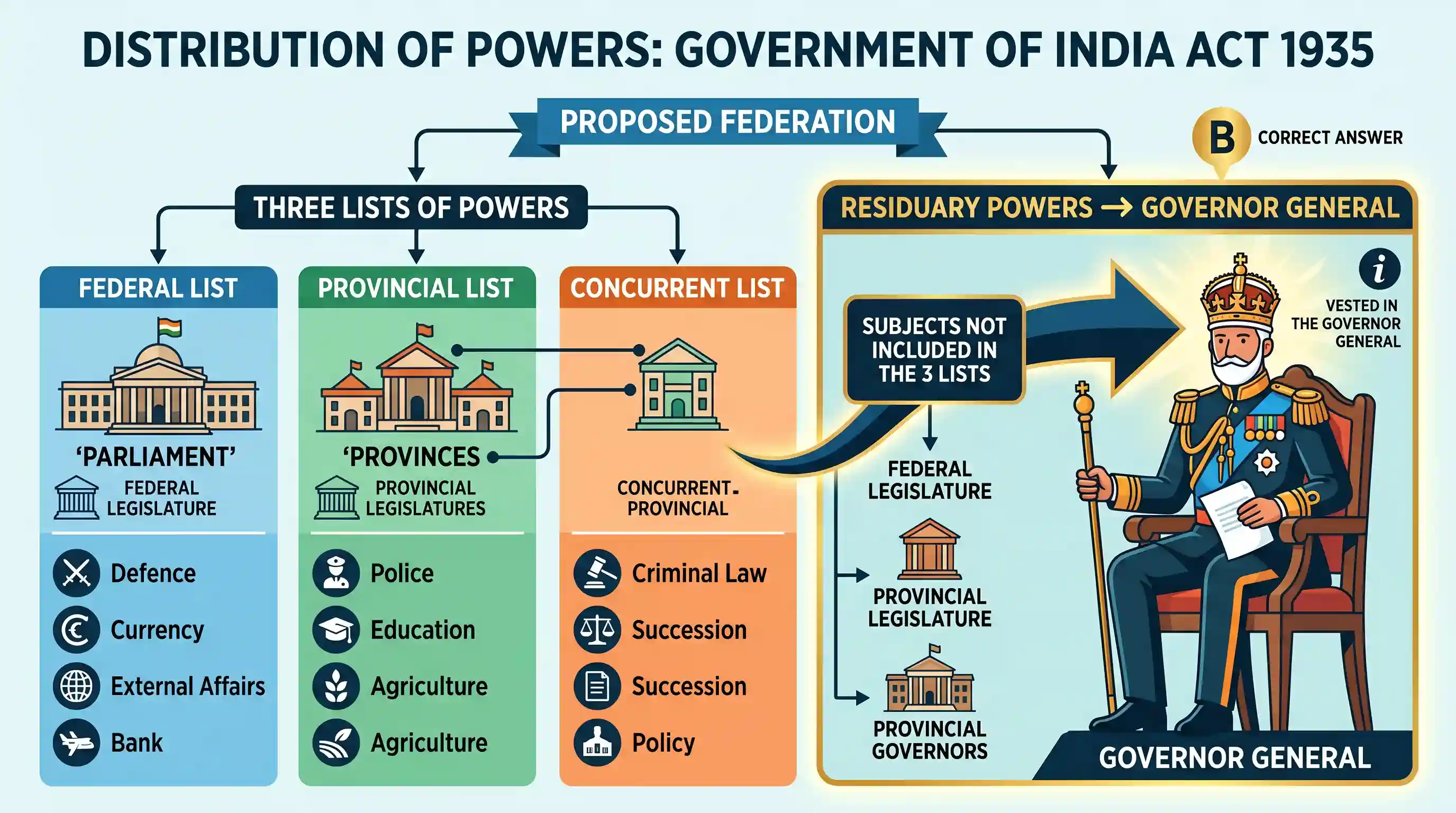
In the Federation established by The Government of India Act of 1935, residuary powers were given to the

- AFederal Legislature
- BGovernor GeneralCorrect
- CProvincial Legislature
- DProvincial Governors
Explanation
The Government of India Act of 1935 was a landmark piece of legislation that proposed a federation of India. It meticulously divided powers between the Centre (Federal Government) and the Provinces into three lists: Federal List, Provincial List, and Concurrent List. However, for any subjects not included in these lists, i.e., the residuary powers, the Act explicitly vested them with the Governor-General. This provision ensured that the British-appointed Governor-General retained significant authority within the proposed federal structure.
Related questions
More UPSC Prelims practice from the same subject and topic.
- Prelims 2018GS1polity-and-governance
If the President of India exercises his power as provided under Article 356 of the Constitution in respect of a particular State, then
- Prelims 2018GS1polity-and-governance
Consider the following statements: 1. In the first Lok Sabha, the single largest party in the opposition was the Swatantra Party. 2. In the Lok Sabha, a "Leader of the Opposition" was recognised for t…
- Prelims 2018GS1polity-and-governance
How is the National Green Tribunal (NGT) different from the Central Pollution Control Board (CPCB)? 1. The NGT has been established by an Act whereas the CPCB has been created by an executive order of…
- Prelims 2018GS1polity-and-governance
Consider the following statements: 1. The Parliament of India can place a particular law in the Ninth Schedule of the Constitution of India. 2. The validity of a law placed in the Ninth Schedule canno…
- Prelims 2018GS1polity-and-governance
Consider the following statements: 1. Aadhaar card can be used as a proof of citizenship or domicile. 2. Once issued, Aadhaar number cannot be deactivated or omitted by the Issuing Authority. Which of…
- Prelims 2018GS1polity-and-governance
"Rule of Law Index" is released by which of the following?