Which one of the following is a very significant aspect of the Champaran Satyagraha?

- AActive all-India participation of lawyers, students and women in the National Movement
- BActive involvement of Dalit and Tribal communities of India in the National Movement
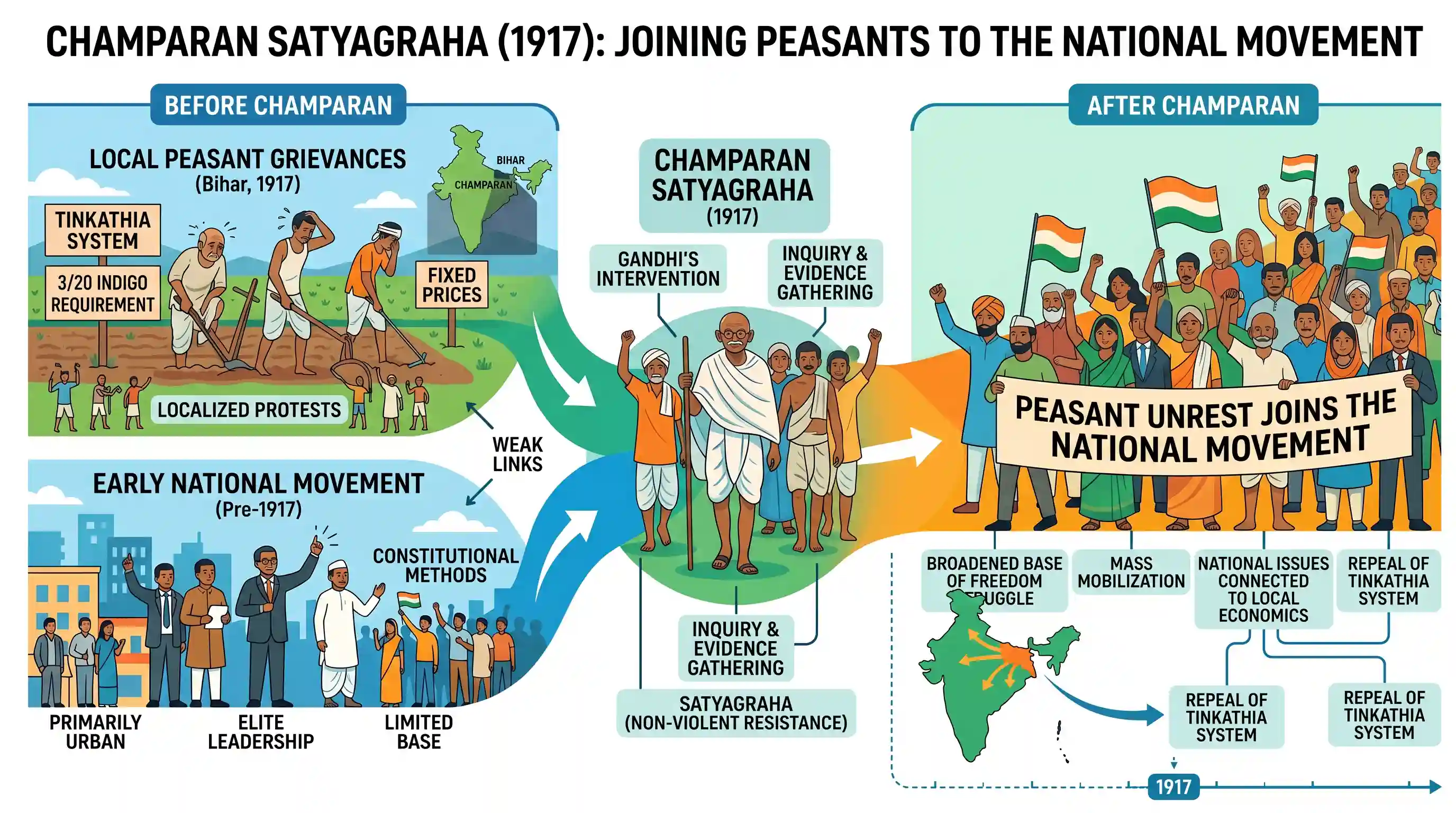
- CJoining of peasant unrest to India's National MovementCorrect
- DDrastic decrease in the cultivation of plantation crops and commercial crops
Explanation
The Champaran Satyagraha (1917) was Mahatma Gandhi's first major successful experiment with Satyagraha in India. Its most significant aspect was its role in integrating local peasant grievances with the broader Indian national movement.
Under the 'tinkathia' system in Champaran, peasants were forced to cultivate indigo on 3/20th of their land and sell it at fixed prices. Gandhi's intervention, investigation, and non-violent resistance gave voice to these exploited peasants, demonstrating the power of mass mobilization and connecting local economic distress to the larger struggle against colonial exploitation. This movement marked a crucial step in involving the rural masses, especially peasants, directly into the mainstream of the national freedom struggle, thereby broadening its base and making it a mass movement.
While the satyagraha involved lawyers and had national implications, its unique contribution was drawing the attention of the national leadership to the plight of peasants and initiating their participation in the anti-colonial movement, rather than general all-India participation of lawyers, students, and women or active involvement of Dalit and Tribal communities (which came later in different contexts).
Related questions
More UPSC Prelims practice from the same subject and topic.
- Prelims 2018GS1history
He wrote biographies of Mazzini, Garibaldi, Shivaji and Shrikrishna; stayed in America for some time; and was also elected to the Central Assembly. He was
- Prelims 2018GS1history
Regarding Wood's Dispatch, which of the following statements are true? 1. Grants-in-Aid system was introduced. 2. Establishment of universities was recommended. 3. English as a medium of instruction a…
- Prelims 2018GS1history
After the Santhal Uprising subsided, what was/were the measure/measures taken by the colonial government? 1. The territories called 'Santhal Paraganas' were created. 2. It became illegal for a Santhal…
- Prelims 2018GS1history
Economically, one of the results of the British rule in India in the 19th century was the
- Prelims 2018GS1history
The staple commodities of export by the English East India Company from Bengal in the middle of the 18th century were
- Prelims 2018GS1history
Who among the following were the founders of the "Hind Mazdoor Sabha" established in 1948?