"3D printing" has applications in which of the following? 1. Preparation of confectionery items 2. Manufacture of bionic ears 3. Automotive industry 4. Reconstructive surgeries 5. Data processing technologies Select the correct answer using the code given below:

- A1, 3 and 4 only
- B2, 3 and 5 only
- C1 and 4 only
- D1, 2, 3, 4 and 5Correct
Explanation
3D printing, also known as additive manufacturing, is a versatile technology with rapidly expanding applications across various sectors. Let's examine each listed application:
-
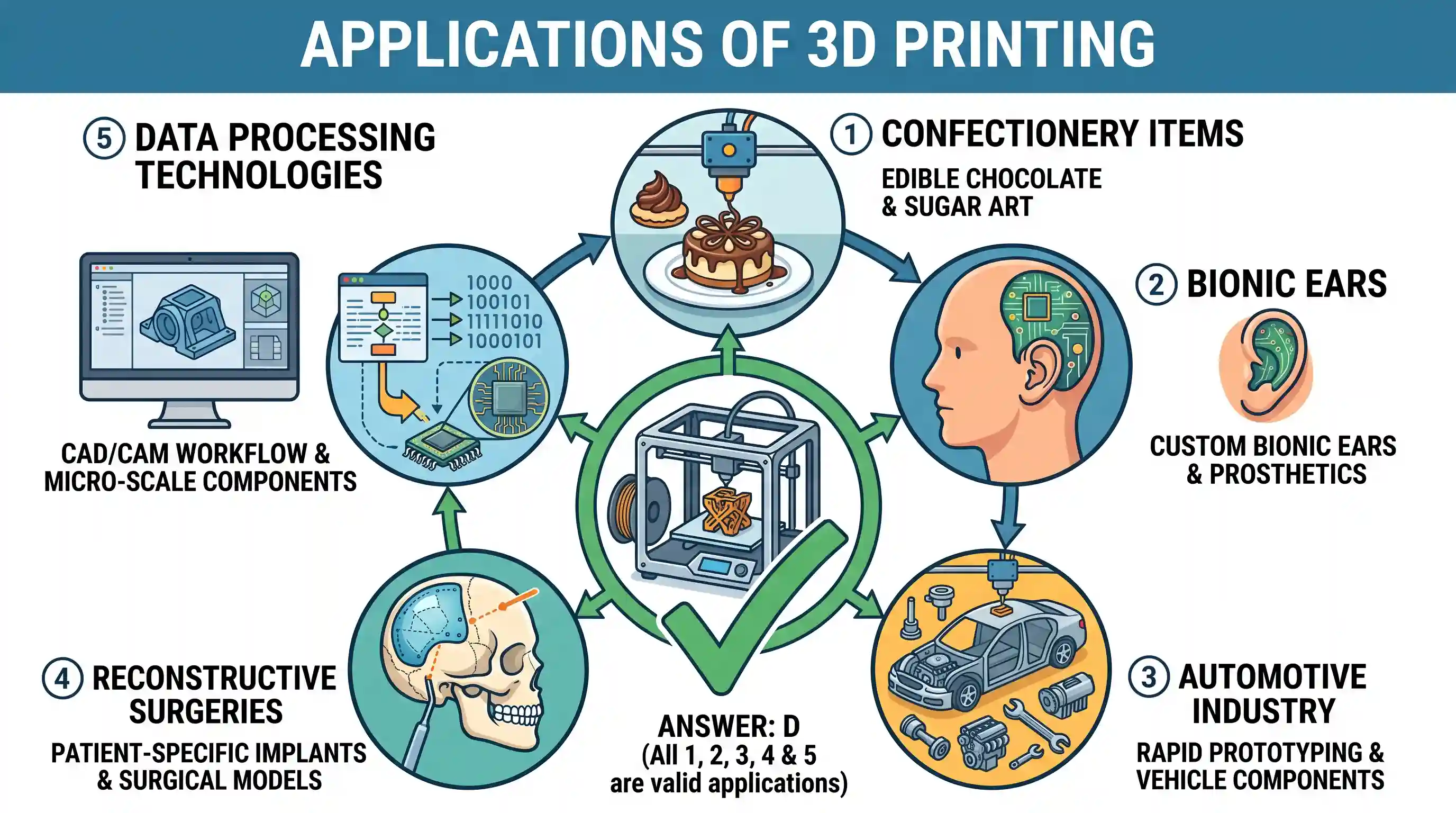
Preparation of confectionery items: Yes, 3D food printers are capable of creating intricate and customized designs using edible materials like chocolate, sugar, dough, and other food pastes. This is already in use in specialized culinary applications.
-
Manufacture of bionic ears: Yes, 3D printing is a revolutionary tool in biomedical engineering and prosthetics. It is used to create highly customized prosthetic devices, including bionic ears, by accurately replicating complex anatomical structures and integrating electronic components.
-
Automotive industry: Yes, the automotive industry extensively uses 3D printing for rapid prototyping of parts, creating complex tooling and jigs, and even for manufacturing lightweight and structurally optimized components for vehicles. It speeds up design iterations and reduces manufacturing costs.
-
Reconstructive surgeries: Yes, in reconstructive surgery, 3D printing is used to create patient-specific anatomical models for surgical planning, custom implants (e.g., for bone replacement or facial reconstruction), and surgical guides, greatly enhancing precision and patient outcomes.
-
Data processing technologies: While 3D printing is a manufacturing technology, its entire workflow relies heavily on data processing. This includes CAD (Computer-Aided Design) for creating 3D models, CAM (Computer-Aided Manufacturing) for preparing the print, and specialized software for slicing and optimizing print paths. Furthermore, there are emerging applications where 3D printing is used to create micro-scale components for computing, sensors, and even advanced data storage devices, making its connection to data processing technologies highly relevant. Therefore, in a broad sense, it has applications that interact with and leverage data processing technologies.
Given the widespread and rapidly evolving nature of 3D printing, it has applications in all the listed fields.
Related questions
More UPSC Prelims practice from the same subject and topic.
- Prelims 2018GS1science-and-technology
What is/are the consequence/consequences of a country becoming the member of the 'Nuclear Suppliers Group'? 1. It will have access to the latest and most efficient nuclear technologies. 2. It automati…
- Prelims 2018GS1science-and-technology
In the Indian context, what is the implication of ratifying the 'Additional Protocol' with the 'International Atomic Energy Agency (IAEA)'?
- Prelims 2018GS1science-and-technology
What is "Terminal High Altitude Area Defense (THAAD)", sometimes seen in the news?
- Prelims 2018GS1science-and-technology
In which of the following areas can GPS technology be used? 1. Mobile phone operations 2. Banking operations 3. Controlling the power grids Select the correct answer using the code given below:
- Prelims 2018GS1science-and-technology
The terms 'WannaCry, Petya and EternalBlue' sometimes mentioned in the news recently are related to
- Prelims 2018GS1science-and-technology
With reference to the Indian Regional Navigation Satellite System (IRNSS), consider the following statements: 1. IRNSS has three satellites in geostationary and four satellites in geosynchronous orbit…