Consider the following: 1. Carbon monoxide 2. Methane 3. Ozone 4. Sulphur dioxide Which of the above are released into atmosphere due to the burning of crop/biomass residue?

- A1 and 2 only
- B2, 3 and 4 only
- C1 and 4 only
- D1, 2, 3 and 4Correct
Explanation
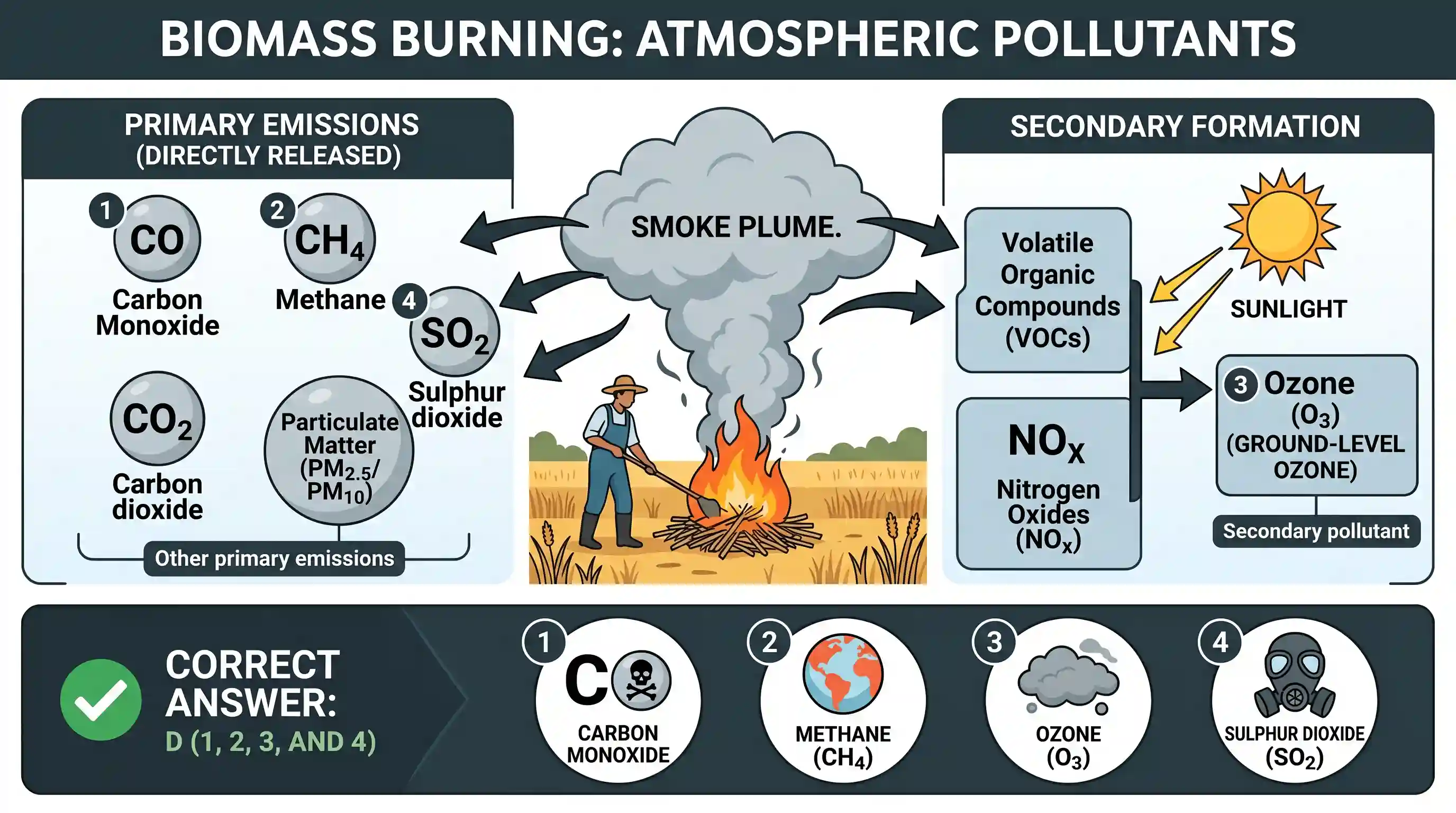
The burning of crop residue (stubble burning) and other forms of biomass is a major source of air pollution. Incomplete combustion of organic matter releases a complex mixture of gases and particulate matter into the atmosphere. All the listed substances are indeed released:
-
Carbon monoxide (CO): This is a product of incomplete combustion and is a highly toxic gas.
-
Methane (CH4): Another product of incomplete combustion and a potent greenhouse gas, released when biomass burns without sufficient oxygen.
-
Ozone (O3): While ozone itself is not directly emitted, its precursors, such as volatile organic compounds (VOCs) and nitrogen oxides (NOx), are released during biomass burning. These precursors then react in the presence of sunlight to form ground-level ozone, which is a harmful air pollutant.
-
Sulphur dioxide (SO2): Although biomass typically has lower sulfur content compared to fossil fuels, some amount of SO2 is still released during its combustion, depending on the specific composition of the biomass residue.
In addition to these, particulate matter (PM2.5, PM10), carbon dioxide (CO2), and other harmful compounds are also released during crop/biomass residue burning.
Related questions
More UPSC Prelims practice from the same subject and topic.
- Prelims 2019GS1geography
Which one of the following National Parks lies completely in the temperate alpine zone?
- Prelims 2019GS1geography
Consider the following statements: 1. Asiatic lion is naturally found in India only. 2. Double-humped camel is naturally found in India only. 3. One-horned rhinoceros is naturally found in India only.…
- Prelims 2019GS1geography
Which of the following are in Agasthyamala Biosphere Reserve?
- Prelims 2019GS1geography
Consider the following statements: 1. Some species of turtles are herbivores. 2. Some species of fish are herbivores. 3. Some species of marine mammals are herbivores. 4. Some species of snakes are vi…
- Prelims 2019GS1geography
Consider the following pairs: Wildlife Naturally found in 1. Blue-finned Mahseer : Cauvery River 2. Irrawaddy Dolphin : Chambal River 3. Rusty-spotted Cat : Eastern Ghats Which of the pairs given abov…
- Prelims 2019GS1geography
Why is there a great concern about the 'microbeads' that are released into environment?