Consider the following statements: 1. Under Ramsar Convention, it is mandatory on the part of the Government of India to protect and conserve all the wetlands in the territory of India. 2. The Wetlands (Conservation and Management) Rules, 2010 were framed by the Government of India based on the recommendations of Ramsar Convention. 3. The Wetlands (Conservation and Management) Rules, 2010 also encompass the drainage area or catchment regions of the wetlands as determined by the authority. Which of the statements given above is/are correct?

- A1 and 2 only
- B2 and 3 onlyCorrect
- C3 only
- D1, 2 and 3
Explanation
Let's analyze each statement regarding the Ramsar Convention and Wetlands Rules:
-
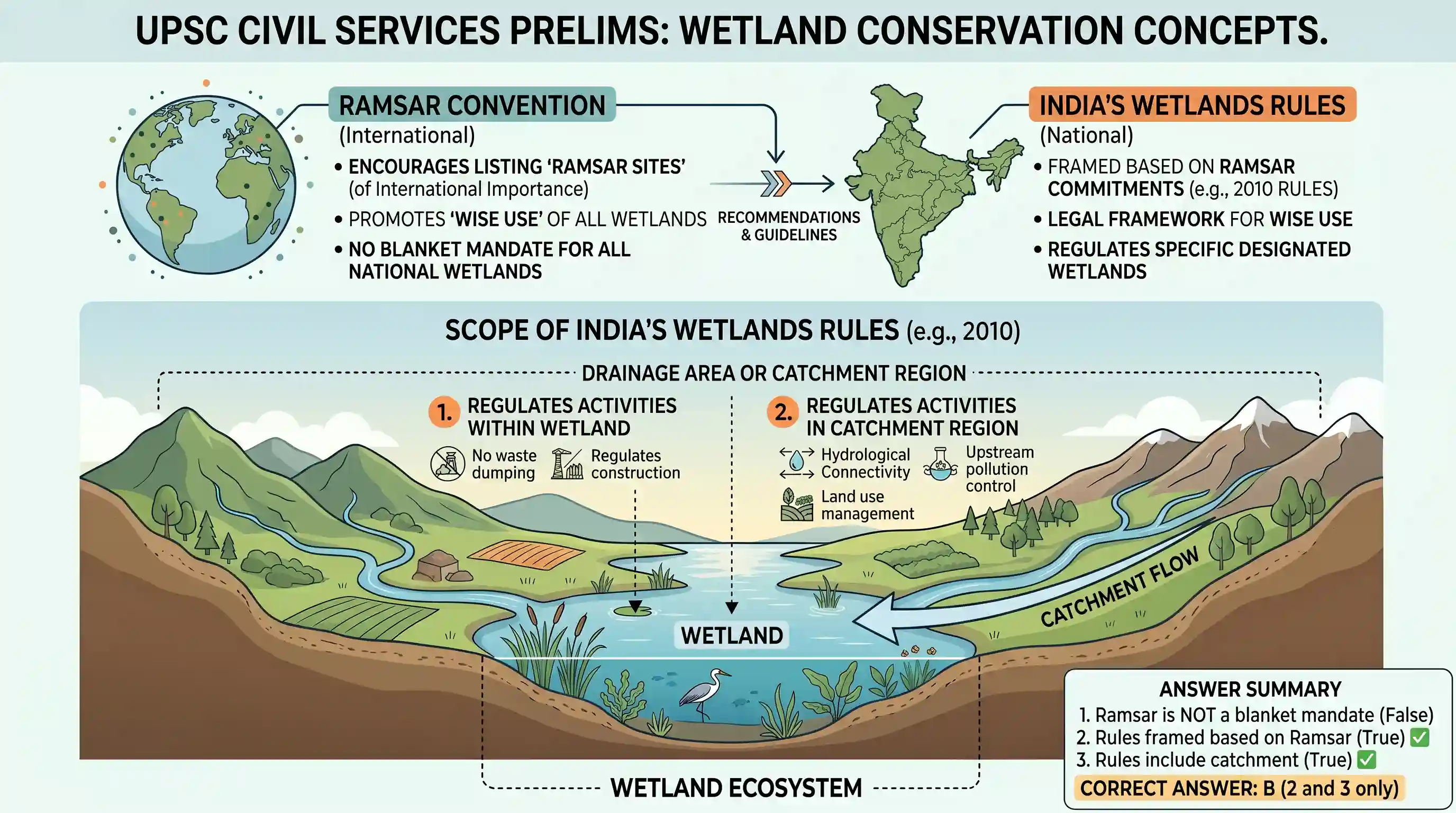
Under Ramsar Convention, it is mandatory on the part of the Government of India to protect and conserve all the wetlands in the territory of India. Incorrect. The Ramsar Convention (Convention on Wetlands of International Importance especially as Waterfowl Habitat) encourages contracting parties to designate suitable wetlands for the List of Wetlands of International Importance (Ramsar Sites) and to promote their wise use. It does not mandate the protection and conservation of all wetlands across the entire territory of a country, though it does promote the wise use concept for all wetlands within the territory.
-
The Wetlands (Conservation and Management) Rules, 2010 were framed by the Government of India based on the recommendations of Ramsar Convention. Correct. India, being a signatory to the Ramsar Convention, framed these rules to provide a legal framework for the conservation and wise use of wetlands in the country, aligning with the convention's principles and guidelines.
-
The Wetlands (Conservation and Management) Rules, 2010 also encompass the drainage area or catchment regions of the wetlands as determined by the authority. Correct. The 2010 Rules (and subsequent 2017 Rules) recognized that the ecological health of a wetland is intrinsically linked to its surrounding drainage or catchment area. Therefore, they sought to regulate activities not just within the wetland boundary but also in its catchment, acknowledging the hydrological connectivity and potential impacts from upstream/surrounding activities.
Thus, statements 2 and 3 are correct.
Related questions
More UPSC Prelims practice from the same subject and topic.
- Prelims 2019GS1geography
Which one of the following National Parks lies completely in the temperate alpine zone?
- Prelims 2019GS1geography
Consider the following statements: 1. Asiatic lion is naturally found in India only. 2. Double-humped camel is naturally found in India only. 3. One-horned rhinoceros is naturally found in India only.…
- Prelims 2019GS1geography
Which of the following are in Agasthyamala Biosphere Reserve?
- Prelims 2019GS1geography
Consider the following statements: 1. Some species of turtles are herbivores. 2. Some species of fish are herbivores. 3. Some species of marine mammals are herbivores. 4. Some species of snakes are vi…
- Prelims 2019GS1geography
Consider the following pairs: Wildlife Naturally found in 1. Blue-finned Mahseer : Cauvery River 2. Irrawaddy Dolphin : Chambal River 3. Rusty-spotted Cat : Eastern Ghats Which of the pairs given abov…
- Prelims 2019GS1geography
Why is there a great concern about the 'microbeads' that are released into environment?