Two Statements S1 and S2 are given below with regard to two numbers followed by a Question: S1: Their product is 21. S2: Their sum is 10. Question: What are the two numbers? Which one of the following is correct in respect of the above Statements and the Question?

- AS1 alone is sufficient to answer the Question
- BS2 alone is sufficient to answer the Question
- CS1 and S2 together are sufficient to answer the Question, but neither S1 alone nor S2 alone is sufficient to answer the QuestionCorrect
- DS1 and S2 together are not sufficient to answer the Question.
Explanation
To determine the two numbers, we need sufficient information to uniquely identify them.
-
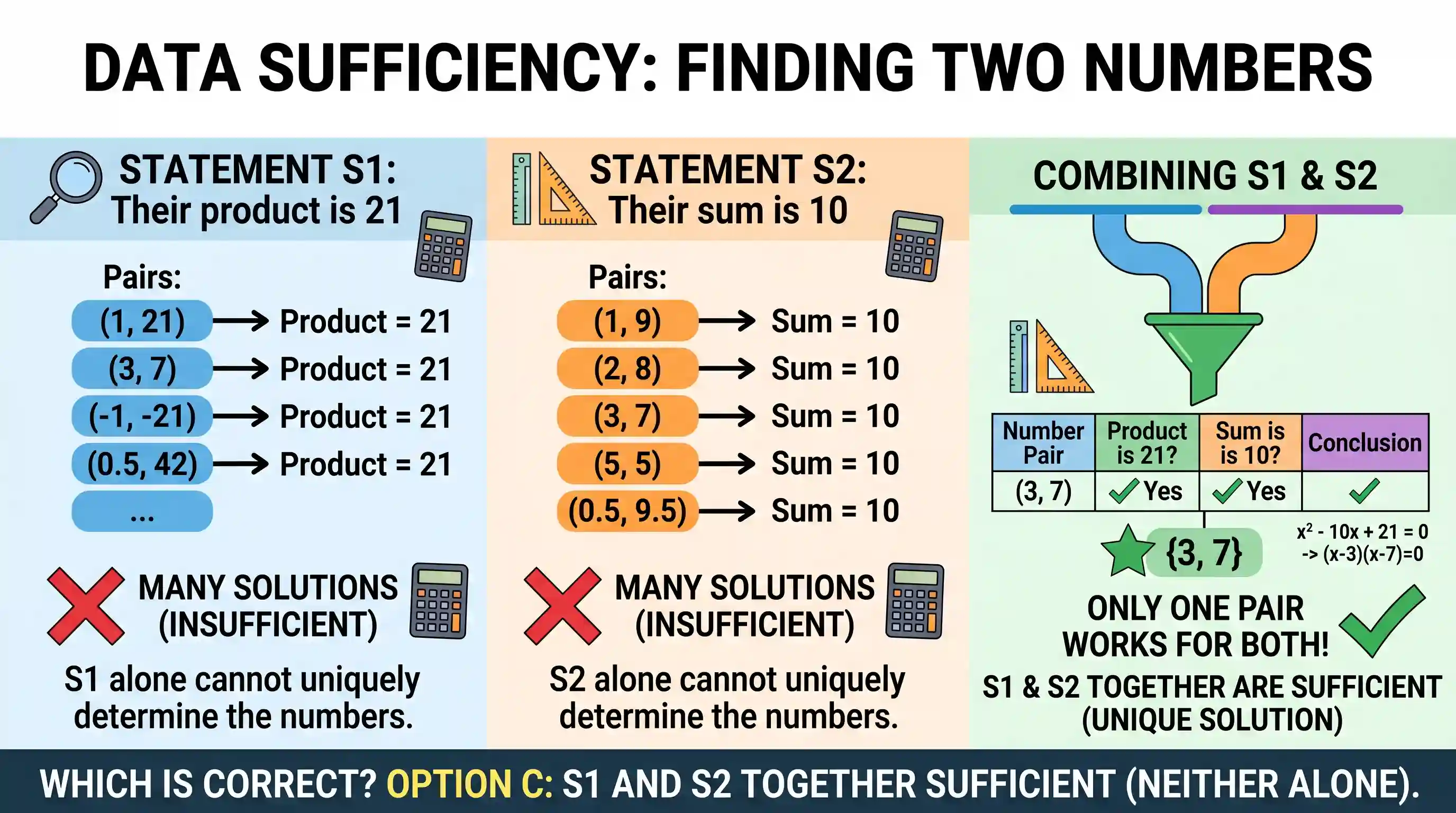
Analyze Statement S1 alone: "Their product is 21." If the product of two numbers is 21, the numbers could be (1, 21), (3, 7), (-1, -21), (-3, -7), or even non-integer pairs like (2, 10.5). S1 alone does not uniquely identify the two numbers. So, S1 alone is not sufficient.
-
Analyze Statement S2 alone: "Their sum is 10." If the sum of two numbers is 10, the numbers could be (1, 9), (2, 8), (3, 7), (4, 6), (5, 5), or non-integer pairs like (2.5, 7.5). S2 alone does not uniquely identify the two numbers. So, S2 alone is not sufficient.
-
Analyze Statements S1 and S2 together: Let the two numbers be x and y. From S1: x * y = 21 From S2: x + y = 10 We have a system of two equations. From the second equation, y = 10 - x. Substitute this into the first equation: x * (10 - x) = 21 10x - x^2 = 21 x^2 - 10x + 21 = 0 Factoring the quadratic equation: (x - 3)(x - 7) = 0 This gives two possible values for x: x = 3 or x = 7. If x = 3, then y = 10 - 3 = 7. The numbers are 3 and 7. If x = 7, then y = 10 - 7 = 3. The numbers are 7 and 3. In both cases, the unique pair of numbers is {3, 7}. Therefore, S1 and S2 together are sufficient to uniquely determine the two numbers.
Based on this analysis: Option A is incorrect because S1 alone is not sufficient. Option B is incorrect because S2 alone is not sufficient. Option D is incorrect because S1 and S2 together are sufficient. Option C correctly states that S1 and S2 together are sufficient, but neither S1 alone nor S2 alone is sufficient.
The final answer is C.
Related questions
More UPSC Prelims practice from the same subject and topic.
- Prelims 2020CSATQuantitative Aptitude
Let p, q, r and s be natural numbers such that p - 2016 = q + 2017 = r - 2018 = s + 2019 which one of the following is the largest natural number?
- Prelims 2020CSATQuantitative Aptitude
How many zeroes are there at the end of the following product? 1 × 5 × 10 × 15 × 20 × 25 × 30 × 35 × 40 × 45 × 50 × 55 × 60
- Prelims 2020CSATQuantitative Aptitude
Let XYZ be a three-digit number, where (x + y + z) is not a multiple of 3. Then (XYZ + YZX + ZXY) is not divisible by
- Prelims 2020CSATQuantitative Aptitude
How many five-digit prime numbers can be obtained by using all the digits 1, 2, 3, 4 and 5 without repetition of digits?
- Prelims 2020CSATQuantitative Aptitude
In the sum A + 1A + 5A + AA + A1 = 1AA for which digit does the symbol A stand?
- Prelims 2020CSATQuantitative Aptitude
If you have two straight sticks of length 7.5 feet and 3.25 feet, what is the minimum length can you measure?