Three Statements S1, S2 and S3 are given below followed by a Question: S1: C is younger than D, but older than A and B. S2: D is the oldest. S3: A is older than B. Question: Who among A, B, C and D is the youngest? Which one of the following is correct in respect of the above Statements and the Question?

- AS1 alone is sufficient to answer the Question
- BS1 and S2 together are sufficient to answer the Question
- CS2 and S3 together are sufficient to answer the Question
- DS1 and S3 together are sufficient to answer the Question.Correct
Explanation
Let's analyze the statements and the question:
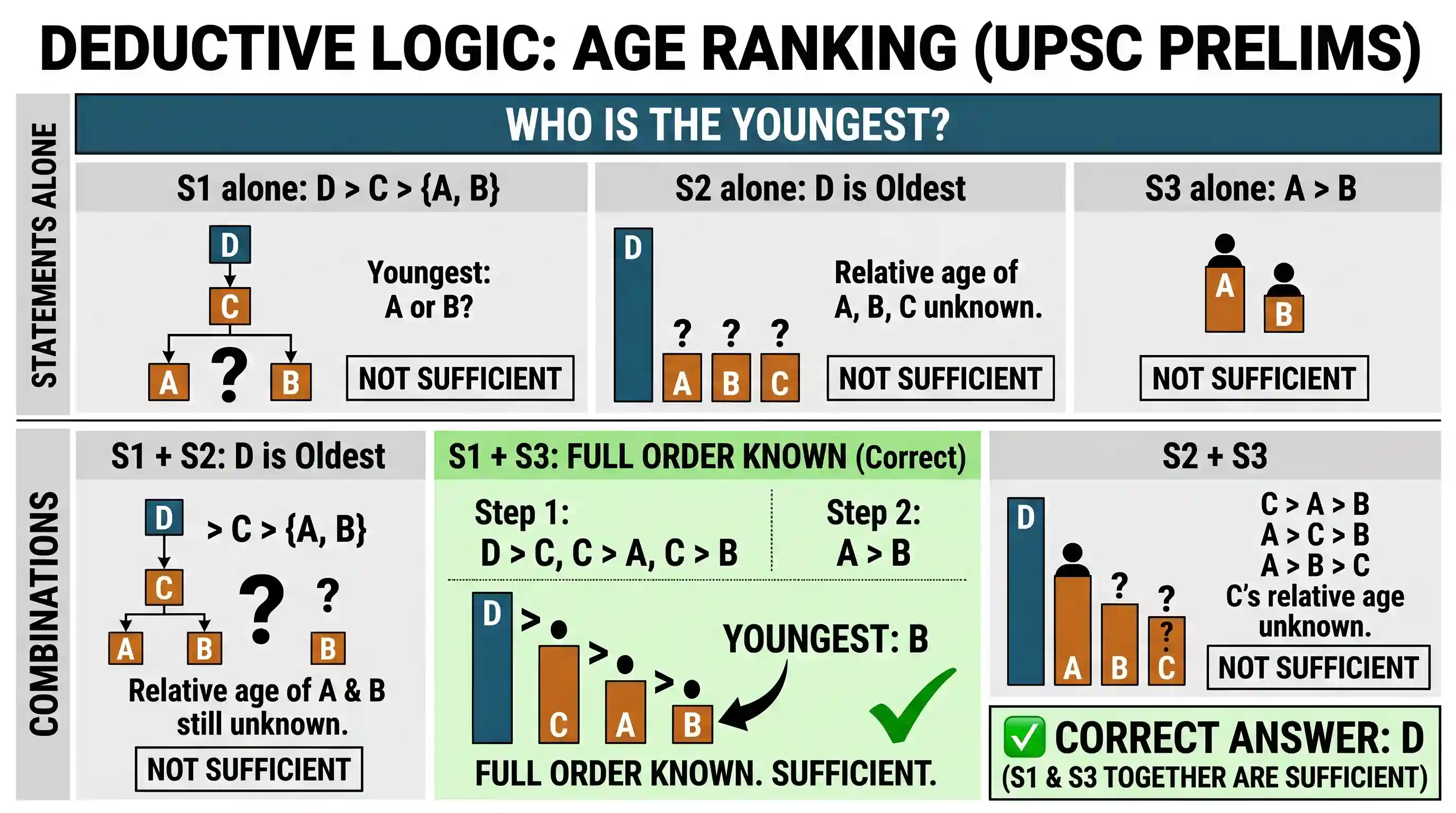
S1: C is younger than D, but older than A and B. This can be written as: D > C > A and D > C > B. From S1 alone, we know D is the oldest (or among the oldest) and C is older than A and B. However, we don't know the relative age of A and B. So, the youngest could be A or B. S1 alone is not sufficient.
S2: D is the oldest. This means D > A, D > B, D > C. S2 alone doesn't give us any information about the relative ages of A, B, and C. So, S2 alone is not sufficient.
S3: A is older than B. This means A > B. S3 alone only tells us about A and B, not C or D. So, S3 alone is not sufficient.
Now let's evaluate the options:
A) S1 alone is sufficient to answer the Question As explained above, S1 (D > C > A and D > C > B) doesn't tell us whether A or B is younger. So, A is incorrect.
B) S1 and S2 together are sufficient to answer the Question S1: D > C > A and D > C > B S2: D is the oldest (confirms D is the oldest, but doesn't resolve A vs B) Combining S1 and S2 still leaves the ambiguity between A and B as the youngest. So, B is incorrect.
C) S2 and S3 together are sufficient to answer the Question S2: D is the oldest. S3: A > B. These statements tell us D is the oldest and A is older than B, but they don't provide any information about C's age relative to A or B. C could be older than A, younger than B, or in between. So, C is incorrect.
D) S1 and S3 together are sufficient to answer the Question. S1: D > C > A and D > C > B S3: A > B
Let's combine these: From S1, we know C is older than A (C > A). From S1, we know C is older than B (C > B). From S3, we know A is older than B (A > B).
Putting these together in order from oldest to youngest: We have D > C (from S1). We have C > A (from S1). We have A > B (from S3).
Therefore, the complete order is D > C > A > B. From this combined order, B is clearly the youngest. Thus, S1 and S3 together are sufficient to answer the question.
The final answer is D
Related questions
More UPSC Prelims practice from the same subject and topic.
- Prelims 2020CSATLogical Reasoning
Two statements S1 and S2 are given below followed by a Question: S1: There are not more than two figures on any page of a 51-page book. S2: There is at least one figure on every page. Question: Are th…
- Prelims 2020CSATLogical Reasoning
Two Statements S1 and S2 are given below with regard to four numbers P, Q, R and S followed by a Question: S1: R is greater-than P as well as Q. S2: S is not the largest one. Among four numbers P, Q, …
- Prelims 2020CSATLogical Reasoning
Two Statements are given followed by two Conclusions: Statements: All numbers are divisible by 2. All numbers are divisible by 3. Conclusion- I All numbers are divisible by 6. Conclusion- II All numbe…
- Prelims 2020CSATLogical Reasoning
Two Statements are given followed by two Conclusions: Statements: All cats are dogs. All cats are black. Conclusion- I: All dogs are black. Conclusion- II: Some dogs are not black. Which of the above …
- Prelims 2020CSATLogical Reasoning
A simple mathematical operation in each number of the sequence 14, 18, 20, 24, 30, 32, .... results in a sequence with respect to prime numbers. Which one of the following is the next number in the se…
- Prelims 2020CSATLogical Reasoning
Consider the following arrangement that has some missing letters: abab_b_bcb_dcdcded_d The missing letters which complete the arrangement are